
Scitalis: The Scitalis is a mythological serpent from Medieval bestiaries known for its stunning, multicoloured markings.
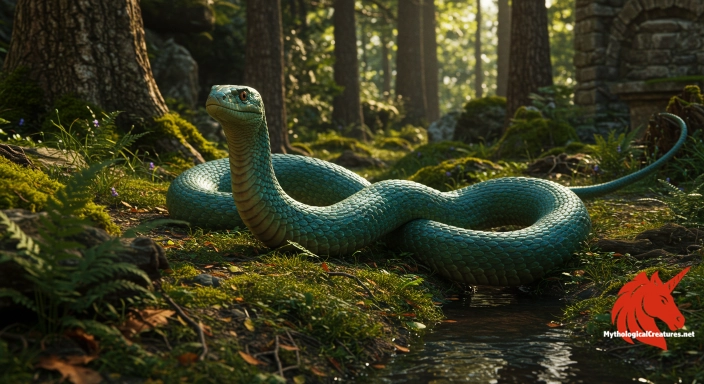
Scitalis
Scitalis - The Scitalis embodies the paradox of lethal beauty, illustrating how an enchanting appearance can serve as both a defensive mechanism and a cautionary symbol.
the legend in five swipes.
the legend in five swipes.
The Earliest Known Accounts of Scitalis
Scitalis stands as one of those enigmatic creatures whose legend has captivated readers from antiquity to medieval times. Born from early classical musings and later immortalised in medieval bestiaries, its origins are steeped in rich allegorical tradition. Emerging at a time when the boundaries between natural history and myth were fluid, this serpent's story was first crafted in poetic texts and later embellished by erudite scholars. In its earliest attestations, such as those by Roman poets, Scitalis was noted for its dazzling appearance that could slow a viewer’s movements through sheer admiration. It thrives as a symbol of beauty and peril intermingled, where the glow of its scales meant both wonder and the risk of enchantment. The creature’s uncanny ability to shed its skin even in winter due to its exceptional bodily heat contributed to its mysterious reputation. Its myth served as both a cautionary tale and a reflection of nature’s unpredictability during times laden with superstition. Over time, Scitalis evolved into a metaphor for the deceptive allure of nature, one that holds beauty at once dangerous and mesmerizing. The blend of natural oddity and symbolic narrative renders this serpent a timeless figure in the tapestry of mythical lore.
Scitalis in the Historical Record
The earliest literary nods to Scitalis emerge from texts such as Lucan’s poetic verses in the 1st century AD, where its unique habit of shedding its skin during the vernal frosts was succinctly recorded. Medieval bestiaries, notably the Aberdeen Bestiary, carried forward and enriched its legacy with vivid descriptions and elaborate illustrations. Later, Isidore of Seville’s encyclopaedic work in the 7th century further detailed Scitalis’s shimmering and immobile nature. These primary sources collectively provide a multifaceted portrait, blending observation with allegorical symbolism. Various manuscript traditions from the medieval period offer differing nuances to its story, some emphasising its hypnotic beauty and others underscoring its intrinsic heat. In several textual variants, the narrative adapts the creature’s features to reflect moral lessons or natural phenomena. Despite such variations, the central theme of the serpent’s radiant scales and the staggering effect they have on onlookers remains a common thread. Diverse accounts reveal the fluidity of its myth, showing an evolution from natural curiosity to symbolic representation. This amalgam of sources confirms that Scitalis has always been more than just a creature; it embodies the complex interaction between human perception and the mysteries of nature.
How powerful did people believe Scitalis to be?
The form of Scitalis is described with a precision that borders on the miraculous, its body cloaked in a mosaic of vibrant and shifting colours. The scales, arranged in intricate patterns, seem to capture light in an artful dance that bewilders the observer. Each segment of its elongated body is adorned with shimmering designs, as if painted by the hand of an unseen divine artiste. The creature’s skin exhibits an otherworldly fluorescence that is almost tactile in its intensity, a brilliance that causes those who gaze upon it to pause in awe. Its bodily structure, while serpentine, is marked by a refined elegance, with a smoothly tapering neck and a head that carries subtle hints of intelligence and enigma. There are accounts of slight variations in size, suggesting that while some specimens appeared modest and lithe, others could grow to impressive lengths, reinforcing its reputation as a creature of wonder. The perpetual heat that emanates from its form is not only physical but symbolic—a burning reminder of the vitality and danger inherent in its beauty. Observers noted that its slow, deliberate movements add to its hypnotic effect, inviting a closer, almost reverential observation. The physical allure of Scitalis thus remains a topic of fascination, where nature and myth coalesce in a being of radiant splendor.
Scitalis: Local Variations in the Story
While the core legend of Scitalis originated in classical sources and medieval bestiaries, its depiction has been subtly reworked in different regions over time. In several European traditions, particularly within the Iberian and Italian regions, local storytellers imbued the serpent with additional mystical qualities, aligning its heat with the passion of the Mediterranean sun. In some northern traditions, the creature has been recast as an omen of both misfortune and providence, blending its hypnotic beauty with an air of mystery. There are also variants in Eastern Europe where the serpent is presented not solely as a passive mesmeriser but as a guardian of hidden treasures or arcane knowledge. Certain regional narratives accentuate its slow and deliberate movements, transforming these into metaphors for caution and reflection. In contrast, the Mediterranean accounts occasionally link its radiant scales to lunar and solar cycles, thereby embedding it within a broader cosmological framework. Despite these regional differences, the unifying element remains its signature dazzling appearance that captivates and entraps. The adaptability of Scitalis’s myth to different cultural contexts demonstrates its resonance with diverse audiences. These regional adaptations underscore that, while the creature remains fundamentally the same, the local ethos continuously reinterprets it to reflect communal values and environmental realities.
The Global Cousins of Scitalis
The vivid image of Scitalis draws natural comparisons with myriad serpentine characters woven into the fabric of myth worldwide. Similar to the beguiling motifs of the Garden of Eden serpent, Scitalis is endowed with an allure that ambiguously hints at both danger and wisdom. Its hypnotic beauty finds echoes in the Nāgas of Indian lore, where the serpents are not only revered for their physical splendour but also for their spiritual connotations. In some East Asian traditions, mythical dragons display intriguing similarities, particularly in their resplendent, shifting colours and symbolic ties to both fire and transformation. A parallel may also be drawn with the gorgonic figures of ancient Greek myth, whose features could simultaneously enchant and paralyse the observer. This interplay of beauty and treachery is a recurring theme in many cultural depictions, suggesting that Scitalis occupies a space in myth that transcends regional boundaries. The creature acts as a mirror to the human fascination with the transformative power of nature, where aesthetic allure often conceals latent hazards. In comparing these various mythological entities, one sees that Scitalis is part of a broader narrative tradition that uses striking animal imagery to convey complex moral and existential lessons. Such cross-cultural connections reaffirm the universality of the serpent as a potent symbol in myth, capable of inspiring both reverence and caution.
Scitalis: Modern Retellings and Reinventions
The legacy of Scitalis has evolved substantially from its early mentions in classical texts to its enduring presence in modern mythological consciousness. Initially recorded by ancient poets and later by medieval scholars, the creature has continuously been reinterpreted to suit the intellectual and cultural climates of successive eras. As the medieval bestiaries flourished, Scitalis came to symbolize the intricate relationship between natural phenomena and moral allegory, a theme that resonated deeply with contemporaries. By the Renaissance, its depiction grew more ornate, and artists began to reimagine its radiant form in a variety of creative media, blending scientific curiosity with fantastical embellishment. In modern times, renewed interest in myth and symbolism, buoyed by the rise of fantasy literature and visual arts, has revived the lore of Scitalis. Contemporary illustrations often highlight its hypnotic scales and fiery nature, rendering it a popular motif in both digital art and literary fantasy. The creature is now seen not only as a relic of ancient myth but also as a symbol of the ever-changing perception of beauty and danger. As scholars continue to explore the intersections of myth, metaphor, and natural history, Scitalis remains a compelling study in how age-old legends adapt to new cultural contexts. Its narrative continues to serve as a reminder of the timeless dialogue between human curiosity and the mysteries of the natural world.
Interesting Fact
An intriguing observation about the Scitalis is that its lethal beauty, rather than being an offensive trait, functions defensively by causing onlookers to slow down, thereby facilitating ambush.
Mythological Treasures
Norse Sagas: A field guide to the beasts of the Viking world
Drawn from the saga accounts themselves, with the powers, weaknesses and doom of each being set out.
Egyptian Legends: A field guide to the gods and monsters of ancient Egypt
Guardians of the living and devourers of the dead, with the role each played in judgement.
Chinese Beasts: A field guide to the dragons and demon kings of Chinese myth
From river dragons to demon kings, with the legends that shaped five thousand years of storytelling.
the legend in five swipes.
Partner with us
Sponsor this space
Reach thousands of mythology enthusiasts with a curated placement on our creature pages.
Learn about sponsorshipQuick Creature Info
Origin:
Features:
Our Mythic Legendary Rating:

Also Sometimes Known As:
Habitat:
Supernatural Powers:
Physical Attributes:
Abilities:
Behavior:
Weaknesses:
Lore:
Related Creatures, Tales or Lore
References
Discover Another Mythical Legend You May Not Have Heard Of?
Uncover the mysteries of ancient folklore and expand your knowledge of legendary beings from cultures around the world.
Dare to Meet the Hephaestus....

The Mythological Creatures Book Series
Yokai, Greek, Norse, Egyptian & Chinese. Five illustrated field guides to the creatures the old stories either warned or told you about.




Curated by the Mythological Creatures Team
Series editor: Mythological Creatures Directory
Primary desk: Hellenic & Ancient Mediterranean Desk
(rev. November 2025)