
Shabrang: Shabrang is the legendary, night‑coloured stallion of Persian hero Siyâvash from the Shahnameh, renowned for his fire resistance and symbolic presence in mythology.
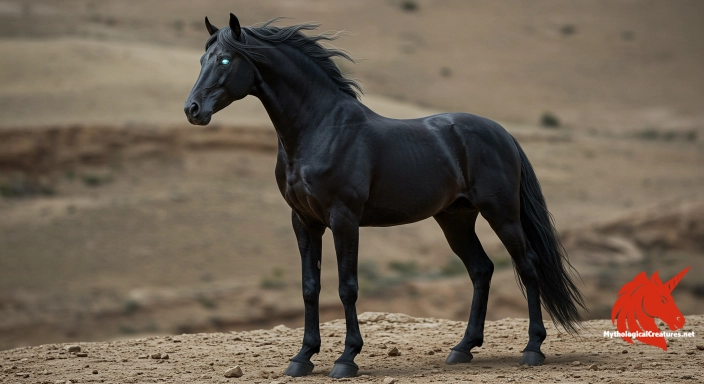
Shabrang
Shabrang - Represents the enduring spirit of justice and the rightful return of a benevolent ruler
the legend in five swipes.
the legend in five swipes.
Where does Shabrang come from?
Shabrang is celebrated as the legendary steed from the rich tapestry of Persian myth, forever entwined with the heroic legacy of Siyāvash as depicted in the Shahnameh. Its name, meaning 'having the colour of night,' hints at the mysterious and powerful aura that surrounds this mythical creature. The steed is integral to the narrative of a fateful trial, where Siyāvash rides it through a vast, blazing fire to prove his righteousness. This dramatic act not only underscores the purity and nobility of the hero but also elevates Shabrang as a symbol of divine favour. The narrative weaves together themes of justice, sacrifice, and resurrection, resonating deeply with the values of ancient Persian society. In the cultural context of the Shahnameh, Shabrang embodies a fusion of martial prowess and spiritual significance. The horse’s association with the subsequent reign of Kai Khosrow further cements its role as an emblem of the rightful and benevolent rule. Its enduring legacy in Persian literature continues to inspire awe and respect for both the hero and his extraordinary mount. Timeless in its appeal, Shabrang bridges the human and the divine, reminding us of the eternal interplay between destiny and virtue. Its mystique and strength continue to be revered as cornerstones of Persian myth and cultural identity.
Shabrang in the Historical Record
The primary source chronicling the tale of Shabrang is the Shahnameh, the epic masterpiece that has immortalised countless legendary figures of Persian lore. This text recounts the extraordinary episode in which Siyāvash, riding Shabrang, passes through a formidable fire as a testament to his purity and righteousness. Ancient manuscripts of the Shahnameh offer a detailed poetic narrative that blends heroic exploits with spiritual symbolism. Alongside the epic, traditional Zoroastrian texts also allude to Shabrang, linking the creature with themes of resurrection and eternal justice. Oral traditions preserved over generations in the Persian cultural milieu have further enriched the narrative with regional flourishes and interpretative nuances. Later commentaries and adaptations in medieval literature have reinforced the horse’s dual role as both a literal and metaphorical vehicle of divine intervention. Variants of the story sometimes emphasize the miraculous aspects of the trial by fire and the steed’s otherworldly nature. These narrative embellishments have contributed to a multifaceted portrayal of Shabrang in the literary canon. The interplay between epic poetry and religious tradition ensures that Shabrang remains a subject of vibrant discussion among historians and enthusiasts alike. Through these diverse sources, the myth of Shabrang has transcended its original context to become a symbol of hope and justice.
Shabrang: Powers, Strengths and Vulnerabilities
Shabrang is depicted as an extraordinary stallion with a coat as deep and dark as the night, exuding an almost supernatural brilliance. Its physical form is often described in poetic terms, showcasing a sleek and powerful build that hints at both grace and immense strength. The creature’s muscular limbs and lithe frame speak of a speed and agility that border on the mythic. Illustrations from ancient texts suggest that its eyes glow with an intense, enigmatic light, reflecting a soul that is part mortal, part divine. The mane and tail flow with an inky, exquisite texture, sometimes catching glints of silvery luminescence under the moonlit sky. Shabrang is often portrayed as larger than life, a common trait in mythological depictions that accentuates its heroic aura. Some accounts hint at unique markings that evoke celestial designs, further linking the creature to cosmic forces. The overall depiction balances natural beauty with an element of the supernatural, creating a striking image intended to inspire both admiration and awe. This synthesis of robust physicality and ethereal charm makes Shabrang not merely an animal but a symbol of enduring mysticism. Every detail of its anatomy has been magnified in art and literature to reflect the profound qualities of courage and sanctity it embodies.
Shabrang: Local Variations in the Story
The legend of Shabrang has evolved distinct regional flavours throughout the storied landscapes of Persia and its neighbouring realms. Within traditional Persian narratives, there remains a strong emphasis on the horse’s role as the harbinger of justice and the eternal bond between heroism and the divine. In various regions of Iran, local storytellers have infused the tale with elements that celebrate the nocturnal imagery of the horse, aligning it with culturally significant symbols of mystery and night. Central Asian adaptations, influenced heavily by Persian literary traditions, sometimes merge the image of Shabrang with indigenous legendary steeds, creating a unique hybrid of mythic symbolism. Some local versions accentuate its function as an omen of righteous rule, interweaving the narrative with tales of prophetic return and cosmic balance. Rural folklore frequently highlights the miraculous fire-trial, framing it as a transformative rite that imbues Shabrang with sanctified powers. Urban artistic interpretations have further modernised these regional traits, blending traditional iconography with contemporary themes. This geographical diversity in the narrative reflects a broader cultural canvas, allowing Shabrang to be embraced as both a national symbol and a universally recognised icon. The regional retellings ensure that while the core myth remains intact, its expression is as varied as the communities that revere it. Over time, this adaptation across different cultures has enriched the horse’s character, making it a canvas for assorted symbolic interpretations.
Shabrang: Counterparts Around the World
Mythology across the world has long celebrated the motif of the divine steed, placing Shabrang in esteemed company with legendary horses such as Bucephalus and Pegasus. Each of these creatures embodies a blend of earthly strength and supernatural grace, serving as noble companions to heroic figures. Bucephalus, famed for his loyalty and inspiring presence alongside Alexander the Great, shares with Shabrang the role of a symbol of formidable power and virtuous leadership. Pegasus, with his ability to traverse the skies, parallels Shabrang’s representation as a link between the mortal realm and the divine. These comparisons highlight universal themes where mythical horses are not mere beasts, but integral elements in the narrative of destiny and transcendence. The distinct cultural contexts—Greek for Pegasus, Macedonian for Bucephalus, and Persian for Shabrang—offer rich insights into how similar symbols can reflect unique societal values. Comparative analysis brings to light the central function of such horses in myth: to epitomise ideals of bravery, loyalty, and the bridging of human endeavour with the divine. While their narratives vary in setting and style, the core attributes of these steeds consistently echo the virtues of their human counterparts. This cross-cultural dialogue not only enriches our understanding of Shabrang but also underscores the global fascination with heroic equine figures. Thus, Shabrang stands as a vivid example of how legendary steeds in diverse mythologies continue to inspire and resonate with the human spirit.
Why is Shabrang still popular?
Over the centuries, Shabrang has evolved from a compelling character in epic poetry to a timeless symbol of justice, nobility, and the eternal struggle for righteousness. In early Persian texts, the horse was portrayed as an indispensable companion to heroes, embodying values that were central to the societal ideals of the time. The vivid depictions found in manuscript illuminations and traditional calligraphy have contributed to a storied visual legacy that still captivates audiences today. In later periods, the myth underwent reinterpretation as it was absorbed into broader cultural and artistic movements, consistently representing the virtues of courage and divine favour. Contemporary interpretations in literature, cinema, and visual arts have reimagined Shabrang as a beacon of resilience and hope in the face of moral adversity. Modern storytellers and artists draw upon the intrinsic symbolism of Shabrang to comment on themes of restoration and the cyclical nature of justice. The horse’s image has also permeated ceremonial and cultural festivals, where it often serves as an emblem of national pride and the timeless fight against tyranny. As academic debates continue to explore the layers of its symbolism, Shabrang’s legacy remains a vibrant topic in discussions of myth and cultural memory. The evolution of its portrayal reflects an enduring relevance that bridges the ancient and the modern. Ultimately, Shabrang is more than a mythical steed—it is an enduring testament to the power of myth in shaping collective identity and inspiring generations.
Interesting Fact
Shabrang's ability to withstand extreme heat and emerge unscathed from a trial by fire remains one of the most celebrated miracles in Persian epic literature, symbolising his supernatural endurance and the divine favour bestowed upon him.
Mythological Treasures
Egyptian Legends: A field guide to the gods and monsters of ancient Egypt
Guardians of the living and devourers of the dead, with the role each played in judgement.
Chinese Beasts: A field guide to the dragons and demon kings of Chinese myth
From river dragons to demon kings, with the legends that shaped five thousand years of storytelling.
Japanese Yokai: A field guide to the spirits and demons of Japanese folklore
Fifteen spirits, with the signs to watch for and what the old tales say to do if you meet one.
the legend in five swipes.
For authors, artists, and makers
Created something from the realm of myth?
If your book, deck, game, or artwork draws from legendary creatures and lore, you can showcase it here in a tasteful, year-round placement.
Share your projectQuick Creature Info
Origin:
Associations:
Our Mythic Legendary Rating:

Also Sometimes Known As:
Habitat:
Supernatural Powers:
Physical Attributes:
Abilities:
Behavior:
Lore:
Related Creatures, Tales or Lore
- RRakhsh
- SSleipnir
- BBucephalus
References
Discover Another Mythical Legend You May Not Have Heard Of?
Uncover the mysteries of ancient folklore and expand your knowledge of legendary beings from cultures around the world.
Dare to Meet the Egg ghost....
The Mythological Creatures Book Series
Yokai, Greek, Norse, Egyptian & Chinese. Five illustrated field guides to the creatures the old stories either warned or told you about.
Curated by the Mythological Creatures Team
Series editor: Mythological Creatures Directory
Primary desk: Asian & Pacific Myth Cycles Desk
(rev. November 2025)