
Shadhavar: The Shadhavar is a legendary creature from medieval Muslim bestiaries, resembling a unicorn with a single horn that splits into multiple hollow branches.
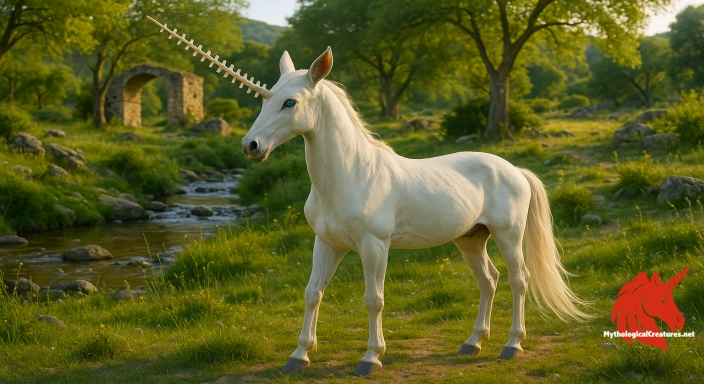
Shadhavar
Shadhavar - Symbolises the interplay between nature and music, with its horn evoking both joy and sorrow, and reflects the complex layering of myth in medieval Islamic culture
Origins & First Encounters
The Shadhavar is a captivating figure that has mesmerised medieval Muslim imaginations with its singular blend of beauty and enigma. It emerged within a rich tapestry of myth and legend, rooted in the cultural textures of the Islamic world and its interactions with Byzantine influences. Its first recorded mentions appear in medieval bestiaries, where it was described in vivid and unusual detail. The creature, also known as Âras, is celebrated for its unique horn that doubles as a musical instrument, captivating both beasts and men alike. It is portrayed as a symbol of both wonder and contradiction, embodying gentle harmonies on one side and profound melancholy on the other. The fascination with the Shadhavar lies not only in its physical attributes but also in the layered symbolism it inspired among courtly elites and storytellers. Over time, it has attracted scholarly attention, with various chroniclers offering differing accounts that add to its mystique. Its presence hints at a cultural dialogue between nature and art, where the boundaries between the real and the mythical blur. The legacy of the Shadhavar continues to intrigue modern enthusiasts of myth and folklore, standing as a testament to the enduring power of medieval imagination.
Source Texts & Tale Variants
Medieval bestiaries serve as the primary archive for the many incarnations of the Shadhavar, with early texts providing tantalising glimpses into its legendary presence. Notable early chroniclers such as al-Qazwini recounted its home in the lands of Rûm, emphasising its musical horn with branching cavities. Later narrators, including al-Damiri and al-Mustawfi, introduced variations that enriched its mythos while at times shifting its character from benign to more fearsome traits. A curious melding of characteristics appears in some texts, where details of the Shadhavar were interwoven with those of the Sirânis, a similarly enigmatic predator. These literary sources offer a spectrum of interpretations, from a creature that delights with its dulcet tones to one that employs its music as a lure for unwary prey. Such narrative discrepancies have spurred much discussion among later scholars and folklorists, who see in these layers a deliberate play of opposites. Diverse manuscript traditions across regions have also preserved unique nuances that reveal regional tastes and cultural influences. The evolution of its depiction in these sources underscores an intricate process of myth-making that defies simple categorisation. In sum, the story of the Shadhavar is as multifaceted as the manuscripts that carry its name, with each version offering new insights into the medieval mind.
Form & Powers
The physical portrayal of the Shadhavar is as striking as it is multifarious, centred on its most distinctive feature—a single, spiralled horn. This horn is not uniform in form; it is celebrated for having multiple hollow branches, with traditional accounts citing numbers as varied as 42 or even 72. As winds caress these hollow projections, they produce melodious sounds capable of enchanting animals and stirring human emotions alike. The creature’s body is often imagined as lithe and graceful, reminiscent of the elegant contours of a unicorn or a noble steed. Its form is imbued with an almost otherworldly luminescence, suggested by subtle hints of moonlit silver and the soft glow of twilight. Some portrayals even hint at a gentle musculature and a regal bearing, underscoring both its ethereal beauty and latent power. Shadows and light seem intricately woven into its appearance, where each anatomical detail contributes to its dual nature of being both alluring and ominous. This detailed anatomy has invited both admiration and caution from those who study its imagery, as every element ties back to its role in capturing hearts or instilling dread. The Shadhavar remains a vivid exemplar of how physical form and symbolic function can converge in mythological representations.
Regional Faces
The depiction of the Shadhavar exhibits a fascinating range of regional variations, reflecting the diverse cultural landscapes in which it was embraced. In Byzantine-influenced realms, the creature is frequently associated with pastoral landscapes and courtly elegance, its musical horn seen as a charm of both beauty and subtle persuasion. In contrast, interpretations within Persian territories often juxtapose its enchanting qualities with an element of predatory ferocity, hinting at a more ambivalent nature. Local adaptations sometimes modify the number of horn branches or accentuate its role as either a benign muse or a dangerous siren-like figure. Artistic depictions in different regions reveal variations in colour, form, and symbolism, with some communities stressing its mystical healing properties and others its role as an omen. Such regional reimaginings illustrate how folklore can transform its subjects to mirror local values and aesthetics. In some narratives, the Shadhavar becomes a metaphor for the fleeting nature of beauty and melody, resonating with the particular cultural memory of loss and longing. The regional stories ensure that the myth remains a living tradition, continuously morphing to accommodate local mythopoetic impulses. This geographical diversity enriches the overall mythos, inviting a deeper exploration of how symbols traverse cultural boundaries.
Cultural Parallels
The Shadhavar occupies a unique niche in the broader tapestry of world mythology through its striking parallels with other legendary creatures. Its single horn, reminiscent of the European unicorn, invites comparisons that merge the realms of mythic purity with a touch of the supernatural. At the same time, its capacity to produce both joyful and sorrowful music draws a compelling link to the sirens of Greek mythology, whose alluring tunes once lured sailors to perilous waters. The nuanced duality found in its musical aspects is echoed in many cultural myths where sound embodies both healing and harm. In some narratives, its charming melody is as potent as the spellbinding allure of fairy music or the mournful call of a banshee. Such cross-cultural connections emphasise an enduring human fascination with creatures that blur the boundary between beauty and danger. The intermingling of these mythic features has encouraged a comparative analysis among scholars who view the Shadhavar as a synthesis of various symbolic archetypes. Its portrayal thus becomes a mirror reflecting the multifaceted nature of myth, where common themes recur in diverse cultural guises. This overlap in imagery not only cements its place in the canon of legendary creatures but also highlights the universality of myth-making traditions.
Legacy & Modern Evolution
Over the centuries, the Shadhavar’s image has evolved dramatically, cloaked in layers of reinterpretation and modern myth-making. Early medieval accounts treasured its musical horn as a rare emblem of wonder, a dynamic interplay between nature and the supernatural. With the passage of time, its portrayal broadened to incorporate more ambiguous traits, merging gentle beauty with a fierce, sometimes dangerous, persona. In contemporary culture, the creature is often revived in fantasy literature and art, where its melodious horn and mysterious aura fascinate a new generation of enthusiasts. Modern reinterpretations have further cemented its status as a symbol of the delicate balance between joy and sorrow, a motif that resonates in today’s artistic and literary imaginations. Its iconography is regularly adapted in visual media, where designers draw on the dualistic nature of its sound to evoke moods ranging from serene elation to poignant melancholy. This evolution speaks to a broader trend in which ancient symbols are recontextualised to reflect current sensibilities without losing their mythic roots. As a cultural touchstone, the Shadhavar continues to inspire creative expressions that preserve the wonder of medieval mysticism while embracing the complexities of the modern world.
Interesting Fact
The Shadhavar’s horn, with its numerous hollow branches, transforms the simplest natural phenomenon—the wind—into an instrument capable of evoking both intense joy and profound sorrow, blurring the boundaries between art and nature in myth.
Limited sponsor opportunity
One slot, carefully chosen partners
We only feature a small number of relevant sponsors at any time. If you create serious myth content, we would like to hear from you.
Partner with usQuick Creature Info
Features:
Associations:
Our Mythic Legendary Rating:

Also Sometimes Known As:
Habitat:
Supernatural Powers:
Physical Attributes:
Abilities:
Behavior:
Lore:
Related Creatures, Tales or Lore
- UUnicorn
- SSirânis
- GGreek Sirens
References
Discover Another Mythical Legend You May Not Have Heard Of?
Uncover the mysteries of ancient folklore and expand your knowledge of legendary beings from cultures around the world.
Dare to Meet the Enmesharra....
Curated by the Mythological Creatures Team
Series editor: Mythological Creatures Directory
Primary desk: Hellenic & Ancient Mediterranean Desk
(rev. November 2025)