
Sunekosuri: The Sunekosuri is a traditional Japanese yōkai known for its mysterious habit of rubbing against the lower legs of passersby in Okayama Prefecture.
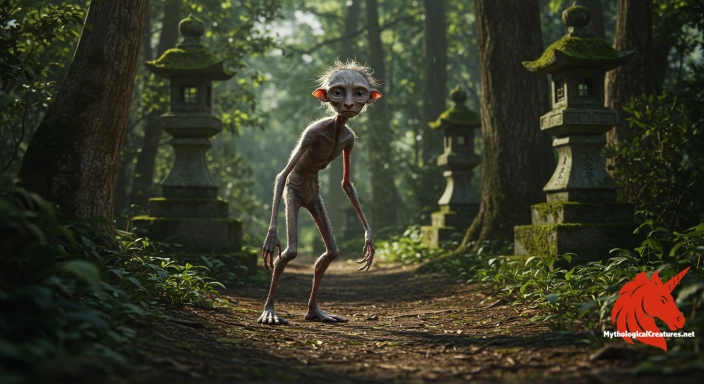
Sunekosuri
Sunekosuri - The sunekosuri embodies the nuanced interplay between the human and supernatural realms in Japanese folklore, reminding people of the unexpected and often playful disruptions that may arise in everyday life.
Origins & First Encounters
Sunekosuri is a captivating figure in Japanese folklore, celebrated as a subtle yet mysterious yōkai whose presence has intrigued generations. Its name, which translates roughly to 'rub against lower legs', immediately hints at its characteristic interaction with passers‐by. The creature has deep roots in regional mythology, particularly within the rural landscapes of Okayama Prefecture, where its legend is interwoven with daily life. Early accounts suggest that the creature may have originated as a cautionary tale for travellers, linking mundane journeys with a brush from the supernatural. The sunekosuri appears as a minor yet persistent presence, quietly meddling with human pathways. Local storytellers have often depicted it as a reminder of the unseen forces that permeate the natural world. Its mythos was shaped by centuries of oral tradition, accumulating layers of interpretation and cultural significance. The enduring allure of the sunekosuri lies in its delicate balance between mischief and the enigmatic, embodying the tangible intersection between the human and spectral realms.
Source Texts & Tale Variants
Records of the sunekosuri are primarily sourced from regional folklore and the accumulated oral traditions of Okayama Prefecture. Early local narratives and community anecdotes provide the first attested glimpses of this elusive yōkai. Various regional compendiums of yōkai, compiled during the Edo period and later, include brief references that have fostered a rich tapestry of story variants. Some accounts portray the creature with a playful disposition, while others highlight its subtle capacity for mischief and disruption. The sparse ancient texts, though limited in detail, have been supplemented by modern collectors who have gathered and documented these fleeting encounters. Over time, local diaries and community records have expanded its narrative, blending historical observations with imaginative embellishments. Divergent versions of the legend have emerged, reflecting both the benign and eerie aspects of the sunekosuri. These varied sources collectively offer insights into its multifaceted nature, even as they leave room for interpretation and new auditory explorations of its myth.
Form & Powers
Visually, the sunekosuri is depicted as an elusive, intangible presence whose form is both understated and striking. It is often imagined as a diminutive, shadow-like entity that evades clear definition, reinforcing its status as a spectral wanderer. Accounts suggest that while its overall shape remains human-like, its most distinguishing trait is the elusive quality with which it interacts with the lower legs of those it encounters. Some descriptions highlight a ghostly silhouette that appears for just a moment before vanishing into the twilight, leaving a physical reminder of its passing. The creature’s appearance is occasionally accompanied by a subtle luminescence, as though it were composed partly of moonlight and mist. Variations in its depiction abound, with some local storytellers imagining a form wrapped in traditional garments that evoke images of bygone eras. Many emphasise the transient, almost imperceptible nature of its form, while others suggest that it leaves behind a faint trace or an unexplained chill. Despite these differences, the sunekosuri is consistently portrayed as a being whose physical presence is as fleeting and delicate as the touch it bestows.
Regional Faces
The myth of the sunekosuri is most deeply embedded in the cultural landscape of Okayama Prefecture, where its legend is intricately tied to local customs and natural landscapes. Regional narratives often cast the creature as both an omen and a whimsical interloper, reflecting the diverse attitudes towards the supernatural in rural Japan. Within Okayama, its reputation as a brush with the mysterious is sometimes viewed with a mix of awe and light-hearted humour. In neighbouring areas, similar spirits are described with slight variations, highlighting the fluid nature of yōkai folklore across different communities. Local adaptations can transform the creature’s role, sometimes depicting it as a benign guide who warns of impending misfortune, while in other tales it is a mere distraction from darker forces. These regional variations underscore how environmental factors, community history, and local belief systems colour the interpretation of the sunekosuri. Festivals and communal gatherings occasionally incorporate elements of its legend, reaffirming its place in local identity. As a result, while the core trait of leg-rubbing remains central, its portrayal adapts to reflect the unique cultural fabric of each region.
Cultural Parallels
When compared with other entities in global mythology, the sunekosuri emerges as a particularly distinctive example of a minor spirit whose actions blur the line between mischief and mystery. Its brief physical interaction—rubbing against the lower legs—can be likened to other folklore figures that provoke sudden, unexplained sensations in travellers. In the broader context of Japanese yōkai, it shares similarities with creatures that evoke both playful curiosity and subtle caution, reminiscent of other small, elusive spirits whose presence hints at the supernatural. Cross-culturally, it can also be compared with European folklore entities that manifest as fleeting, almost imperceptible presences along lonely roads. Despite these similarities, the sunekosuri’s specific cultural and geographical ties imbue it with a uniquely Japanese aesthetic and narrative function. It functions not only as an agent of disruption but also as an implicit reminder of nature’s hidden forces. Similar creatures in Korean and Chinese traditional lore sometimes interact with humans in unexpected, tactile ways, thus revealing common themes in how societies perceive unexplained encounters. This comparative perspective enriches our understanding of the sunekosuri as both a local oddity and a member of a wider global family of folkloric spirits.
Legacy & Modern Evolution
The cultural legacy of the sunekosuri has evolved significantly over the centuries, transitioning from a primarily cautionary figure to one that is celebrated in modern reinterpretations. Historical depictions were characterised by a subtle, ambiguous quality, reflecting the cautious respect communities had for unexplained natural phenomena. In contemporary times, the creature has found new expression in various media, including manga, anime, and local art exhibitions that celebrate yōkai traditions. Modern audiences appreciate the sunekosuri for its quirky charm as well as its rooted connection to regional heritage and traditional spirituality. Local festivals in Okayama occasionally spotlight the creature, integrating it into cultural re-enactments that draw both locals and curious tourists alike. This revitalisation has contributed to a broader resurgence of interest in Japan’s vast and diverse world of yōkai. Contemporary interpretations often balance its unsettling reputation with a more playful portrayal, bridging the gap between ancient myth and modern creativity. As digital archives and folklore forums continue to highlight such timeless figures, the sunekosuri remains a poignant symbol of the enduring interplay between history, myth, and the everyday world.
Interesting Fact
Although its only apparent mischief is the gentle brushing against legs, the sunekosuri encapsulates a deep-seated belief in Japan that even the smallest supernatural encounters carry significant cultural symbolism.
Limited sponsor opportunity
One slot, carefully chosen partners
We only feature a small number of relevant sponsors at any time. If you create serious myth content, we would like to hear from you.
Partner with usQuick Creature Info
Features:
Our Mythic Legendary Rating:

Habitat:
Supernatural Powers:
Physical Attributes:
Abilities:
Behavior:
Weaknesses:
Lore:
Related Creatures, Tales or Lore
- NNurikabe
- KKappa
References
Discover Another Mythical Legend You May Not Have Heard Of?
Uncover the mysteries of ancient folklore and expand your knowledge of legendary beings from cultures around the world.
Dare to Meet the Venilia....
Curated by the Mythological Creatures Team
Series editor: Mythological Creatures Directory
Primary desk: Asian & Pacific Myth Cycles Desk
(rev. November 2025)