
Teshub: Teshub is the Hurrian weather god and head of the Hurrian pantheon, renowned for his control over wind, thunder, and lightning.
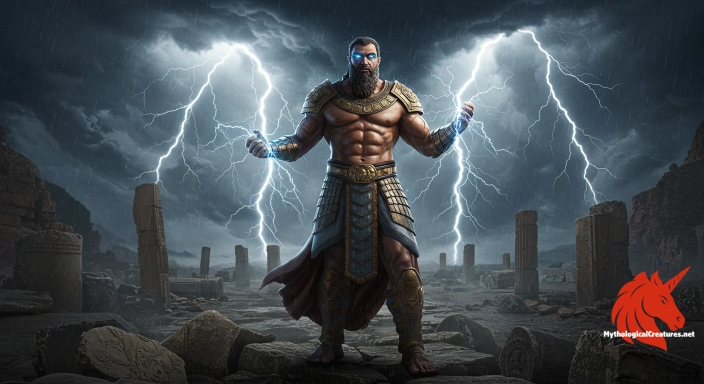
Teshub
Teshub - Teshub is the Hurrian weather god and head of the Hurrian pantheon, renowned for his control over wind, thunder, and lightning. He is typically depicted as an armed, bearded figure wielding divine weapons and driving a bull-drawn chariot. His dual nature as both a protector and a destroyer embodies the unpredictable forces of nature.
Origins & First Encounters
Within the ancient Hurrian cosmogony, Teshub emerges as a central force whose authority over storms and atmospheric phenomena defined his divine character. His origins are enshrouded in dramatic myth, and early narratives recount his birth from the dismembered skull of Kumarbi, marking the inception of divine conflict. He is celebrated for wielding the elements, commanding winds, lightning, thunder, and rain with a power that both devastates and nourishes. His role was pivotal in societies where the vagaries of nature dictated the success of agriculture and survival. Early records from the Ur III period, including theophoric names and royal inscriptions, attest to his vast influence. Teshub’s ascent to leadership within the Hurrian pantheon symbolised the vital interrelationship between human endeavours and the natural world. The ancient worship of this weather god underscores the cultural importance placed on his ability to maintain cosmic and societal order. His iconography, though sparing, reflects a dual capacity for destruction and benevolence, echoing the unpredictable character of the weather itself. Despite the fragmentary nature of the surviving texts, the legacy of Teshub endures as a powerful embodiment of nature’s dynamic forces.
Source Texts & Tale Variants
A rich array of ancient texts provides insight into the multifaceted mythos surrounding Teshub. The Song of Emergence stands out as a seminal narrative, vividly depicting his birth amid cosmic turmoil and the ensuing struggle for divine supremacy. In addition to this myth, hymns originating from Aleppo offer a glimpse into the intricate rites and liturgies that celebrated his prowess. Hurrian kaluti, or offering lists, enumerate his divine retinue and underscore the elaborate rituals dedicated to him. Hittite translations of these texts further propagated his mythology beyond his native Hurrian context. Numerous inscriptions, including those of Luwian origin, deepen the narrative while reflecting regional adaptations of his character. Ugaritic texts also incorporate Teshub into a broader tapestry of Near Eastern deities, revealing a cross-cultural exchange of mythic motifs. A solitary tradition even suggests an alternative lineage, hinting at a connection with the moon god Kušuḫ. These diverse sources together illustrate a vibrant and evolving narrative that enriched the religious landscape of the ancient Near East.
Form & Powers
The visual depictions of Teshub, though limited, consistently conjure an image of a commanding and robust deity. He is generally rendered as a bearded, armed figure whose physical presence exudes both regality and martial strength. In many representations, he is shown holding a bundle of lightning, a symbolic tool that encapsulates his dominion over thunder and storms. On select reliefs, he is depicted riding a chariot drawn by two sacred bulls, a motif that reinforces his connection to nature’s raw power. His facial expression and posture are imbued with intensity, suggesting readiness for battle as well as the capacity to restore cosmic order. The stylistic choices in his portrayals reflect a duality that is central to his identity—both fearsome in conflict and protective in benevolence. Regional artistic variations reveal subtle differences in how his features were accentuated, with some traditions emphasising muscularity and others highlighting divine wisdom. Despite the scarcity of surviving images, each serves as a potent reminder of his role as the arbiter of natural forces. Overall, his physical representation communicates not just power, but the harmonious blend of destruction and fertility inherent in the weather.
Regional Faces
Teshub’s worship extended far beyond his Hurrian origins, adapting to the unique cultural landscapes of several regions. His principal cult centres, such as the elusive Kumme and the historically significant city of Arrapha, were vital hubs where his divine authority was both celebrated and invoked. In northern Mesopotamia, where agriculture was fundamentally dependent on natural rainfall, his persona resonated deeply with local communities. The Mitanni empire, with its influence in northern Syria, embraced his power through the establishment of revered sites like Kaʿbat. In southeastern Anatolia, in regions including Kizzuwatna, Teshub was seamlessly integrated into local religious practices, reflecting a syncretism that enriched his myth. His veneration in Aleppo further underscores the process by which regional traditions absorbed and adapted his storm god attributes. Each locale contributed distinct elements to his character, highlighting aspects ranging from fertility and growth to the volatile nature of storms. This regional diversity underscores a shared cultural recognition of weather phenomena as both life-sustaining and potentially catastrophic. Ultimately, Teshub’s regional variations exemplify how ancient societies reinterpreted a singular mythological figure to align with local cosmologies and natural landscapes.
Cultural Parallels
Teshub’s narrative and attributes evoke striking resemblances with a broad spectrum of storm deities throughout the ancient world. His dual role as both a creator of life-giving rains and an agent of destruction is echoed in Mesopotamian deities like Adad, who similarly balanced the fine line between boon and calamity. Ugaritic Baal, another formidable storm god, shares thematic elements such as the cyclical struggle against chaotic forces and the restoration of order following natural upheaval. These parallels extend to the Anatolian deities Tarḫunna and Tarḫunz, whose local interpretations further illuminate the shared motifs of divine conflict and regeneration. Such cross-cultural comparisons highlight the transmission of mythic themes across a vibrant network of ancient peoples. The symbolic interplay of thunder and lightning, central to Teshub’s identity, is a recurring motif in many Indo-European and Near Eastern mythologies. Despite differences in ritual and iconography, the underlying narrative of harnessing nature’s volatile energy remains a unifying element among these gods. The comparative study of these deities reveals a common psychological and cultural response to the uncontrollable forces of nature. Through this process of cultural synthesis, Teshub not only aligns with but also enriches the archetype of the storm deity across disparate ancient traditions.
Legacy & Modern Evolution
The mythic legacy of Teshub endures as both a symbol of ancient religious thought and a subject of modern scholarly fascination. Over the centuries, his narrative has evolved as he was interwoven into the religious frameworks of the Hittites, Luwians, Ugarit, and other neighbouring cultures. His distinctive storm imagery has resonated through time, influencing artistic, literary, and theological interpretations well into the modern era. Contemporary research frequently revisits his myths to unravel the complexities of ancient perceptions of nature and divinity. His adaptation into various local pantheons underscores an enduring dialogue about the human relationship with the natural world. In modern cultural discourse, reinterpretations of Teshub’s persona continue to inspire creative endeavours that reimagine ancient struggles between order and chaos. The evolution of his storied character reflects shifts in societal attitudes toward the environment and the divine. His symbolic association with both destruction and renewal provides a rich framework for understanding natural phenomena in mythic terms. Overall, Teshub’s lasting influence highlights the enduring interplay between nature, mythology, and human culture, inviting ongoing reinterpretation and appreciation across the ages.
Interesting Fact
A striking element of Teshub's mythology is his dramatic birth from Kumarbi's split skull, a narrative that poetically mirrors the cyclical and transformative power of storms.
Mythology commerce, done carefully
Align your store with our global myth audience
If you sell myth-inspired jewellery, prints, decks, or collectibles, we can feature your brand without overwhelming the reading experience.
Partner with usQuick Creature Info
Type:
Origin:
Features:
Our Mythic Legendary Rating:

References
Discover Another Mythical Legend You May Not Have Heard Of?
Uncover the mysteries of ancient folklore and expand your knowledge of legendary beings from cultures around the world.
Dare to Meet the Kianda....
Curated by the Mythological Creatures Team
Series editor: Mythological Creatures Directory
(rev. November 2025)