
Three-legged crow: The three‐legged crow is a mythological avian creature from East Asian lore that symbolizes and inhabits the Sun.
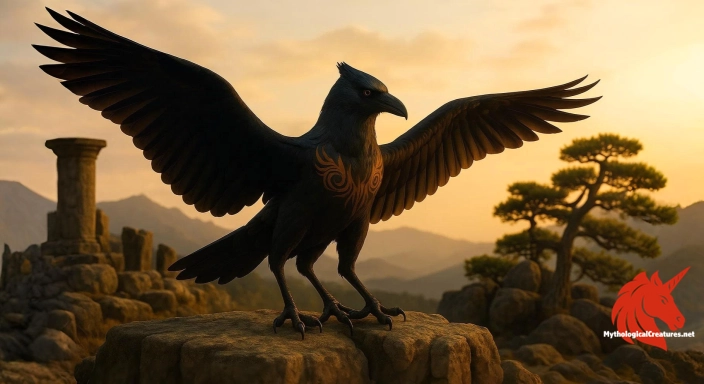
Three-legged crow
Three-legged crow - Represents the Sun, leadership, and the cyclical nature of life; revered as a divine messenger and symbol of cosmic authority
Origins & First Encounters
The three‐legged crow is a mythological avian icon that stands out in East Asian traditions as an embodiment of the sun’s power. Its origins can be traced back to ancient times, with early archaeological evidence linking it to ritualistic and totemic practices in China as far back as 5000 BCE. The crow’s distinctive imagery and solar connection have been interwoven with cultural narratives, emphasising both the mystery of nature and the cyclical patterns of day and night. Over the centuries, this celestial creature has been revered not only as a symbol of light and warmth but also as a harbinger of cosmic balance and renewal. Early mythologies celebrated its role as a messenger between the heavens and earth, inspiring countless works of art and literature. The captivating symbolism of the three‐legged crow reflects humanity’s enduring fascination with the sun as a source of life and renewal. With its enduring legacy, the creature has maintained a significant presence in the cultural and spiritual traditions of East Asia. Its myth continues to inspire new interpretations, serving as a bridge between the ancient past and modern creative expressions.
Source Texts & Tale Variants
Ancient sources detailing the three‐legged crow are both archaeological and textual, offering a rich tapestry of narrative diversity. Artefacts from the Yangshao and Longshan cultures reveal an early bird‐sun motif that laid the foundation for later mythologies. Traditional Chinese chronicles have preserved various versions of the legend, most notably the tales centered around the Yangwu or Jinwu, the golden crow. These narratives are complemented by discoveries from Northeast Asia, where totemic representations in cultures such as Xinle and Hongshan further reinforce the crow’s celestial role. The myth was also carried along trade routes, as evidenced by its depiction on ancient coins found in regions like Lycia and Pamphylia. Multiple story variants have evolved over time, each adding layers of symbolic and cultural meaning. In some texts, the crow is portrayed with supernatural abilities related to the cycle of day and night, linking it closely to themes of rebirth and vitality. The convergence of these diverse sources and story variants illustrates the creature’s vast cultural imprint and its enduring appeal across different eras.
Form & Powers
The physical portrayal of the three‐legged crow is as extraordinary as its mythic reputation. Its most remarkable feature is, quite naturally, the presence of three powerful legs, which not only provide a unique symmetry but also symbolise the celestial triad of the sun’s phases. Artists often depict this bird with a shimmering plumage that recalls the glow of the dawn or the fiery brilliance of the midday sun, frequently employing hues of radiant gold and deep crimson. The eyes of the crow are typically rendered as piercing and intense, intimating a profound wisdom inherited from the celestial sphere. Intricate feather patterns and dynamic brushstrokes in traditional art bring out the creature’s otherworldly elegance and strength. The extra limb, whether portrayed as centrally positioned or as a subtle accent, reinforces its supernatural status. Variations in size and detail across different artworks symbolise its adaptability in representing diverse cosmological ideas. Throughout its depictions, the crow’s form is designed to evoke the life‐affirming energy of the sun, marrying the beauty of nature with the enigma of myth.
Regional Faces
The myth of the three‐legged crow, while rooted in East Asian traditions, exhibits intriguing regional variations that reflect local beliefs and aesthetic nuances. Within China, the creature is predominantly celebrated as a golden or fiery emissary of the sun, a motif that underscores its divine association. In the folklore of neighbouring countries such as Korea and Japan, subtle stylistic differences emerge, blending the core tripedal theme with unique cultural sensibilities. Northern regions, including those represented by the ancient Xinle and Hongshan cultures, emphasise the crow’s connection to both leadership and cosmic order through artefacts and ceremonial depictions. Meanwhile, in areas as distant as Lycia and Pamphylia, symbolic integration with local iconography has led the crow to be associated with royal authority and mysticism. These adaptations demonstrate how the fundamental image of the celestial bird has been reshaped to fit various spiritual and societal frameworks. Local artisans and storytellers have tailored its physical representation and narrative function, ensuring that the crow remains relevant within varying cultural contexts. Such diversity in depiction only enriches the overall mythology, highlighting the creature’s multifaceted connections to the sun and to human civilisation.
Cultural Parallels
When compared with other mythological figures, the three‐legged crow stands out as a unique emblem of solar power and cyclical renewal. Its role as a conduit between the terrestrial and the celestial realms finds echoes in myths from around the world, such as the phoenix which similarly symbolises rebirth and eternal fire. The Egyptian Bennu bird also offers a parallel, as both creatures personify the regenerative forces of the sun. Unlike many other legendary birds that are typically depicted with the conventional pair of legs, the tripedal form of this crow underscores themes of completeness and triadic cosmic balance. Comparative mythology shows that such unconventional details are often used to mark the sacred and the extraordinary, distinguishing these creatures as symbols of ultimate transformation. This interconnection across cultures reveals how diverse societies harness shared imagery to explain the mysteries of nature. The crow’s distinctive form and vibrant symbolism have thus carved a niche in a broader global tapestry of mythic celestial beings. By examining these parallels, one can appreciate both the uniqueness of the three‐legged crow and its universal appeal in representing the power and enigma of the sun.
Legacy & Modern Evolution
The rich mythological history of the three‐legged crow has evolved dramatically over time, reflecting shifts in artistic styles and cultural priorities. Initially emerging from early totemic rituals, its image underwent profound transformation as it was assimilated into classical narratives and imperial symbology. Throughout successive Chinese dynasties, the crow’s solar attributes were reinterpreted in ways that emphasised its role as a divine messenger and a marker of cosmic harmony. Artistic depictions grew increasingly sophisticated, moving from rudimentary carvings to intricate illustrations that celebrated its mysterious allure and celestial might. In medieval periods, the crow began to be associated with themes of royal authority and spiritual guidance, findings that subtly informed iconography and literature alike. In the modern era, contemporary artists, filmmakers, and writers have reimagined the myth, translating ancient symbolism into new narratives that resonate with today’s global audience. This continuous reinterpretation has kept the myth vibrant, allowing it to adapt to shifting cultural landscapes while preserving its timeless essence. Today, the three‐legged crow not only retains its status as a symbol of the sun’s life‐giving energy but also stands as a testament to the enduring power of myth to inspire and unite disparate generations.
Interesting Fact
One of the most striking aspects of the three‐legged crow is its role as a direct embodiment of the Sun, a rarity among mythological creatures, which underscores its importance in rituals, art, and ancient symbolism.
Reach myth fans
Connect your myth-driven brand with this audience
Our readers are writers, educators, gamers, and collectors who care about mythology. Enquire about a limited sponsor placement on creature pages.
Enquire about sponsorshipQuick Creature Info
Associations:
Our Mythic Legendary Rating:

Also Sometimes Known As:
Habitat:
Supernatural Powers:
Physical Attributes:
Abilities:
Behavior:
Lore:
References
Discover Another Mythical Legend You May Not Have Heard Of?
Uncover the mysteries of ancient folklore and expand your knowledge of legendary beings from cultures around the world.
Dare to Meet the Amunet....
Curated by the Mythological Creatures Team
Series editor: Mythological Creatures Directory
Primary desk: Asian & Pacific Myth Cycles Desk
(rev. November 2025)