
Ugallu: Ugallu, the Big Weather-Beast, is a Sumerian ud-demon depicted with a lion head and avian feet.
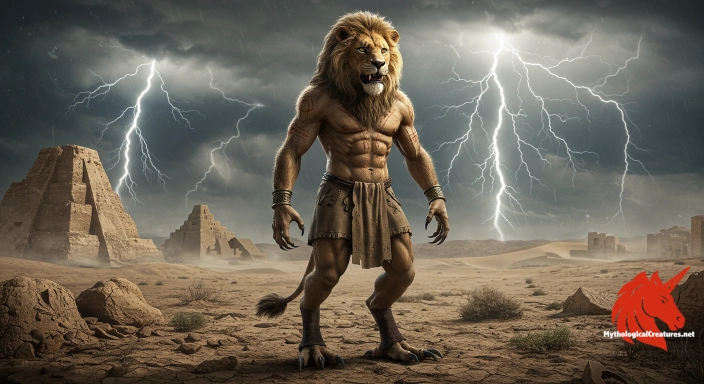
Ugallu
Ugallu - Represents divine intervention through storms and serves as an apotropaic symbol in ancient Mesopotamian culture
Origins & First Encounters
Ugallu, the Big Weather-Beast, emerges from ancient Mesopotamian lore as a formidable emblem of nature’s untamed power and divine intervention. Born in the early second millennium BC, his presence is interwoven into the spiritual fabric of both Sumerian and Akkadian cultures. His very name, meaning 'big storm' or 'big day', encapsulates the awe and apprehension stirred by sudden celestial events. The creature’s iconography, with a lion’s head dominating his visage, speaks to a synthesis of regal authority and raw, elemental fury. Over time, depictions of Ugallu evolved to incorporate variations such as the transformation of his human-like feet into eagle talons, symbolising an ascent from the earthly realm to a celestial dynamism. Amulets and protective figurines repeatedly portray his imposing form, underscoring his role as both a harbinger of chaotic storms and a guardian against them. As one among the class of ud-demons, he signalled significant moments of cosmic intervention in human affairs. His enduring myth offers a window into the intricate interplay between fear, reverence, and the human need to harness and understand natural forces.
Source Texts & Tale Variants
Ancient incantation tablets and ritual texts frequently reference Ugallu as part of the broader pantheon of ud-demons, creatures that traversed the boundaries between divine protection and destructive might. Early Mesopotamian sources do not provide a single continuous narrative about him; instead, his character appears sporadically in catalogues of protective beings and in lists intended to ward off dark influences. Amuletic inscriptions and tamarisk figurines adorned with his image reveal that he was deeply embedded in the magical practices of his time. References to his role are interlaced with descriptions of cosmic and atmospheric disturbances, hinting at his purpose during moments of upheaval. Variants of his story are discernible through slightly differing depictions in ritual sequences, where shifts between human and avian features serve as symbolic transitions. Some texts suggest that his presence was invoked during specific festivals or ceremonies marking key transitions within the calendar year. Although explicit myths focusing solely on Ugallu are sparse, his recurring appearance across diverse ritual contexts underscores his multifaceted role. Fragments of later commentaries and amulet inscriptions further enrich our understanding of how his symbolic power was harnessed to protect against the unpredictable forces of nature.
Form & Powers
Ugallu is most recognisable by his majestic lion’s head, which is rendered with expressive features that convey both nobility and the menace of an approaching storm. His face, carved with precise detail, exudes an intensity that captures the imagination, complete with a pronounced snout and formidable teeth that mirror a predator’s ferocity. The juxtaposition of his leonine head with feet that initially resembled those of a bird—and later transformed into the talons of an eagle—creates an arresting hybrid form that spans the realms of earth and sky. His robust physique is further accentuated by a short, finely detailed skirt that hints at his divine status while revealing a sense of martial readiness. Thoughtful artistic touches, such as subtle markings and textures, evoke the natural elements of wind and cloud. The gradual evolution of his anatomy in artistic depictions points to a deep reverence for the interplay between human and animalistic traits. Each emblematic detail, from the curve of his mane to the strength of his limbs, is crafted to signify his dual role as both a harbinger of destructive tempests and a guardian spirit. The composite imagery not only speaks to his mythological significance but also reflects a broader tradition of using hybrid creatures to embody the forces of nature.
Regional Faces
The image of Ugallu has undergone a rich process of regional adaptation, with local traditions infusing his portrayal with varying artistic and symbolic nuances. In the northern fringes of Mesopotamia, his lion-like features were often accentuated, aligning with a cultural emphasis on martial prowess and the raw energy of untamed beasts. Southern depictions, by contrast, tend to highlight more refined and protective aspects, often smoothing the transitions between his animalistic features. In some Akkadian sources, the evolution from human-like to eagle-inspired feet signified a deeper cosmological shift, marking an ascent from earthly limitation to divine mobility. Regional craftworkers incorporated unique motifs and symbolic adornments, which not only distinguished their local interpretations but also linked Ugallu to broader theological narratives. Certain localised variants even merged his iconography with that of neighbouring deities, creating hybrid figures that blurred the lines between distinct mythological roles. Each regional adaptation underscores the flexibility of ancient iconography, adapting a single mythic figure to incorporate local aesthetics and spiritual needs. These variations reflect a continuous dialogue between an evolving cultural landscape and the timeless allure of a creature that embodies both chaos and protection.
Cultural Parallels
Comparative studies reveal intriguing parallels between Ugallu and other hybrid beings across ancient mythologies, highlighting a shared fascination with the fusion of disparate animal forms. His composite nature, merging the ferocity of a lion with the agility of a bird, resonates with similar mythic constructs in Greek, Egyptian, and Near Eastern traditions. Figures such as the Sphinx and other hybrid guardians similarly merge elements from different species, evoking both protective and fearsome qualities. The deliberate combination of terrestrial and heavenly attributes in Ugallu parallels broader themes in world mythology where the natural and divine intersect. Like many composite creatures, he embodies the inherent tension between chaos and order, a dichotomy that recurs throughout mythological narratives. His dual role as both an omen of destructive weather and a protector against malevolent spirits finds echoes in later mythological constructs across different cultural spheres. This convergence of themes speaks to a universal human impulse to personify and negotiate the forces of the natural world. In this light, Ugallu can be seen as part of a larger tradition where symbolic hybridity serves as a powerful metaphor for the inextricable links between nature, divinity, and human destiny.
Legacy & Modern Evolution
Ugallu’s mythological journey stretches from the dusty archives of ancient tablet inscriptions to the dynamic canvases of modern artistic interpretation. His early depictions on clay figurines and protective amulets were crafted with the practical aim of warding off the feared forces lurking within violent storms and tumultuous days. Over the centuries, his image evolved markedly, reflecting shifts in both religious thought and the aesthetic values of successive cultures. In contemporary settings, scholars and artists alike have rediscovered Ugallu, often portraying him as a complex symbol of nature’s overwhelming power and the delicate balance between chaos and order. Modern literature and visual media reimagine his imposing yet protective form, drawing on ancient motifs to capture the imagination of a new generation. His presence in academic discourse and museum collections has inspired reinterpretations that blend historical detail with innovative creative expression. The enduring re-emergence of Ugallu in modern popular culture, from graphic novels to digital installations, underscores a timeless appeal that transcends its ancient origins. As society continues to grapple with natural unpredictability in an increasingly complex world, Ugallu remains a potent emblem of both warning and wonder, his legacy continually reshaped by each passing era.
Interesting Fact
Ugallu's fluctuating iconography over the centuries illustrates the dynamic evolution of mythological symbols in response to cultural shifts and artistic innovation.
Limited sponsor opportunity
One slot, carefully chosen partners
We only feature a small number of relevant sponsors at any time. If you create serious myth content, we would like to hear from you.
Partner with usQuick Creature Info
Origin:
Features:
Associations:
Our Mythic Legendary Rating:

Also Sometimes Known As:
Habitat:
Supernatural Powers:
Physical Attributes:
Abilities:
Behavior:
Weaknesses:
Lore:
References
Discover Another Mythical Legend You May Not Have Heard Of?
Uncover the mysteries of ancient folklore and expand your knowledge of legendary beings from cultures around the world.
Dare to Meet the Bromus....
-e24066b7-6e2e-49c3-87af-91ad65a746d3_small.webp "Depiction of Bromus")
Curated by the Mythological Creatures Team
Series editor: Mythological Creatures Directory
Primary desk: Hellenic & Ancient Mediterranean Desk
(rev. November 2025)