
Ungud: Ungud is a revered snake god from the Wunambal mythology of northwestern Australia, depicted as a giant python and symbolic Rainbow Serpent.
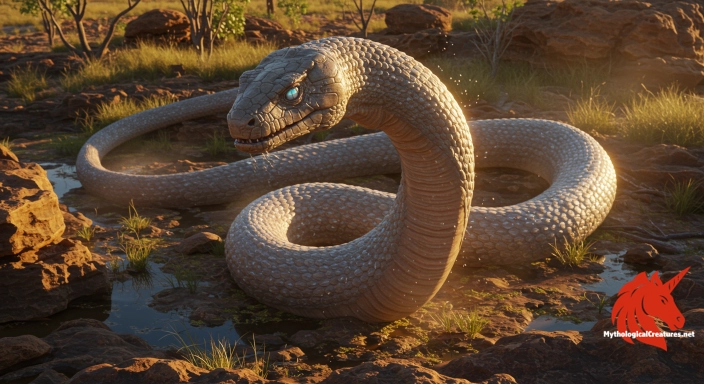
Ungud
Ungud - Embodies creative powers, life, and fertility; integral in the formation of natural species through Dreaming.
Origins & First Encounters
Ungud stands as a central figure in the ancient mythology of the Wunambal people of northwestern Australia, a deity whose presence resonates with the deep rhythms of the earth and sky. Ungud’s origins reach back to a time when the world was in its infancy, a period when only sky and earth existed. Emerging as a formidable snake god, he is remarkable for his fluid identity, sometimes manifesting as male, at other times as female or even androgynous. His nature is intricately linked to rainbows, symbolising the fertility and creative energies that infuse both the land and the shamans who serve as his earthly representatives. In the earliest myths, Ungud is described as residing underground in the guise of a giant python, embodying the primal forces of water and earth. His role in the cosmic order is fundamental, as he is credited with stirring the monsoons and bringing forth rain, which is essential for life. Through his dynamic presence, he encapsulates the transformative impact of nature, guiding the cycles of growth and regeneration. The rich tapestry of his myth underscores a sacred connection between the physical landscape and the spiritual universe. His legend is interwoven with the dreams and rituals of his people, marking him as a timeless symbol of creation and renewal.
Source Texts & Tale Variants
The narratives surrounding Ungud have been handed down through generations by the Wunambal people, preserved primarily in oral traditions and ritual practices. These stories, though varied in detail, consistently elevate him as a primal force in the creation of both land and life. Over time, early accounts of his divine acts and supernatural grace have been recorded by anthropologists and echoed in indigenous art forms. Some versions depict Ungud as intricately linked with the forces of earth and water, emphasising his role in bringing rain and nurturing life. Alternative tales highlight his creative partnership with Wallanganda, the sky deity, whose celestial presence complements Ungud’s earthy influence. In the realm of dreamtime narratives, his contributions to the formation of living beings are recounted with nuanced symbolism. The multiplicity of stories reflects the vibrant and evolving nature of Aboriginal spirituality, where each recital adds layers to his mythic character. While written sources remain limited, the oral accounts are profound in scope and rich in symbolism. Variations in his myth are often influenced by the context of local rituals, ensuring that his story remains both a communal treasure and a dynamic element of cultural memory.
Form & Powers
Visions of Ungud typically reveal a majestic, serpentine form that exudes both strength and enigmatic beauty. Artists and storytellers depict him as a giant python whose iridescent scales catch the light in a manner reminiscent of a vivid rainbow. His physical appearance is marked by sinuous curves and fluid movement, a living embodiment of nature’s dynamism. In some portrayals, his skin shimmers with subtle hues of red, blue, and green, symbolising both the fertile earth and the ephemeral spectrum of rain. The deity’s eyes are often described as deep and penetrating, conveying an ancient wisdom and a connection to the unseen realms. His form is not static; the myths suggest a capacity to change, reflecting his androgynous essence and the dual aspects of creation and destruction. Depictions frequently include nuanced markings along his body, which serve as a visual metaphor for his role in bridging the earthly with the divine. Ungud’s size is amplified in the imaginations of his people, with legends portraying him as a force that stretches across the horizon. This rich iconography reinforces his status as a guardian spirit whose physicality mirrors the life-giving and transformative powers of nature.
Regional Faces
The portrayal of Ungud varies appreciably across different communities within northwestern Australia, each region attributing unique characteristics to his myth. Among the Wunambal people, he is revered primarily as the subterranean giant and the catalyst for rain, yet neighbouring tribes often blend his identity with that of the broader Rainbow Serpent tradition. In some areas, his association with water is more pronounced, leading to local narratives that emphasise his guardian role over sacred waterholes and riverbeds. Variations in his myth have also been used to express dualities, such as the interplay between life and destruction, which are adapted to local environmental conditions. Certain communities highlight his androgynous fluidity as emblematic of natural balance, mirroring local social and ceremonial values. Rock art and traditional carvings reveal regional artistic interpretations that differ in style and symbolism, yet consistently celebrate his serpentine form. Regional adaptations also incorporate local rites and ceremonies that reflect the community’s intimate relationship with the land and its cycles. In these cultural landscapes, Ungud becomes not just a mythic being but also a symbol of continuity and resilience, adapted to the rhythms of each unique terrain. Such variations underscore the diversity of indigenous expressions while maintaining a core myth that speaks of creation, fertility, and renewal.
Cultural Parallels
Ungud’s myth resonates beyond the borders of northwestern Australia, reflecting a broader motif found in many world cultures where serpentine deities symbolise creation and fertility. His enigmatic, morphing identity draws compelling parallels with figures such as the Rainbow Serpent, revered in various Aboriginal myths as the curator of life and water. In the broader context, his attributes share striking similarities with the Nāga of South Asian traditions, both representing the vital forces of water and the earth. The fluidity in his gender presentation is echoed in other deities who defy binary classifications, thereby symbolising transformation and the limitless nature of creation. He also invites comparisons with Mesoamerican deities like Quetzalcoatl, where the snake motif serves as a bridge between the celestial and the terrestrial realms. In these cross-cultural narratives, the serpent is often portrayed as a guardian of sacred knowledge and a mediator of life’s cyclical rhythms. This thematic overlap demonstrates a universal human tendency to revere serpentine forms as embodiments of both protection and renewal. Such comparative analysis enriches our understanding of Ungud by positioning his myth within a global tapestry of serpent symbolism. Each tradition, while distinct in its cultural and environmental imprint, underscores the potent magnetism of the serpent as an emblem of life’s enduring mystery.
Legacy & Modern Evolution
Across the passage of time, the myth of Ungud has evolved into a powerful symbol of cultural identity and environmental consciousness. Ancient oral traditions have been revitalised in modern art, literature, and performance, ensuring that his legend remains vibrant in the contemporary consciousness. Modern interpretations maintain the core themes of creation, fertility, and the interconnection of nature, while also exploring his ambiguous gender as a symbol of fluid identity. The depiction of Ungud has been reimagined in murals, sculptures, and multimedia projects by indigenous artists, who use his image to comment on social and ecological issues. His narrative has grown in scope to include contemporary concerns about environmental stewardship, reflecting a deep-seated respect for the cyclical patterns of nature. Community rituals continue to invoke his spirit to celebrate life’s regenerative powers, bridging ancient wisdom with modern challenges. Scholars and cultural custodians alike view his story as a critical link between traditional ecological knowledge and contemporary environmental advocacy. The enduring legacy of Ungud highlights how traditional mythologies can adapt to and inform modern discourses on identity, sustainability, and spiritual resilience. His myth serves as a testament to the transformative power of narrative, ensuring that the ancient connections between humanity and nature flourish in modern times.
Interesting Fact
Ungud's fluid gender presentation challenges modern binary gender perceptions, reflecting a nuanced understanding of divine duality in Aboriginal mythology.
Mythology commerce, done carefully
Align your store with our global myth audience
If you sell myth-inspired jewellery, prints, decks, or collectibles, we can feature your brand without overwhelming the reading experience.
Partner with usQuick Creature Info
Origin:
Associations:
Our Mythic Legendary Rating:

Also Sometimes Known As:
Habitat:
Supernatural Powers:
Physical Attributes:
Abilities:
Behavior:
Lore:
References
Discover Another Mythical Legend You May Not Have Heard Of?
Uncover the mysteries of ancient folklore and expand your knowledge of legendary beings from cultures around the world.
Dare to Meet the Scitalis....

Curated by the Mythological Creatures Team
Series editor: Mythological Creatures Directory
Primary desk: Asian & Pacific Myth Cycles Desk
(rev. November 2025)