
Warak ngendog: Warak ngendog is a mythical, composite creature celebrated during the Dugderan Festival in Semarang.
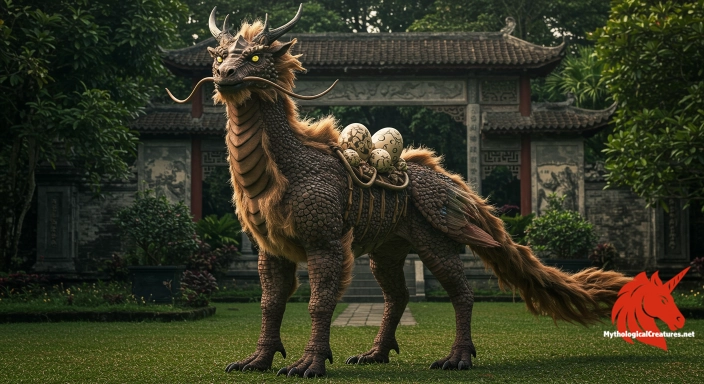
Warak ngendog
Warak ngendog - Represents the multicultural heritage and festive spirit of the Semarang community, celebrating the approach of Ramadan.
How did Warak ngendog enter folklore?
Warak ngendog is a captivating emblem of cultural fusion that has enchanted the residents of Semarang for many years. Its origins lie in a rich tapestry of local folklore, where diverse influences from Javanese, Chinese, and Arabian traditions merge seamlessly. The creature's name, meaning 'egg laying bird', hints at its unique depiction as a being that carries eggs on its back, symbolising fertility and rebirth. It emerged within the vibrant milieu of the Dugderan Festival, celebrated in the days leading up to Ramadan, and has since become a cherished icon. Early manifestations of this myth were propagated through oral traditions and playful narratives among children. The figure has grown to represent not only a fantastical creation but also a symbol of ethnic unity and shared cultural heritage. Lavish parades, community gatherings, and artistic reinterpretations during festival times have further solidified its place in local lore. Over time, Warak ngendog has come to epitomise the spirit of Semarang, blending historical tradition with festive exuberance, and serving as a reminder of the region’s enduring artistic legacy.
Which texts first mention Warak ngendog?
The primary record of Warak ngendog originates from a confluence of folk narratives and festive traditions central to Semarang’s Dugderan Festival. While ancient texts may not explicitly catalogue its myth, local oral histories and festival programmes serve as rich sources of its lore. Diverse storytellers have offered varying interpretations, focusing on different aspects such as its Chinese dragon head, Arabian buraq-like form, and Javanese goatish traits. In different retellings, the creature has been portrayed both as a playful children’s toy and as a symbol imbued with deeper cultural significance. Community artists, market vendors, and local chroniclers have all contributed to the evolving story, ensuring that multiple variants coexist in the public imagination. These variants reflect the dynamic interplay of ethnic identities, with each version adding layers of meaning and artistic detail. Festival pamphlets, local exhibitions, and public parades further reinforce these narratives, offering a vivid picture of its role in communal celebrations. This multifaceted documentation has allowed Warak ngendog to thrive as a living myth, constantly adapted and enriched by successive generations.
Warak ngendog: Physical Form and Supernatural Powers
Warak ngendog presents an extraordinary physical amalgamation that defies traditional categorisation, merging features from a range of animals into a singular, fantastical form. Its head is reminiscent of a formidable Chinese dragon, adorned with intricately scaled ridges and elegantly curved horns. The creature’s body merges the graceful contours of a winged horse, emblematic of the buraq from Islamic lore, with the sturdy, compact build of a goat, reflecting Javanese influences. A particularly striking aspect is the ornate eggs it is said to carry on its back, imbuing the figure with an air of mystique and symbolic fertility. Further descriptions liken parts of its physique to that of a giraffe, imbuing it with a sense of elevated grandeur, while echoes of lion-like regality and avian agility round out its appearance. The interplay of scales, fur, and feather-like textures lends the creature a multi-layered visual appeal that is both colourful and complex. Its expressive eyes, full of depth and subtle luminescence, contribute to the creature’s otherworldly charm. Artisans dedicate significant attention to capturing every nuance, ensuring that each representation of Warak ngendog reflects both its mythic heritage and the imaginative flair of its creators. Variations in size and detail further highlight the flexibility of its design, making each rendition a unique celebration of artistic diversity. Collectively, these attributes combine to create a figure that is as enigmatic as it is visually arresting, inviting continuous reinterpretation and admiration.
Warak ngendog: One Legend, Many Local Versions
The depiction of Warak ngendog shifts subtly across the various communities in and around Semarang, underlining its role as a symbol of regional identity. In urban Semarang, the creature is intricately crafted for the high-energy displays at the Dugderan Festival, reflecting a modern celebration of heritage. Rural interpretations, by contrast, tend to emphasise a simpler, more rustic rendition of the myth, highlighting its playful and approachable nature. Artists in different localities modify features to cater to community preferences, sometimes accentuating its egg-bearing attribute or its composite animal features in unique ways. These regional adaptations often mirror the specific cultural narratives and aesthetic sensibilities of their locale, revealing a lively dialogue between tradition and local innovation. The festive environment of the Johar Market further provides a dynamic backdrop against which these various interpretations are showcased. Such localised versions foster a sense of communal ownership, with every area contributing its own distinct chapter to the creature’s evolving story. In this way, Warak ngendog becomes not just a singular myth but a collage of regional creativity, continuously reinterpreted and embraced by diverse groups within the region.
What figures resemble Warak ngendog?
Warak ngendog occupies a unique space amongst mythological hybrids, characterised by the intermingling of elements from disparate cultural traditions. Its Chinese dragon head harmoniously aligns with the mighty dragons revered throughout East Asian lore, while the inclusion of a buraq-like body situates it within the broader spectrum of Islamic mythical narratives. Similar to mythic hybrids like the Greek Chimera, the creature represents a blend of traits that defy conventional zoological classification, inviting comparative exploration across cultures. The playful incorporation of features from animals such as lions and goats resonates with other regional folkloric creatures, simultaneously highlighting the universality of hybrid motifs. Its role as an egg-bearing figure also finds echoes in various fertility myths, which celebrate the cyclical nature of life and rebirth. Warak ngendog, therefore, becomes a visual and symbolic bridge linking Eastern, Middle Eastern, and Southeast Asian mythologies. The creature’s comparative analysis reveals a shared human fascination with blending the ordinary with the extraordinary, thereby crafting symbols that transcend cultural boundaries. Ultimately, it embodies the idea that myth and folklore are living traditions, capable of evolving and interfacing with a wide array of cultural narratives across time and space.
Warak ngendog: Then and Now
Over the course of decades, Warak ngendog has evolved from a simple children’s toy into a vibrant emblem of communal pride and cultural expression. Its early iterations, primarily created as playful figures for festival celebrations, have gradually undergone refinements that highlight its role as a unifying symbol among diverse ethnic groups. Modern reinterpretations have seen the creature take centre stage in elaborate parades and public art installations, where traditional motifs are blended with contemporary design sensibilities. This evolution reflects a broader trend of reimagining folklore in a way that honours historical roots while embracing modern artistic innovation. With renewed interest in cultural heritage, Warak ngendog now features in multimedia exhibits, digital art projects, and community-driven festivals that celebrate local identity. These adaptations have reinforced its status as not only a relic of the past but also as an evolving icon that speaks to the dynamic cultural landscape of Semarang. Its continued popularity in both traditional festivals and modern reinterpretations underscores a timeless appeal, resonating with new generations. Through dynamic reinvention, Warak ngendog remains an enduring bridge between history and modernity, symbolising the collective memory and creative spirit of its community.
Interesting Fact
An interesting aspect of Warak ngendog is its role as a multifaceted cultural symbol, merging diverse mythological elements into one playful yet profound icon.
For serious mythcraft
Your project belongs among the legends
If your work deepens how people understand, play with, or teach mythology, a sponsor placement here keeps it in front of the right readers all year.
Submit a sponsorship enquiryQuick Creature Info
Features:
Associations:
Our Mythic Legendary Rating:

Also Sometimes Known As:
Habitat:
Supernatural Powers:
Physical Attributes:
Behavior:
Lore:
References
Discover Another Mythical Legend You May Not Have Heard Of?
Uncover the mysteries of ancient folklore and expand your knowledge of legendary beings from cultures around the world.
Dare to Meet the Gytrash....
Curated by the Mythological Creatures Team
Series editor: Mythological Creatures Directory
Primary desk: Asian & Pacific Myth Cycles Desk
(rev. November 2025)