
Will-o'-the-wisp: Will-o'-the-wisp is a mysterious, ghostly light that appears over marshes and bogs, captivating and confounding those who witness it.
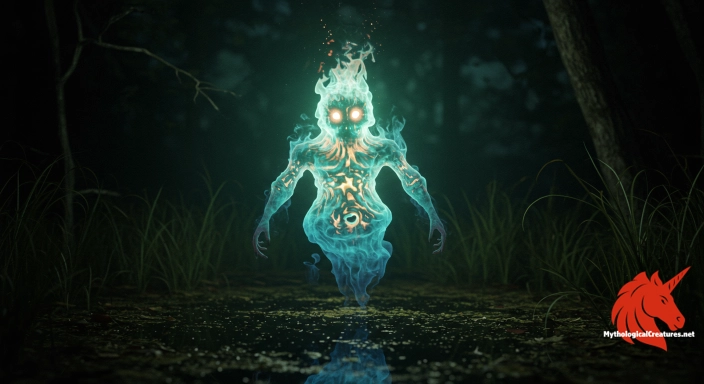
Will-o'-the-wisp
Will-o'-the-wisp - Serves as a symbol of nature’s mysterious and unpredictable forces, blurring the line between myth and natural phenomenon
Origins & First Encounters
Emerging from the mists of ancient lore, the will-o’-the-wisp captivates as a spectral and enigmatic glow that haunts the twilight of marshes and bogs. It is a phenomenon steeped in myth, with its earliest mentions found in local oral traditions and early written folklore. The light appears mysteriously at night, its capricious dance both a guide and a warning to unwary travellers. Over the centuries, this flickering flame has come to represent the liminal boundary between the known and the unknown. The creature’s origins lie in a mix of superstition and attempts to explain natural luminescence, encapsulating the human desire to make sense of inexplicable occurrences. Its very name, derived from Latin as ignis fatuus, underscores the perceived futility and whimsy of this ephemeral spark. Through the lens of cultural memory, the will-o’-the-wisp has transcended mere explanation to become a symbol of nature’s untamable mystery. Its continual presence in folklore reflects an enduring fascination with phenomena that blur the lines between science and the supernatural.
Source Texts & Tale Variants
Ancient manuscripts and regional tales form the primary fabric of the will-o’-the-wisp’s mythological sources. Over many generations, storytellers and chroniclers have documented this elusive light in a wide range of texts that reveal regional nuances and cultural adaptations. Diverse accounts can be found in medieval European chronicles, where the phenomenon was often depicted as a mischievous spirit or even a forewarning omen. Written records in Latin, French, and German capture the varied names—ignis fatuus, feu follet, and Irrlicht—each embellished with unique local details. Oral traditions have further enriched these narratives with lively descriptions and dramatic cautionary lessons. Beyond the European context, North American stories like the Paulding Light and the Spooklight echo the overarching theme of a light that misleads its observers. Furthermore, traditions in the Arab world and Southeast Asia have also provided distinctive variants, each adapted to their local environments and beliefs. These multiple sources together create a rich tapestry of story variants that continue to inspire curiosity and scholarly debate.
Form & Powers
The will-o’-the-wisp is most commonly visualised as a small, flickering orb, its radiance subtly shifting between hues of pale blue and warm amber. Observers often remark on its luminous quality, which seems both delicate and eerily persistent against the dark night. The light’s movements are described as erratic yet strangely rhythmic, as if it were dancing to an otherworldly tune. In close observation, some have noted that the orb pulsates with a soft glow, giving the impression of breathing life into the night. Its size is generally small, comparable to that of a firefly, yet its impact on the mind is monumental due to its mysterious allure. Certain accounts even speak of the light splitting into multiple smaller orbs that weave together in a transient ballet. This physical manifestation blurs the boundaries between a natural phosphorescent phenomenon and a supernatural presence. In many descriptions, the shimmering aura of the light lends it an ethereal aspect, resulting in interpretations that intertwine botanic processes with paranormal intrigue.
Regional Faces
The manifestation of the will-o’-the-wisp is richly coloured by the regional folklore from which it springs, with each culture bestowing distinct names and characteristics upon it. In the United Kingdom, for instance, it is often called the jack-o’-lantern, friar’s lantern, or hinkypunk, imbuing it with a playful yet cautionary character. Across continental Europe, Latin and French traditions have recorded it as ignis fatuus and feu follet, highlighting its perceived folly and deceptive nature. Meanwhile, German tales refer to it as Irrlicht, a name that emphasises its confusing and bewildering aspect. In the stark landscapes of Scandinavia, phenomena like the Hessdalen light in Norway echo similar mysteries under the northern skies. North American regions have woven the phenomenon into local lore with names such as the Spooklight and the Paulding Light, each carrying its own regional attributes. Even within Arab folklore, the creature appears as Abu Fanoos, linking the spectral light to culturally specific mythic narratives. These adaptations illustrate how local geography and cultural perspectives continuously reshape the narrative identity of this elusive, ghostly beacon.
Cultural Parallels
When viewed across global mythologies, the will-o’-the-wisp shares striking similarities with other spectral lights and fire spirits in various cultures. Its elusive and fleeting nature is mirrored in entities such as the Chinese ghost fire and the Japanese hitodama, each revered for both their beauty and inherent mystery. The essence of these lights lies in their ability to both mesmerise and mislead, drawing on a universal theme of nature’s capricious charm. They are often juxtaposed with other natural phenomena like the fox fire seen in parts of Asia, where the eerie luminescence carries similar connotations of misdirection and enchantment. This cross-cultural parallel emphasises an underlying human need to attribute supernatural explanations to inexplicable natural events. Moreover, the similarities in behavioural lore—guiding or deceiving travellers at night—help link these phenomena in a broader tapestry of myth and legend. Comparative studies reveal that whether termed a will-o’-the-wisp, hitodama, or ghost fire, these entities underline the transient boundary between material reality and spiritual myth. Ultimately, this cultural interconnection enriches the global narrative of spectral phenomena, suggesting a shared human response to the magical mysteries of the natural world.
Legacy & Modern Evolution
The myth of the will-o’-the-wisp has evolved remarkably over the centuries, mirroring the shifts in human understanding from mysticism to science. Initially regarded as a supernatural messenger or a capricious spirit, its spectral light inspired awe and caution among rural communities and travellers. In more recent times, modern scientific inquiry has provided naturalistic interpretations based on bioluminescence and chemical reactions, yet the allure of the myth remains undiminished. This enduring legacy is evident in contemporary literature, film, and art, where the will-o’-the-wisp is often depicted as a symbol of the seductive lure of the unknown. Modern reinterpretations frequently blend traditional folklore with scientific phenomena, creating a narrative that is both rational and mystically evocative. Its image continues to fascinate, serving as a metaphor for the elusive and often illusory nature of guidance in life. Throughout its historical evolution, the will-o’-the-wisp has maintained a dual identity—both a subject of scientific curiosity and a timeless emblem of folklore. Today, it stands as a testament to the enduring power of myth in shaping our perception of the natural world.
Interesting Fact
Will-o'-the-wisp stands as a cross-cultural phenomenon, manifesting under various names and interpretations worldwide, which underscores the universal allure of the unexplained.
For indie creators
Give your myth project a permanent home
Indie authors, artists, small studios, and makers can secure an annual, non-intrusive sponsor slot that meets readers where they explore.
Obtain more informationQuick Creature Info
Features:
Associations:
Our Mythic Legendary Rating:

Also Sometimes Known As:
Habitat:
Supernatural Powers:
Physical Attributes:
Abilities:
Behavior:
Weaknesses:
Lore:
Related Creatures, Tales or Lore
- HHitodama
- NNaga fireballs
- SSt. Elmo's fire
References
Discover Another Mythical Legend You May Not Have Heard Of?
Uncover the mysteries of ancient folklore and expand your knowledge of legendary beings from cultures around the world.
Dare to Meet the Cymatolege....
-6c243ff3-6397-4d7f-a536-c7a769ac249f_small.webp "Depiction of Cymatolege")
Curated by the Mythological Creatures Team
Series editor: Mythological Creatures Directory
Primary desk: Northern & European Folklore Desk
(rev. November 2025)