
Adathan and Yadathan: Adathan and Yadathan are a pair of uthras in Mandaean cosmology who serve as guardians in the World of Light.
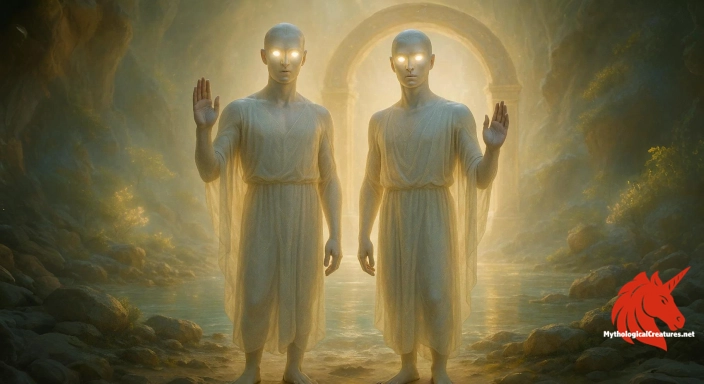
Adathan and Yadathan
Adathan and Yadathan - They are central to Mandaean cosmology, ensuring the sanctity of the divine realm and guiding the faithful through the passage of life.
Origins & First Encounters
Adathan and Yadathan are esteemed guardians within the Mandaean cosmology, revered as ethereal sentinels at the sacred Gate of Life in the World of Light. Their origins trace back to ancient Mandaean scripture where they first emerge as vital figures in the divine hierarchy. The early attestations in texts such as the Right Ginza and the Qulasta underscore their prominent status among the uthras. They embody the harmonious interplay between divine illumination and the mystic forces of existence, offering a bridge between human experience and celestial order. Their perpetual presence in ritual prayers and liturgical recitations reflects a deep-rooted cultural reverence that has endured through the ages. The pair are not merely symbolic, but are celebrated as active participants in the processes that connect the temporal with the eternal. Their names, always appearing together, hint at a complementary duality that enriches the spiritual narrative of Mandaeism. As both protectors and heralds of cosmic life, they inspire devotion and maintain a central role in both communal worship and individual reflection. Ultimately, Adathan and Yadathan continue to illuminate the pathways of the faithful, sustaining a tradition that honours the intricate balance of light and life.
Source Texts & Tale Variants
The primary sources detailing the lives and roles of Adathan and Yadathan include seminal texts such as the Right Ginza and the Qulasta, where their divine functions are vividly portrayed. Book 14 of the Right Ginza explicitly names them as the guardians of the "first river," thereby linking them to the primordial flow of sacred water. The Ginza Rabba, another core scriptural work, reinforces their importance by consistently mentioning them in tandem with other revered uthras. Variations in the textual narratives offer a window into the evolving ritualistic and theological interpretations within Mandaean tradition. In liturgical settings, such as the Asut Malkia prayer, the invocation of their names underscores their enduring spiritual significance. Some manuscripts exhibit slight differences in wording or emphasis, hinting at regional or chronological variations in their portrayal. The rich, allegorical language used in these texts creates a tapestry of meaning that continues to inspire both ritual recitation and scholarly discussion. Diverse scriptural traditions within Mandaeism attest to their unique role in bridging the earthly with the divine. Thus, the ancient manuscripts collectively affirm their status as indispensable figures whose stories have been passed down with care over the centuries.
Form & Powers
Descriptions of Adathan and Yadathan are wrapped in the metaphorical language of divine radiance and celestial splendour. They are often envisioned as bearing an ethereal glow that transcends ordinary physical form, reflecting the luminous nature of the World of Light. Their appearances are depicted with subtle elegance; some traditions suggest they are adorned in garments that shimmer with the hues of dawn and early light. While not confined to human dimensions, their forms echo graceful, elongated features that hint at both earthly beauty and otherworldly perfection. The imagery used in Mandaean art and literature often likens their presence to a play of light over a serene canvas, imbuing them with an almost surreal quality. Their eyes, sometimes described as mirrors of sacred fire, serve as windows into mystical realms while symbolising the clarity of divine wisdom. The fluidity in their depiction, much like the ever-changing river they guard, allows for interpretations that range from statuary forms to abstract luminous manifestations. Although explicit physical details are sparse, the recurring motif of radiant, unearthly beauty stands at the forefront of their depiction. This blend of symbolism and abstraction invites a continual reinterpretation, making their appearances as enigmatic as they are inspiring.
Regional Faces
Within the various communities that have preserved Mandaean tradition, the depiction of Adathan and Yadathan shows subtle regional nuances influenced by local cultural aesthetics. In regions such as ancient Mesopotamia, where the Mandaean faith took deep root, artistic renditions of these guardians often incorporate elements drawn from the local visual lexicon. Certain Iraqi interpretations might emphasise intricate decorative patterns that echo the natural flow of the sacred river, while Iranian renditions often highlight a more austere yet luminous portrayal. Variations in the pronunciation of their names and the stylistic details in manuscript illustrations reveal an adaptive tradition that marries ancient symbolism with regional artistic sensibilities. In diaspora communities, modern reinterpretations have emerged, blending traditional iconography with contemporary artistic techniques. These local adaptations have enriched the collective imagery, ensuring that every representation retains core attributes while celebrating regional diversity. The interplay between established textual descriptions and local creative expression has allowed for a dynamic evolution of their portrayal. Despite these regional differences, the underlying themes of duality, protection, and celestial light remain universally recognised. As a result, Adathan and Yadathan continue to serve as pan-regional symbols of divine guardianship, uniting disparate communities through a shared spiritual heritage.
Cultural Parallels
The guardian duo of Adathan and Yadathan finds intriguing parallels in various mythological traditions that also celebrate dual divine figures. Similar to paired deities in Zoroastrianism, they serve as mediators between the material and spiritual realms, illustrating the universal motif of balance. Early Gnostic traditions feature analogous guardians whose roles mirror that of maintaining cosmic order and safeguarding sacred thresholds. In ancient Egyptian and Mesopotamian mythologies, protective pairs often symbolise the unity of opposites, a theme that resonates strongly with the Mandaean portrayal. The depiction of these figures as custodians of an entrance into a mystical realm is reminiscent of the angelic and divine pairs found in other faiths, including certain strands of early Christian thought. Such comparisons underscore a broad, cross-cultural fascination with the idea of duality and the need for celestial equilibrium. The recurrent theme of two guardians standing watch over a gateway is a testament to the shared human desire to understand the connection between life and the divine. Detailed comparative analyses reveal that these cultural echoes are not coincidental, but rather point to a deep-seated archetypal pattern. By exploring these interconnections, one observes that Adathan and Yadathan, like their counterparts elsewhere, encapsulate the enduring quest for harmony between the seen and unseen worlds.
Legacy & Modern Evolution
The historical evolution of Adathan and Yadathan mirrors the rich tapestry of Mandaean religious thought and cultural resilience over the centuries. Their early depictions in sacred texts have evolved into a legacy that continues to inspire both devotion and modern artistic expression. Over time, these guardians have transcended their original esoteric roles to become emblems of divine protection and hope in the face of adversity. Medieval manuscripts and traditional liturgies ensured that their symbolic presence remained a constant, even as the religious landscape shifted around them. In contemporary times, particularly among diaspora communities, renewed interest in preserving Mandaean heritage has revitalised the iconography and narrative associated with these figures. Modern interpretations often cast them as timeless arbiters of light and life, bridging ancient mysticism with the sensibilities of the modern world. Artistic renditions in modern media and scholarly discussions have reimagined their roles as not only spiritual custodians but also as symbols of cultural identity and endurance. These re-interpretations celebrate their capacity to inspire resilience and continuity within a community that treasures its ancient roots. As living symbols of an enduring tradition, Adathan and Yadathan continue to illuminate the intersection of past wisdom and the present quest for spiritual meaning.
Interesting Fact
An interesting aspect of Adathan and Yadathan is that their dual guardianship not only secures the threshold of the divine realm but also symbolises the harmonious balance between cosmic order and spiritual illumination.
Limited sponsor opportunity
One slot, carefully chosen partners
We only feature a small number of relevant sponsors at any time. If you create serious myth content, we would like to hear from you.
Partner with usQuick Creature Info
Origin:
Features:
Associations:
Our Mythic Legendary Rating:

Habitat:
Supernatural Powers:
Physical Attributes:
Abilities:
Behavior:
Lore:
References
Discover Another Mythical Legend You May Not Have Heard Of?
Uncover the mysteries of ancient folklore and expand your knowledge of legendary beings from cultures around the world.
Dare to Meet the Hrímnir....

Curated by the Mythological Creatures Team
Series editor: Mythological Creatures Directory
Primary desk: Hellenic & Ancient Mediterranean Desk
(rev. November 2025)