
Aeternae: The Aeternae are a legendary race of monstrous humanoids, noted for their bony, saw-toothed protuberances on their heads.
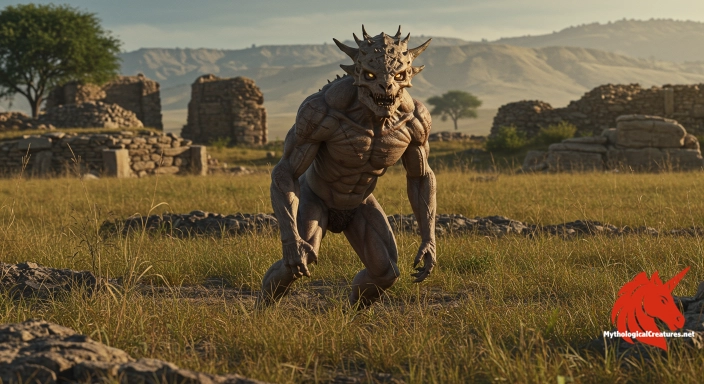
Aeternae
Aeternae - They embody the ancient fears of the unknown and illustrate the blend of myth and history in early exploration narratives.
Origins & First Encounters
Legends of the Aeternae emerge from the fragmented chronicles of one of history’s most intrepid conquerors, echoing through the dusty narratives of Alexander the Great’s campaigns. Their first known appearance is entwined with the early encounters in the northern Indian plains, where the tangible and the mythical merged. These enigmatic beings were depicted with an aura of formidable strength and mystique, captivating both the imagination of soldiers and chroniclers alike. Historical records hint at their dual nature as both physical adversaries and symbols of nature’s untamed ferocity. The accounts, though sparse, portray them as beings whose very existence challenged the boundaries between myth and reality. The mysterious origins of the Aeternae underscore the broader ancient preoccupation with the dangers that lurked beyond the familiar world. In a time when distant lands were shrouded in wonder and peril, the Aeternae symbolised the intersection of human ambition with nature’s inherent unpredictability. Their legacy, woven through the tapestry of early exploration, invites modern speculation about the veracity and symbolism of such encounters. Even now, their story sparks the curiosity of those who seek to understand how light and shadow often coexist in the mythic imagination. The enduring allure of the Aeternae lies in their capacity to illustrate the eternal dance between human endeavour and the mysteries of the unexplored.
Source Texts & Tale Variants
Early travel accounts associated with Alexander the Great constitute the primary source material for the legend of the Aeternae. Detailed narratives from these expeditions blend observations of the exotic with elements of mythic embellishment, establishing a foundation that has intrigued interpreters for centuries. The sparse reports highlight encounters during which these creatures were witnessed engaging in violent skirmishes with the invading forces. Over time, variations of these initial descriptions emerged, each adding nuanced layers that sometimes introduced supernatural or allegorical interpretations. Certain classical texts hint at the possibility that the Aeternae were conceived as metaphors for the untamed dangers of distant lands. Later medieval compendiums and bestiaries absorbed these early stories, reworking them into elaborate illustrations of man versus the unknown. Over centuries, sporadic mentions in diverse manuscripts further enriched the creature’s lore. The evolving narrative not only detailed their physical attributes but also placed them within the broader context of the marvels encountered on ancient journeys. Despite the limited direct evidence, the original encounters have spurred a cascade of story variants that continue to fascinate. Each retelling serves to deepen the myth while reminding us that history and legend often share a common, shadowy terrain.
Form & Powers
The Aeternae are most strikingly portrayed with bony, saw-toothed protuberances exuding an aura of raw, almost prehistoric hostility. These jagged formations, seemingly grown organically from their skulls, contributed to a visage that was both awe-inspiring and terrifying. Descriptions frequently highlight that these features were not mere anatomical curiosities but deadly instruments designed for close combat. Their skin is often depicted in ashen tones, which accentuate the harsh outlines of their skeletal crest. In various accounts, the creature’s build oscillates between a distorted humanoid form and something derived from nature’s more primal blueprints. Some narratives portray them as possessing an almost spectral agility despite their menacing appearance, a trait that adds to their legendary mystique. The eerie, reflective quality observed in their eyes is said to amplify the sense of predatory intent. In several interpretations, every physical detail—from their limb proportions to their unsettling facial structure—is imbued with symbolism. These striking features invited early chroniclers to blend empirical observation with imaginative reconstruction, leading to a compounded mythic image. Ultimately, the Aeternae’s appearance remains a testament to how physical anomalies can be immortalised within the heroic and often fearsome narratives of ancient cultures.
Regional Faces
Accounts of the Aeternae differ markedly across various cultural and geographical traditions, each imprinting local sensibilities upon their depiction. In the landscapes of the northern Indian plains, for instance, the creatures have been cast as fierce denizens of untamed wilderness, guardians whose very presence warns of nature’s sovereign power. These regional adaptations often inject spiritual or mystical elements, aligning their fearsome traits with the local pantheons of war deities and nature spirits. Some traditions even suggest that the distinctive saw-toothed crests held symbolic significance as marks of divine retribution or favour. In neighbouring folklore, narratives emerge where the Aeternae are less monstrous and more emblematic of the unpredictable forces lurking at the fringes of civilisation. Such localised retellings have incorporated indigenous motifs, blending the tangible environment with the supernatural realm. The enduring emphasis on their lethal head protuberances, however, unites these regional variations under a common iconographic theme. Folktales in certain communities portray them as both physical adversaries and moral omens, reflecting deeper cultural anxieties about external threats. This rich tapestry of regional interpretations underscores the way myth adapts to the cultural context while maintaining an invariant core of terror and fascination. Through these diverse lenses, the Aeternae persist as a compelling symbol of the interface between man, nature, and the unknown.
Cultural Parallels
The Aeternae share compelling similarities with other mythic entities whose deformed and exaggerated features signal both supernatural prowess and the embodiment of nature’s untamed force. Their saw-toothed cranial appendages resonate with images found in the depictions of cyclopes and the various horned entities recorded in diverse ancient mythologies. Much like other legendary beings, their physical anomalies are often interpreted as a sign of their connection to a realm that transcends ordinary human experience. In several cultural traditions, similar monstrous features have been ascribed to both protective and malevolent figures, creating a nuanced balance between danger and reverence. The pattern of imbuing aberrant anatomy with spiritual or sinister qualities is a recurring motif seen from Eastern bestiaries to the lore of Nordic giants. Such comparisons not only highlight the universality of the creature’s fearsome aesthetic but also speak to a broader mythological tendency to interpret the unnatural as a window into the mystical. Alternative narratives draw parallels with spectral guardians or nature spirits known to inhabit the liminal spaces of ancient thought, thus reinforcing the Aeternae’s archetypal role. The shared use of supernatural physical characteristics underlines a common human strategy for articulating encounters with the unknown. By placing the Aeternae alongside other culturally significant aberrations, one can discern a tapestry of myth where fear, wonder, and respect are interwoven. These cross-cultural resonances serve to underscore the profound ways in which ancient societies sought to understand the extraordinary through the language of myth.
Legacy & Modern Evolution
From the earliest days of recorded exploration, the image of the Aeternae has undergone a remarkable transformation, evolving from a shadowed footnote in military annals to a robust symbol within the mythic lexicon. Their initial portrayal in the accounts of Alexander the Great, though brief, left an impression that spurred centuries of reinterpretation. In the medieval period, these creatures were absorbed into elaborate bestiaries, where the boundaries between factual description and allegorical embellishment blurred seamlessly. This evolving narrative continued into the Renaissance, with scholars and artists alike reimagining the Aeternae as embodiments of nature’s hidden perils and divine retribution. Contemporary reworkings have taken yet another turn, positioning the Aeternae within modern fantasy and speculative fiction as archetypes of both post-apocalyptic dread and romanticised eldritch mystery. Their visually arresting features, particularly the ominous cranial projections, have inspired a range of artistic representations that play on themes of the grotesque and the sublime. Today, the legacy of the Aeternae not only serves as a reminder of the ancient world’s blend of observation and myth-making but also as a fertile ground for reimagining human confrontations with the unknown. New interpretations have utilised digital art, literature, and film to invoke both historical curiosity and timeless existential themes. As modern myth-makers continue to explore the boundaries of history and fantasy, the imprint of the Aeternae endures as a potent symbol of our shared fascination with the extraordinary. The timeless narrative of these creatures underscores the power of myth to transform fleeting encounters into enduring cultural icons.
Interesting Fact
An enduring mystery about the Aeternae is whether they represent a real, misunderstood tribe or a purely mythological invention born from ancient explorers' fear of the unknown.
For serious myth projects
Feature your work alongside the legends
From academic works to story-rich games, we highlight projects that respect world mythologies. Talk to us about a measured, long-term placement.
Start a conversationQuick Creature Info
Features:
Our Mythic Legendary Rating:

Habitat:
Supernatural Powers:
Physical Attributes:
Abilities:
Behavior:
Lore:
References
Discover Another Mythical Legend You May Not Have Heard Of?
Uncover the mysteries of ancient folklore and expand your knowledge of legendary beings from cultures around the world.
Dare to Meet the Strix....
-6eebb458-1724-4d63-889e-863d8a62961b_small.webp "Depiction of Strix")
Curated by the Mythological Creatures Team
Series editor: Mythological Creatures Directory
Primary desk: Hellenic & Ancient Mediterranean Desk
(rev. November 2025)