
Alpos: Alpos is a Sicilian giant from Greek mythology and the son of Gaea.
Alpos
Alpos - Represents the raw and elemental power of the Earth as embodied in the giants of Greek myth.
the legend in five swipes.
the legend in five swipes.
How old is the legend of Alpos?
Alpos emerges in myth as a striking figure rooted in the ancient Sicilian landscape, a giant born of the fertile and elemental power of Gaea. His lineage, directly tied to the Earth's primordial essence, positions him amongst the early beings that shaped the classical mythic cosmos. The scant attestations leave room for a rich tapestry of interpretation, where his colossal form symbolises the raw and untamed forces of nature. His name, rendered in ancient Greek as Ὄλπον, carries enigmatic connotations that invite scholars and enthusiasts to reflect on his unique place in the mythological hierarchy. The association with Sicily also hints at a regional identity, distinguishing him from the more commonly recounted giants of mainland lore. Although later mythographers tended to focus on titanic figures and Olympian dramas, the presence of Alpos reminds us of the deep-rooted connection between divinity and the land. Early interpretations suggest that his existence may have echoed the ancient ritual celebrations of nature and the Earth. Over time, his story has been woven into the fabric of local mythology, offering insights into how ancient cultures revered the immeasurable power of their environment.
Alpos: How the Tale Was Told and Retold
The myth of Alpos is preserved in a collection of fragmentary references scattered throughout ancient literary traditions. Various Hellenistic texts and local inscriptions hint at his existence as part of Gaea’s storied progeny. While he is not extensively documented in the canonical works of Hesiod or Homer, later compendia and encyclopaedic collections subtly allude to his persona. Some scattered scholia and commentaries have kept his memory alive amidst a broader catalogue of mythical beings. Oral traditions across Sicily offered additional layers of narrative, whereby his role was sometimes emphasised as a guardian of natural energies. Diverse story variants have surfaced over time, with some depicting him embroiled in conflicts against the celestial order and others portraying him as a benign force inherent to the Earth. The Renaissance period saw a revival of interest in these minor mythic figures, spurring creative reinterpretations that enriched his narrative. In essence, Alpos’s myth is pieced together through these various sources, each contributing to a multifaceted if elusive portrait of the giant.
Alpos: Size, Shape and Strange Features
Depictions of Alpos prove elusive in ancient sources, with descriptions varying considerably amongst scholars and traditions. Rather than diminishing our understanding, this diversity of portrayals speaks to the enduring fascination this figure has commanded across different regions and eras. No single account holds supremacy over another; instead, each contributes to the rich tapestry of interpretations surrounding this enigmatic being.
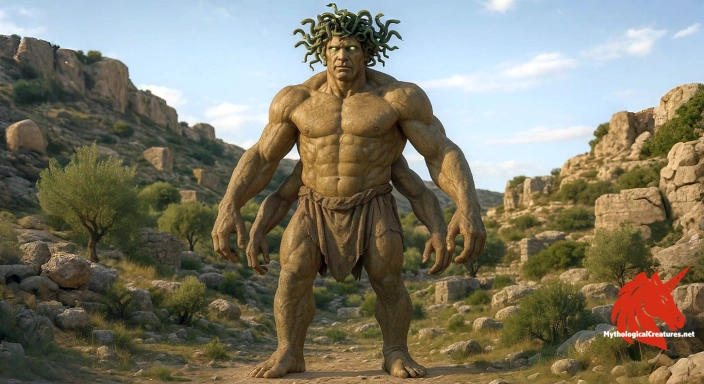
Visualisations often portray Alpos as an imposing colossus whose very presence reflects the endurance and potency of the Earth. His stature is described as monumental, with a robust physique that seems to echo the rough, unyielding terrain of Sicily itself. Ancient artistic renditions sometimes show his skin as textured like weathered stone or earthen clay, imparting him with a timeless, elemental quality. Broad shoulders and a formidable silhouette are common attributes, suggesting not only physical strength but also a deep connection with nature's vast resources. In many accounts, his eyes are imagined to gleam with an inner fire reminiscent of volcanic cores, symbolising the fervour seething beneath the surface of the Earth. Wild, untamed hair and a luxuriant beard are depicted in ways that hearken to the tangled roots and rich soil from which he was born. Adornments made of natural materials such as vines and leaves further highlight his inseparable bond with the natural world. Variations in his depiction sometimes reveal shifts in his size and muscularity, yet all portrayals underscore an awe-inspiring blend of physical might and an almost mystical serenity.
An alternative tradition presents a markedly different visage: here, Alpos emerges as a being of multiple arms, reminiscent of the ancient Hundred-Handed Ones of Greek cosmogony. In this rendering, his head teems with serpents rather than hair, a hundred vipers writhing where locks might be, evoking comparisons to the Gorgon Medusa. This version ascribes to him cosmic proportions and ambitions, a giant of such magnitude that he could reach upward to touch the Sun itself, draw down the Moon from its celestial path, and harass the very stars with his serpentine tresses. This portrayal emphasizes not earthbound power but rather a primordial challenge to the ordered heavens themselves.
What do different regions call Alpos?
The figure of Alpos underwent significant regional reinterpretation as his myth spread beyond the classical Greek heartlands into the rugged contours of Sicily and neighbouring territories. In local Sicilian oral traditions, he was celebrated as a protective spirit whose colossal form mirrored the sublime, unyielding character of the island’s environment. Some traditions infused his myth with local geological phenomena, associating him with the dramatic volcanic and mountainous landscapes of Sicily. In other regions, such as parts of Southern Italy and the broader Mediterranean basin, his character was adapted to reflect indigenous themes, melding Greek myth with local legendary motifs. Communities sometimes ascribed to him the role of a guardian whose battles with elemental forces symbolised the eternal struggle between nature and civilisation. Artistic depictions in these regions often integrated distinct local symbols, transforming Alpos into a composite emblem of both Greek myth and regional heritage. Such variations not only highlight the flexibility of myth but also illustrate how local cultures make ancient figures their own. Regardless of the differing narratives, all versions converge on a shared reverence for the giant as a living embodiment of the Earth’s majestic, indomitable force.
What parallels exist to Alpos in other traditions?
Alpos shares remarkable thematic commonalities with other colossal mythic beings found across diverse cultural traditions. Like his Greek counterparts among the Titans and giants, his birth from the Earth itself establishes a paradigm of nature personified and elevated to a divine status. Figures such as the Norse Jötunn or the Celtic Fomorians resonate with similar attributes of profound natural power and mysterious origins. The cross-cultural recurrence of giant beings suggests an archetypal narrative in which humanity grapples with the overwhelming forces of the natural world. Comparative reflections reveal that, despite variations in specific attributes, these giants often serve as primordial symbols of chaos, fertility, and the raw power of nature. In some traditions, the immense stature and elemental origins of such beings are utilised to illustrate the tenuous boundary between the mortal and the divine. Alpos, in particular, occupies a unique niche by merging the characteristics of a familial offspring of Earth with the broader mythological motif of titanic struggle. Such comparative analysis underscores the universal allure of mythic giants as enduring tests of human imagination and as metaphors for natural phenomena beyond human control.
Alpos: Then and Now
Over the centuries, the myth of Alpos has evolved from a localized Sicilian legend into a symbol resonant with broader themes of nature and the sublime. In early antiquity, his presence was modestly acknowledged as part of the sprawling genealogies that celebrated Earth’s earliest progeny. As classical literature was reassembled and reinterpreted through the ages, his myth became a subtle counterpoint to the dominant narratives of Olympian gods and titanic clashes. During medieval times, remnants of his lore surfaced in allegorical tales that emphasised the mystical interplay between man and the natural world. The Renaissance ignited a renewed fascination with ancient myths, leading to artistic and literary creations that reimagined Alpos’s formidable image for a modern audience. In contemporary cultural discourse, his figure has been embraced by movements seeking to reconcile humanity with the natural environment, portraying him as a guardian of ecological wisdom. Modern fantasy literature and visual arts have also drawn inspiration from his myth, using him to evoke the perennial awe of nature’s power. His narrative, replete with symbolic depth, continues to evolve as it is adapted to comment on today’s environmental and cultural challenges. In this light, Alpos stands not only as a relic of antiquity but also as a versatile emblem for the eternal dialogue between humanity and the Earth.
Interesting Fact
Alpos remains one of the lesser-known giants in Greek mythology, underscoring the diversity of mythic figures that emerged from ancient cultural lore.
Mythological Treasures
Greek Myths: A field guide to the monsters of ancient Greece
Every monster here earned its place in legend, and each gets a full page of artwork and the story behind it.
Egyptian Legends: A field guide to the gods and monsters of ancient Egypt
Guardians of the living and devourers of the dead, with the role each played in judgement.
Chinese Beasts: A field guide to the dragons and demon kings of Chinese myth
From river dragons to demon kings, with the legends that shaped five thousand years of storytelling.
the legend in five swipes.
Support the directory
Promote your myth project and fund more research
Sponsor placements help keep this directory growing and free to use while giving your work a focused, relevant audience.
Learn how sponsorship worksQuick Creature Info
Origin:
Features:
Associations:
Our Mythic Legendary Rating:

Habitat:
Supernatural Powers:
Physical Attributes:
Abilities:
Lore:
Related Creatures, Tales or Lore
References
Discover Another Mythical Legend You May Not Have Heard Of?
Uncover the mysteries of ancient folklore and expand your knowledge of legendary beings from cultures around the world.
Dare to Meet the Jenu....
The Mythological Creatures Book Series
Yokai, Greek, Norse, Egyptian & Chinese. Five illustrated field guides to the creatures the old stories either warned or told you about.
Curated by the Mythological Creatures Team
Series editor: Mythological Creatures Directory
Primary desk: Hellenic & Ancient Mediterranean Desk
(rev. November 2025)