
Angitia: Angitia is an ancient goddess of healing and magic, worshipped by the Marsi, Paeligni, and other Oscan-Umbrian peoples of central Italy.
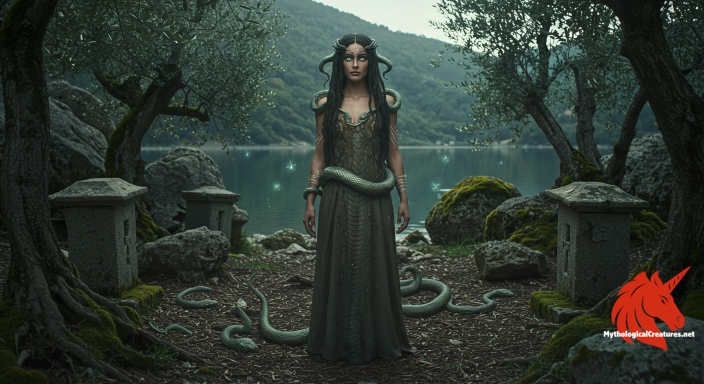
Angitia
Angitia - Central to the healing arts and revered by snake charmers; her cult reflects a blending of Italic and Greek traditions.
the legend in five swipes.
the legend in five swipes.
Angitia: How the Story Began
Angitia emerges as a luminous embodiment of ancient healing and magic, revered among central Italy's Oscan-Umbrian peoples. Her origin in the cultural tapestry of the Marsi and Paeligni infuses her story with both indigenous depth and transcultural reverence. Ancient inscriptions and mythic narratives attest to her long-established role as a mediator between the natural and the supernatural. She is reputed to have nurtured the art of healing snakebites, a practice that was as practical as it was mystical. Her divine presence was celebrated in sacred groves and temples, where communities sought her benevolence in times of distress.
Legends interweave her with prominent figures from Greek myth, suggesting familial ties to sorceresses such as Medea and Circe. The melding of Greek and Italic traditions in her myth reflects the dynamic cultural exchanges that flourished in ancient Italy. Her veneration by the Marsic legions and other groups underscores her significance in both civic and spiritual life. The healing and protective qualities attributed to her reveal a nuanced understanding of nature’s dualistic power. Overall, Angitia remains a compelling figure whose story continues to stimulate scholarly and cultural curiosity.
What are the earliest texts about Angitia?
Inscriptions and literary testimonies provide a rich matrix through which Angitia’s myth is preserved. Prominent among these sources are the inscriptions found at Luco dei Marsi, identified in antiquity as the Lucus Angitiae, or Sacred Grove of Angitia. An inscription dedicated on behalf of the Marsic legions dating from the late 4th century BC stands as an early testament to her local importance. Additional artefacts, such as a dedicatory cippus from Civita d'Antino and references in the Umbrian Iguvine Tablets, further attest to her widespread veneration.
Ancient authors like Gnaeus Gellius recounted variants of her myth, positioning her as one of the daughters of Aeëtes alongside Medea and Circe. Her story is also echoed by Servius and Silius Italicus, who offered alternative perspectives linking her identity directly with Medea. These literary sources illuminate her dual role as both a curative power and a progenitor of snake-charming traditions. Her name appears in multiple forms across different regions, including a pluralised form that hints at a possible multiplicity of local aspects. The layered nature of these texts and inscriptions suggests that her narrative was not fixed but rather evolved with the shifting tides of cultural interpretation. Together, these diverse sources construct a multifaceted portrait of Angitia as a goddess whose identity was as flexible as it was powerful.
How did the old accounts describe Angitia?
Although ancient artistic representations of Angitia are rare, imaginative reconstructions portray her as an enigmatic figure of refined beauty. She is often depicted with a dignified presence, her visage marked by sharp, perceptive eyes and a serene yet commanding countenance. Artistic impressions suggest that her flowing hair, frequently adorned with subtle serpent motifs, symbolises her deep connection to the natural world. Her attire might have been embellished with intricate patterns reminiscent of reptilian scales, blending both human elegance and otherworldly essence. Such depictions are thought to encapsulate the dual nature of her powers, balancing both the charm of healing and the peril of venom.
Some reconstructions propose a depiction of her with serpents coiled gracefully around her arms, serving as both protective agents and emblems of her mastery over snakes. Her physical form is rendered as both robust and ethereal, suggesting a body that embodies the fluidity and resilience of water. Iconographic elements frequently underscore a luminous skin and an almost mystic glow that highlights her otherworldly origins. The amalgamation of human and serpentine traits in her appearance symbolises the intimate relationship between life, death and regeneration. Overall, the visual tradition of Angitia, though fragmentary, conveys an image of divine strength, healing wisdom and a seamless bond with the serpentine forces of nature.
Where is the legend of Angitia strongest?
The myth of Angitia demonstrates remarkable regional diversity throughout the Italian peninsula. In the Marsi heartland, she is revered primarily as a healing deity whose powers extend to curing snakebites and other maladies. The sacred groves and temples dedicated to her in Marsic territories emphasise her role as a protector and intercessor in daily life. Communities in the Paeligni region attached a particular significance to her control over serpents, interpreting her as a guardian against the perils of nature. These local practices reflect a deep-seated belief in the curative interplay between the divine and the natural environment.
In Umbria and the central Apennines, her mythology absorbed Hellenistic influences, leading to a more complex divine narrative that intertwined with Greek sorcery. Roman interpretations, often etymologically linked to the word 'anguis' meaning serpent, further modified her character to suit contemporary religious expectations. Other Italic groups, such as the Sabines and Vestini, recorded her name in inscriptions that featured slight variations, indicating localised cult practices. These regional adaptations allowed her attributes to shift seamlessly between roles as a healer, a witch and a protective force. Consequently, the evolution of her myth across regions underscores the fluidity of ancient religious practices and the adaptability of divine iconography.
How does Angitia compare to figures in other traditions?
Angitia’s multifaceted nature invites comparison with several prominent deities of healing and sorcery across Mediterranean cultures. Her close association with serpents parallels the lore of Asclepius, whose rod entwined with a snake symbolises both danger and remedy. In a similar vein, her lineage and magical abilities resonate with the legendary narratives of Medea and Circe, revered for their transformative spells. Her status as an ancestral figure for snake charmers aligns her with figures in various cultures who are credited with the mastery over serpentine forces. This interplay between medicinal expertise and sorcery also draws a line of comparison with healing figures in neighbouring Italic traditions.
Classical themes of regeneration and transformation found in her myth echo the cyclic nature of many ancient deities who presided over life and death. Her narrative exists alongside broader European mythic structures where the snake often serves as a liminal creature bridging the mortal and divine realms. Comparative analysis highlights the nuanced roles of healing, protection and magic that characters in Greek and Italic myths typically exhibit. The interlacing of serpent symbolism in her iconography with those in other ancient cultures underscores a shared cultural language of mysticism. Ultimately, Angitia embodies a rich synthesis of mythological motifs that resonate with diverse traditions, offering insights into the universal appeal of transformative divine power.
Who tells the story of Angitia now?
Over the centuries, the legacy of Angitia has evolved in response to shifting cultural and religious landscapes in Italy. Her early role as a local goddess of healing and snake-charming gradually integrated into the broader framework of Greco-Roman myth. Roman reinterpretations modified her narrative by emphasising her connection to the word 'anguis' and aligning her with more familiar healing archetypes. In later periods, her cult receded from mainstream religious practice but continued to thrive in folklore and local tradition.
Modern scholarly interest in ancient Italic religions has revived attention to Angitia as a potent link to pre-Roman spirituality. Contemporary artists and writers often draw upon her myth to explore themes of transformation, healing and the mysterious interplay of nature and magic. Her emblematic association with snakes has inspired modern reinterpretations in art, literature and even new age spiritual practices. This continuity of influence reflects the enduring human fascination with figures who embody both danger and divine benevolence. Through continued exploration in academic research and popular culture, Angitia’s myth remains a vibrant testament to the complexity of ancient belief systems.
Interesting Fact
Angitia’s cult was so intertwined with the art of snake-charming that her followers claimed descent from her, highlighting the cultural reverence for serpentine elements in ancient healing practices.
Mythological Treasures
Greek Myths: A field guide to the monsters of ancient Greece
Every monster here earned its place in legend, and each gets a full page of artwork and the story behind it.
Japanese Yokai: A field guide to the spirits and demons of Japanese folklore
Fifteen spirits, with the signs to watch for and what the old tales say to do if you meet one.
Norse Sagas: A field guide to the beasts of the Viking world
Drawn from the saga accounts themselves, with the powers, weaknesses and doom of each being set out.
the legend in five swipes.
Reach myth fans
Connect your myth-driven brand with this audience
Our readers are writers, educators, gamers, and collectors who care about mythology. Enquire about a limited sponsor placement on creature pages.
Enquire about sponsorshipQuick Creature Info
Features:
Associations:
Our Mythic Legendary Rating:

Also Sometimes Known As:
Habitat:
Supernatural Powers:
Physical Attributes:
Abilities:
Behavior:
Lore:
Related Creatures, Tales or Lore
- MMedea
- CCirce
- HHygieia
References
Discover Another Mythical Legend You May Not Have Heard Of?
Uncover the mysteries of ancient folklore and expand your knowledge of legendary beings from cultures around the world.
Dare to Meet the Deva....
-8884ac19-2686-4a18-8ed7-e607f9309978_small.webp "Depiction of Deva")
The Mythological Creatures Book Series
Yokai, Greek, Norse, Egyptian & Chinese. Five illustrated field guides to the creatures the old stories either warned or told you about.

Curated by the Mythological Creatures Team
Series editor: Mythological Creatures Directory
Primary desk: Hellenic & Ancient Mediterranean Desk
(rev. November 2025)