
Deva: Deva in Jain texts refers to the heavenly beings that are born instantaneously without parents.
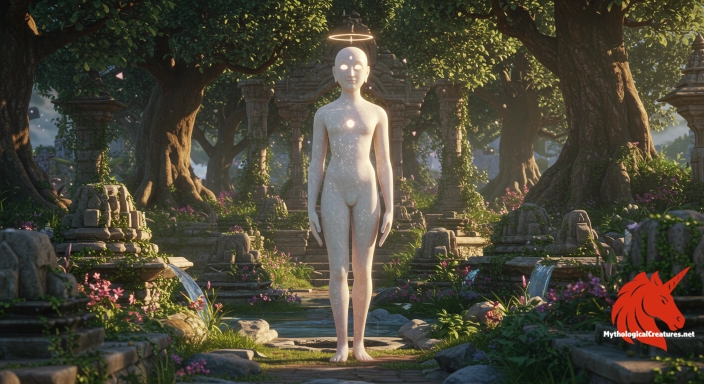
Deva
Deva - Represent a class of celestial beings with inherent clairvoyance, playing a key role in the cosmological structure of Jainism.
the legend in five swipes.
the legend in five swipes.
The Origin Story of the Deva
The term Deva occupies a central position in the rich tapestry of Jain cosmology, where it signifies both the exalted nature of heavenly beings and, in certain contexts, the revered Tirthankaras.
Its origins can be traced back to ancient Sanskrit literature, where early Jain texts first introduced these celestial figures as embodiments of both power and insight.
Early attestations of Deva in Jain tradition reflect an intricate interplay between the spiritual and the supernatural, highlighting their unique mode of birth and inherent clairvoyance.
These beings, emerging into existence without parental lineage, stand in stark contrast to ordinary mortals and even to other mythological entities such as the hell beings, known as naraki.
Culturally, the concept of the Deva underscores themes of impermanence and spiritual reward, resonating deeply with the Jain principles of karma and rebirth.
The dual application of the term—referring both to ethereal beings and, in some narratives, to spiritual guides—illustrates the flexibility and depth of Jain metaphorical language.
The portrayal of these celestial figures has evolved through centuries of oral and written tradition, adapting to changing spiritual and artistic sensibilities.
Through all these variations, the Deva remains a symbol of divine grace and the ephemeral nature of heavenly existence in the Jain worldview.
Deva: Manuscripts, Texts and Variants
Ancient Jain scriptures, including various Agamas and sutras, serve as the primary repository of narratives concerning the Deva.
In these texts, the celestial beings are often described as possessing avadhi jnana, a form of innate clairvoyance granted by their celestial birth.
Multiple Jain treatises elaborate on the mystical circumstances of their birth, emphasising the instantaneous nature of their emergence in specially prepared beds.
The textual tradition is replete with story variants that juxtapose the Deva with other radiant beings, occasionally overlapping with depictions of the Tirthankaras.
Some traditional accounts present these beings as ephemeral custodians of cosmic order, their existence tied to the fluctuations of karma.
Other texts offer a more allegorical portrayal, suggesting that the Deva embodies a transient form of divine energy destined to rise and fall with time.
This diversity in narrative sources reflects a longstanding dialogue among Jain scholars regarding the true nature of divine light and spiritual imminence.
Despite these variations, there is a consistent emphasis on their supernatural attributes and their critical role in the celestial hierarchy.
How would you recognise the Deva?
Visual representations of the Deva are marked by an ethereal beauty that sets them apart from mortal beings.
Traditionally, they are depicted with a luminous and serene countenance, often radiating a soft, almost imperceptible glow that hints at their spiritual nature.
Artistic renditions show these beings with slender, graceful forms and delicate features that reflect their elevated status.
Their attire is frequently illustrated with intricate patterns and flowing garments that seem imbued with a celestial sheen, enhancing their otherworldly allure.
In many traditional images, a halo or aura surrounds them, symbolising their connection to higher forms of knowledge and divine energy.
The mode of their birth—instantaneous and free of physical constraints—has inspired depictions where the Deva appears amidst an array of celestial motifs such as lotus blossoms and shimmering light.
Some portrayals also include subtle references to the transient nature of their physical form, reminding viewers of the impermanence that even divine beings must eventually face.
Across various artistic traditions, size and scale are employed symbolically, often portraying the Deva as both grand in stature yet delicately proportioned to emphasise their refined spiritual qualities.
Deva: One Legend, Many Local Versions
The representation of the Deva exhibits noteworthy regional diversity, reflecting local cultural influences and artistic traditions throughout the Indian subcontinent.
In northern regions, temple art often portrays these celestial beings with bold, vibrant colours and elaborate embellishments that echo the local cultural zest.
Conversely, in southern Jain communities, depictions tend to be more minimalist and serene, with an emphasis on subtle spiritual radiance rather than ostentatious ornamentation.
Local festivals in various parts of India sometimes incorporate the Deva in processions and ritual performances, each adapting the imagery to align with regional religious practices.
This regional embellishment not only enriches the iconography but also embeds the Deva within a broader cultural narrative that resonates with local audiences.
Artisans and storytellers have, over generations, introduced unique details—such as distinctive jewellery styles or specific flora in the background—that reflect the local milieu.
These adaptations help bridge the gap between the transcendent qualities of the Deva and the pragmatic sensibilities of regional worshippers.
Ultimately, the regional variations attest to the fluidity of mythological symbols, illustrating how a singular concept can be universally revered yet locally transformed.
What figures resemble the Deva?
The Deva finds interesting parallels with celestial beings in various mythological traditions around the world, illustrating a common human fascination with divine intermediaries.
In Hindu mythology, for instance, the term Deva is similarly applied to gods who govern natural and cosmic phenomena, though in Jainism the emphasis often shifts towards transient spiritual grace.
This duality can be contrasted with the angelic figures of Abrahamic religions, where messengers of divine will embody attributes of both guidance and moral oversight.
Mythologies across cultures frequently feature beings born without conventional parentage, echoing the Jain narrative of the miraculous, instantaneous birth of the Deva.
Like the immortal Olympian deities of ancient Greece, these beings are often portrayed as possessing supernormal powers, yet the Jain version focuses more on the impermanent nature of existence despite the celestial birth.
East Asian traditions, with their own pantheon of ethereal spirits and immortals, also provide a comparative framework, highlighting common themes of transcendence and mortality.
Each cultural tradition adapts the archetype to reflect its understanding of cosmic order, making the Deva a versatile symbol in comparative mythology.
In analysing these parallels, one appreciates how different societies negotiate the boundaries between the finite and the divine, using similar narrative motifs to explain the mysteries of existence.
Deva: Then and Now
The historical evolution of the Deva has witnessed a remarkable transformation from its early scriptural incarnations to modern cultural depictions.
Ancient icons have gradually been reinterpreted within the framework of contemporary spirituality, where the Deva now often symbolises inner enlightenment as well as cosmic order.
In traditional Jain art and temple architecture, the Deva continues to occupy a revered space, serving as a visual allegory for transient but sublime spiritual brilliance.
Modern reinterpretations, however, frequently imbue these celestial figures with additional layers of meaning, connecting them to broader dialogues on impermanence and the ethical consequences of karma.
Contemporary literature, cinema, and graphic novels explore these beings as metaphorical influencers in the quest for personal transformation and social justice.
The evolving portrayal reflects shifts in artistic style and a growing desire to humanise divine experience amidst modern existential challenges.
In academic and popular discourse alike, the Deva is celebrated as a timeless emblem, bridging the ancient and the modern through its persistent thematic richness and symbolic flexibility.
This dynamic legacy continuously invites new interpretations that resonate with the universal human quest for meaning and transcendence.
Interesting Fact
An intriguing aspect of Deva is their capacity for clairvoyance from the moment of birth, highlighting a unique divergence from typical biological reproduction and underscoring the mystical elements of Jain cosmology.
Mythological Treasures
Egyptian Legends: A field guide to the gods and monsters of ancient Egypt
Guardians of the living and devourers of the dead, with the role each played in judgement.
Chinese Beasts: A field guide to the dragons and demon kings of Chinese myth
From river dragons to demon kings, with the legends that shaped five thousand years of storytelling.
Japanese Yōkai: A field guide to the spirits and demons of Japanese folklore
Fifteen spirits, with the signs to watch for and what the old tales say to do if you meet one.
the legend in five swipes.
Support the directory
Promote your myth project and fund more research
Sponsor placements help keep this directory growing and free to use while giving your work a focused, relevant audience.
Learn how sponsorship worksQuick Creature Info
Our Mythic Legendary Rating:

Habitat:
Supernatural Powers:
Physical Attributes:
Lore:
References
Discover Another Mythical Legend You May Not Have Heard Of?
Uncover the mysteries of ancient folklore and expand your knowledge of legendary beings from cultures around the world.
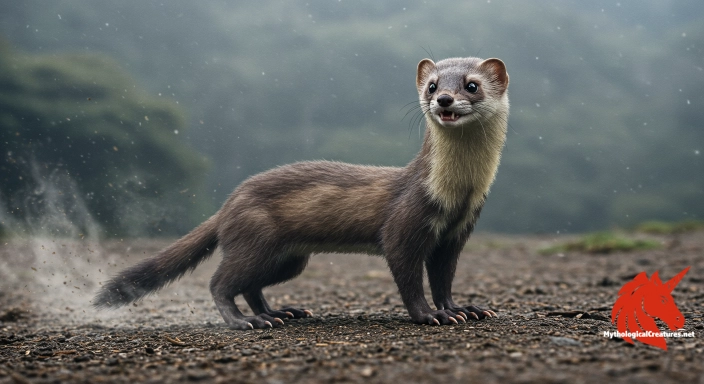
Dare to Meet the Kamaitachi....
The Mythological Creatures Book Series
Yōkai, Greek, Norse, Egyptian & Chinese. Five illustrated field guides to the creatures the old stories either warned or told you about.

Curated by the Mythological Creatures Team
Series editor: Mythological Creatures Directory
Primary desk: Asian & Pacific Myth Cycles Desk
(rev. November 2025)