
Azrael: Azrael is the archangel of death in Islamic and Jewish traditions.
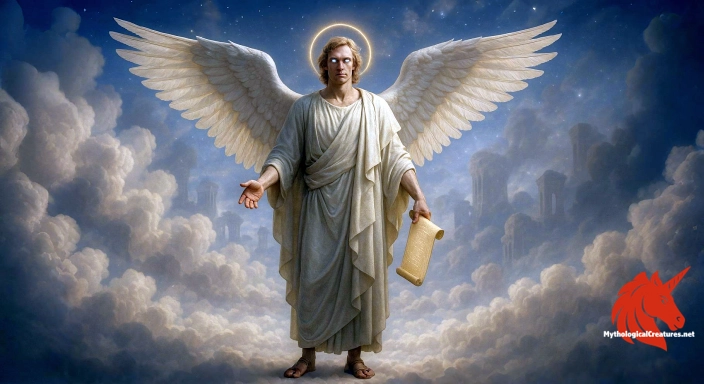
Azrael
Azrael - He is central to the understanding of death and the afterlife in Abrahamic traditions, recording the fate of mortals.
Origins & First Encounters
Azrael stands as one of the most compelling figures within the realm of divine emissaries, seamlessly bridging the worlds of life and the hereafter. His name, translating to ‘God has helped’, alludes to a benevolence that permeates even the most solemn aspects of existence. Emerging from ancient traditions, he first appears in early Islamic texts and apocryphal writings where he is entrusted with the delicate duty of transitioning souls. His role is defined not by cruelty but by compassion, as he is seen as a psychopomp rather than a mere harbinger of death. In both Islamic and Judaic thought, he is intrinsically linked to the mechanics of fate and destiny. The early attestations to his story are interwoven with cultural rituals surrounding mortality and the afterlife. His depiction reveals an intricate balance between divine justice and mercy, reflecting varied theological perspectives. Spiritual narratives often celebrate his gentle stewardship of souls, highlighting how even death is administered with care. Many traditions regard his task as not only inevitable but also sacred, inviting trust and reverence. Over the centuries, his story has evolved yet remains a pivotal symbol in discourses on mortality and transcendence.
Source Texts & Tale Variants
Ancient apocalyptic texts such as the Apocalypse of Peter provide one of the earliest windows into Azrael’s myth, emphasising his importance in the celestial order. Beyond this, Islamic tradition venerates him as an integral archangel whose responsibilities extend to the meticulous recording of mortal lives. Although the Quran does not name him explicitly, later exegetical works imbued him with a character that overlaps with the Quranic figure of Malak al-Mawt. Jewish literature offers parallel accounts where the Angel of Death, known as Malakh ha-Maweth, fulfills a similar role. Mystical and midrashic texts contribute varied narratives, each adding layers of symbolism to his duties. These sources blend legal, eschatological, and philosophical insights into the nature of life’s transition. Different translations and commentaries have led to multiple story variants, each coloured by the cultural milieu in which they were crafted. Versions of his tale stress either the inevitability of fate or the compassionate guidance provided to departed souls. In many readings, the act of recording and erasing names on a divine scroll underscores the meticulous and impartial nature of cosmic order. In this way, foundational texts have established a framework that continues to influence the way Azrael is understood in both religious and literary contexts.
Form & Powers
Descriptions of Azrael often focus on his ethereal quality and the air of quiet dignity that surrounds him. He is sometimes portrayed as an awe-inspiring figure cloaked in a radiant, otherworldly light that sets him apart from ordinary beings. His robes, depicted in a variety of traditional artworks, flow like living shadows, marked by intricate motifs that evoke celestial order and mystery. Some accounts suggest that his eyes hold a deep, reflective quality, mirroring the sorrows and hopes of the souls he encounters. His stature is variably described, at times appearing both immense and immaterial, a visual representation of the paradox of being everywhere yet unseen. In certain traditions the presence of softly glowing wings lends him an added measure of grace and swiftness in his solemn task. The visual narratives sometimes blend human features with divine attributes, symbolising the interstice between mortal frailty and supernatural duty. His overall depiction is designed to comfort as much as it warns, reinforcing the notion that the journey from life to the next is tenderly guided. Artistic interpretations over the centuries have oscillated between stark minimalism and intricate detail, each version echoing the timeless mystery of death. In every portrayal, however, the emphasis remains on a harmonious blend of majesty, compassion, and solemn responsibility.
Regional Faces
Across various cultural landscapes, Azrael’s character is adapted to reflect local perceptions of the afterlife and divine intervention. In Islamic regions, he is predominantly revered as one of the four archangels, serving a role that is both administrative and redemptive in nature. Middle Eastern interpretations often cast him as a resident of the Third Heaven, aligning him with esoteric visions of cosmic hierarchies. In contrast, Jewish narratives frame his presence within a context of ritual and law, where the recording of life’s moments is imbued with profound moral significance. Persian and Arab storytelling enrich his persona with lyrical depictions that blend sorrow with an underlying beauty of destiny. European apocryphal traditions, influenced by both Christian mysticism and ancient lore, occasionally portray him with elements reminiscent of the Grim Reaper, yet his compassion remains a defining trait. Sufi literature adds yet another layer, presenting him as a mirror to the soul’s inner journey through a process of purification and transcendence. Regional art and literature frequently incorporate local symbols, further tailoring his image to match indigenous spiritual narratives. Whether cloaked in the symbolism of Middle Eastern mysticism or the allegorical imagery of Europe, his purpose as a gentle guide remains universal. In each culture, the evolution of his narrative showcases a rich interplay between local beliefs and the overarching themes of life, death, and rebirth.
Cultural Parallels
The role assigned to Azrael finds intriguing parallels in mythologies from across the globe, each interpreting the passage between life and death in its own unique way. Greek mythology, for instance, introduces Thanatos, a personification of death whose silent presence underscores the inevitable transition from life. European folklore’s Grim Reaper shares visual similarities with Azrael, yet the latter is often depicted with an undercurrent of divine mercy rather than menace. In Eastern traditions, figures like Yama serve as custodians of the afterlife, adjudicating souls in manners that mirror Azrael’s meticulous recording of mortal deeds. Egyptian lore too brings forward deities such as Anubis who guide souls with a blend of stern duty and reverence. Despite cultural differences, a recurring motif remains the mediation between mortality and immortality, a task that Azrael performs with understated compassion. Some comparative narratives highlight that while other death deities evoke fear or finality, Azrael consistently embodies a peaceful passage. This contrast underscores distinct theological emphases, where death is not merely an end but a continuation of a grander cosmic cycle. Such cross-cultural connections encourage a broader understanding of death—not as an isolated phenomenon, but as an intrinsic, fated part of the human voyage. In bridging different mythologies, Azrael’s character serves as a testament to the universal contemplation of life’s impermanence and the hope that follows.
Legacy & Modern Evolution
The figure of Azrael has undergone a significant evolution from ancient religious texts to modern portrayals in art and literature. Over time, his depiction has shifted from a purely fearsome agent of death to a more nuanced symbol underscoring the gentle passage between worlds. Medieval mystics expanded upon early accounts, infusing his role with layers of ethical and philosophical depth that resonate with contemporary audiences. In modern narratives, films, novels, and visual arts often present Azrael as a reflective mediator whose actions are imbued with both gravity and empathy. Contemporary interpretations tend to emphasise his calm, caring presence as a counterbalance to the ever-present mystery of mortality. His image has been reimagined to align with modern existential questions, blending traditional religious iconography with a more personal, almost human touch. Discussions in popular culture now frequently highlight his role as a necessary enforcer of cosmic balance, inviting debates about fate and free will. The ongoing reinterpretation of his myth demonstrates how ancient themes can adapt to the modern psyche, nurturing a dialogue between the mystical past and present-day sensibilities. His enduring legacy in literature and art provides both comfort and a stark reminder of the universal truths that bind all human experience. Even as new generations redefine what it means to face the unknown, Azrael remains a symbol of the inevitable, yet tender, transition from life to what lies beyond.
Interesting Fact
An intriguing aspect of Azrael is how his name and function traverse cultural boundaries, being acknowledged in both Islamic and Jewish traditions as a benevolent guide in the journey beyond life.
Advertising opportunity
Showcase your mythology project
We offer limited sponsor placements for books, courses, games, and creators aligned with our audience.
View partnership optionsQuick Creature Info
Origin:
Associations:
Our Mythic Legendary Rating:

Also Sometimes Known As:
Habitat:
Supernatural Powers:
Physical Attributes:
Abilities:
Behavior:
Lore:
References
Discover Another Mythical Legend You May Not Have Heard Of?
Uncover the mysteries of ancient folklore and expand your knowledge of legendary beings from cultures around the world.
Dare to Meet the Hamadryad....

Curated by the Mythological Creatures Team
Series editor: Mythological Creatures Directory
Primary desk: Hellenic & Ancient Mediterranean Desk
(rev. November 2025)