
Bushyasta: Bushyasta is the Zoroastrian daeva of sloth, known as 'the long-handed'.
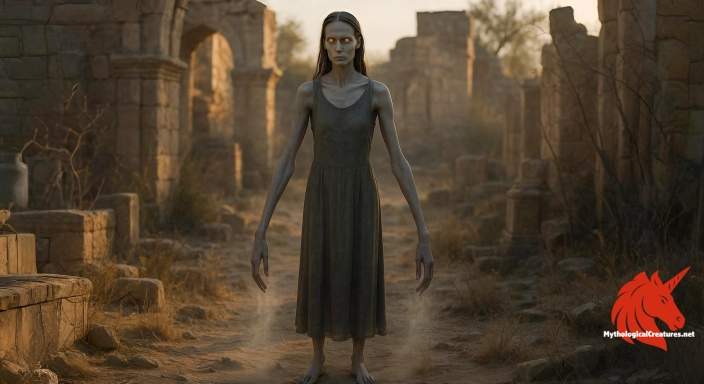
Bushyasta
Bushyasta - Bushyasta highlights the dangers of laziness and the neglect of religious duties in Zoroastrian ethics.
the legend in five swipes.
the legend in five swipes.
Bushyasta: First Encounters and Early Records
Bushyasta emerges as a striking persona amid the complex cosmology of Zoroastrian demonology, embodying the corrosive force of laziness and procrastination. Her origins are traced back to ancient Avestan texts, where her brief yet potent portrayal hinted at deeper moral allegories. The demon is renowned by the stock epithet ‘the long-handed,’ a title that intimates both her physical and metaphorical ability to reach into the lives of the devout. Early attestations of her character illustrate a figure set against the vigorous demand for spiritual and productive activity, symbolising the seductive ease of inaction. The texts suggest that her presence serves as a caution against the moral decay that accompanies idleness. In a belief system deeply concerned with the cosmic struggle between good and evil, she personifies the internal challenges faced by those striving for ethical rectitude. Her myth is interwoven with the broader narrative of ascetic discipline, where every lapse in vigour carries significant existential repercussions. Over time, her identity has become emblematic of the constant tension between spiritual diligence and the allure of lethargy, reflecting universal human concerns with perseverance and productivity. Her enigmatic role continues to provoke reflection on the nature of procrastination as both a personal fault and a metaphysical threat.
Bushyasta: The Written Sources
Ancient liturgical texts and oral traditions provide the primary foundation for understanding Bushyasta, with her earliest mentions found in the Avesta. The sparse yet impactful descriptions within these scriptures emphasise her function as a daemon of sloth that undermines the faithful. Middle Persian compositions later expanded on her symbolism, often referring to her as Bushasp and attributing to her a capacity to sap the energy of even the most devout. Various translations and marginal commentaries over the centuries have attempted to capture her elusive character, even if narrative details remain relatively thin. In the limited scriptural passages, she is portrayed as a catalyst for moral decline by fostering procrastination and forgetfulness. The fragmentary nature of her documentation has inspired scholars and storytellers alike to fill in the gaps with allegorical interpretations. Oral folklore, in particular, has enriched her mythos by highlighting her role in lulling the world into a state of superficial sleep. Diverse communities have adapted these accounts to serve as warnings against the perils of indolence, interweaving her image with broader moral lessons. Collectively, these sources reinforce her representation as a pivotal, if enigmatic, counterforce to the energy and commitment required by a righteous life.
What could Bushyasta do?
The physical representation of Bushyasta is dominated by her infamous epithet, ‘the long-handed’, which serves as the most vivid aspect of her iconography. Artistic renditions consistently depict her with arms that extend unnaturally far, symbolising the far-reaching impact of laziness in impeding human endeavour. Her overall form is often portrayed as spectral and indefinable, mirroring the insidious nature of sloth that can sabotage vigour unexpectedly. Some illustrations capture her with a downcast, languid gaze and a drooping countenance that hints at her inherent torpor. She is sometimes clothed in flowing, tattered robes that blend into the shadows, evoking an aura of decay and neglect. The elongated hands are not merely physical oddities but also serve as visual metaphors for the slow, creeping paralysis of effort and initiative. Variations in her depiction range from a monstrous, imposing figure to a more subtle, almost whisper-like presence, each interpretation underscoring different aspects of inactivity. Her visage is frequently rendered with ambiguous features that combine both menace and melancholy, inviting the observer to consider the duality of lethargy. Such portrayals ultimately reinforce her status as a potent symbol of the paralyzing effects of idleness, serving as a constant reminder of the vital need for action.
How does Bushyasta differ by region?
The myth of Bushyasta has travelled well beyond the confines of early Zoroastrian scripture, adapting to diverse cultural landscapes across Persia and Central Asia. In various regional traditions, her core attributes of inducing laziness and procrastination have been preserved even as local storytellers add their own nuances. In Iranian folklore, for example, she is sometimes intermingled with other spirits associated with the night and sleep, concretising her presence in everyday moral narratives. Artistic traditions in these regions have reimagined her long limbs as symbols not only of moral failing but also of the mysterious forces at work in the natural world. In some communities, her myth has been adapted into parables that caution against subtly succumbing to the allure of inactivity. Persian miniature artists have often portrayed her with delicate, flowing forms that both fascinate and unsettle the viewer. Regional adaptations also highlight her role as a personification of internal struggle, with local customs using her story as a didactic tool for overcoming laziness. In certain parts of Central Asia, rituals and moral tales that invoke her serve to inspire diligence and alertness among the faithful. These adaptations ensure that while her origins remain firmly within the Zoroastrian canon, her embodiment of sloth continues to resonate across multiple cultural traditions, reflecting local attitudes toward industriousness and spiritual discipline.
How does the Bushyasta legend compare worldwide?
Bushyasta occupies a distinctive position not only within Zoroastrian lore but also alongside comparable figures found in other cultural and religious traditions. Similar to the personifications of sloth in various mythologies, her character resonates with the universal human preoccupation with overcoming the inertia that thwarts progress. In many Western traditions, the notion of sloth as a deadly sin has been encapsulated in allegories that, while not as vividly personified, evoke the same unsettling sentiment that Bushyasta inspires. Across Eastern philosophies, too, there are manifestations of lethargic forces that act as obstacles on the path to enlightenment, echoing her role as a deterrent to purposeful action. Such comparisons highlight the cross-cultural recognition of inaction as a formidable adversary to both spiritual and worldly success. Like other demonic figures that embody destructive human traits, she is a personification of internal challenges rather than external threats. Comparative narratives also reveal that while the textual details may differ greatly, the symbolic warnings against complacency are remarkably consistent. In bridging these mythological landscapes, one sees that Bushyasta is not an isolated anomaly but part of a broader tapestry that utilises allegorical beings to warn against the stagnation of the spirit. This universality further underscores the enduring appeal of her figure as an embodiment of the age-old battle between motivation and indecision. Through such analogies, her demonic form speaks to a shared human experience of struggling with the lure of inactivity.
Bushyasta: The Modern Legacy
Over the centuries, the depiction of Bushyasta has evolved from a narrowly defined demon in ancient scripture to a multifaceted symbol employed in modern moral discourse. Initially, her character served an explicit didactic purpose—to warn devotees of the corrosive effects of laziness. As artistic traditions matured, her image was reinterpreted in various media, each version emphasising different aspects of the malaise associated with inaction. In more recent times, literary and artistic works have reimagined her as a metaphor for modern procrastination, reflecting societal anxieties about stagnation and lost productivity. Contemporary interpretations occasionally imbue her with a tragic dimension, suggesting that the forces of lethargy are as much internal and psychological as they are supernatural. Modern Zoroastrian communities and scholars, while upholding her traditional warnings, also explore her as an allegory for the broader challenges faced in an increasingly distracted world. The evolution of her image parallels broader shifts in cultural attitudes towards productivity, with her legacy serving as a cautionary emblem against both personal and communal inertia. As academic and popular interest in myth and metaphor continues to grow, Bushyasta remains a compelling figure whose story is frequently revisited and reanalysed. Current artistic endeavours, from gallery exhibitions to digital media, have taken liberties with her portrayal, blending classical elements with contemporary critique. Such reimaginings underscore her timeless relevance, as she persists as a symbol of the perpetual struggle between dynamic vitality and the seductive pull of idleness. Thus, Bushyasta endures in the collective imagination as a layered reminder of the enduring battle against the habitual traps of procrastination.
Interesting Fact
Bushyasta is one of the few explicitly named daevas in Zoroastrian scriptures, underscoring how deeply the concept of sloth was intertwined with spiritual discipline in ancient Persia.
Mythological Treasures
Egyptian Legends: A field guide to the gods and monsters of ancient Egypt
Guardians of the living and devourers of the dead, with the role each played in judgement.
Chinese Beasts: A field guide to the dragons and demon kings of Chinese myth
From river dragons to demon kings, with the legends that shaped five thousand years of storytelling.
Japanese Yōkai: A field guide to the spirits and demons of Japanese folklore
Fifteen spirits, with the signs to watch for and what the old tales say to do if you meet one.
the legend in five swipes.
Partner with us
Sponsor this space
Reach thousands of mythology enthusiasts with a curated placement on our creature pages.
Learn about sponsorshipQuick Creature Info
Origin:
Features:
Our Mythic Legendary Rating:

Also Sometimes Known As:
Habitat:
Supernatural Powers:
Physical Attributes:
Abilities:
Behavior:
Lore:
Related Creatures, Tales or Lore
- AAcedia
- BBelphegor
- SSloth Demon (from Christian tradition)
References
Discover Another Mythical Legend You May Not Have Heard Of?
Uncover the mysteries of ancient folklore and expand your knowledge of legendary beings from cultures around the world.
Dare to Meet the Rougarou....

The Mythological Creatures Book Series
Yōkai, Greek, Norse, Egyptian & Chinese. Five illustrated field guides to the creatures the old stories either warned or told you about.



Curated by the Mythological Creatures Team
Series editor: Mythological Creatures Directory
Primary desk: Hellenic & Ancient Mediterranean Desk
(rev. November 2025)