
Ceasg: The ceasg is a Scottish mermaid with the upper body of a woman and the tail of a young salmon.
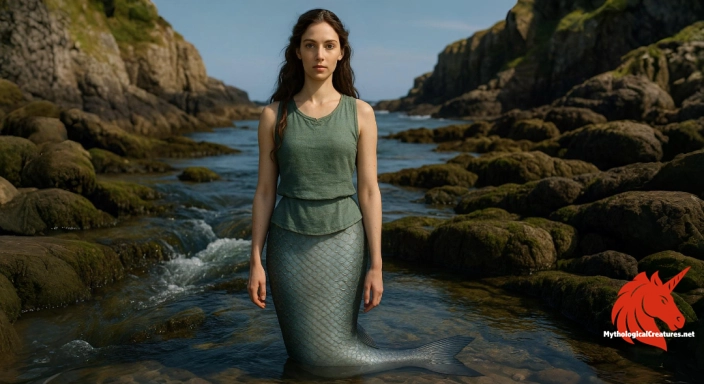
Ceasg
Ceasg - Represents the dual nature of the sea as both a giver of life and a force of destruction, and may echo ancient practices of sea deity worship
Origins & First Encounters
The ceasg is a striking figure in Scottish folklore, blending the allure of a beautifully formed woman with the elemental vitality of a young salmon. Born of oral tradition, she has long been revered as both maighdean na tuinne and maighdean mhara, titles that capture her unique dual existence in both the sea and the freshwater streams. Her mythic presence is rooted in ancient coastal communities, where the unpredictable might and benevolence of the sea were both celebrated and feared. Over the centuries, narratives of the ceasg have evolved to mirror the human fascination with the natural world, imbuing her with the power to grant three wishes to those able to capture her. Many tales record her involvement in unions with mortal men, bestowing a legacy upon families who benefit from her supernatural guidance. The ceasg’s dual role as a nurturer and a formidable entity underscores the precarious balance between beauty and danger. Early attestations present her as a mystical embodiment of the natural order, one that brings fortune yet demands respect from those who dwell by the waters. Her legend, interwoven with themes of fate, transformation, and the capriciousness of nature, continues to be an integral part of Scotland’s cultural narrative. In modern retellings, she remains a symbol of nature’s dual capacity for both kindness and retribution.
Source Texts & Tale Variants
Ancient storytellers and coastal chroniclers first set the ceasg’s legend among the oral traditions of Scotland, preserving her deeds through generations of recitations. Early manuscripts and folklore compilations capture her as both a beneficent wish-granter and a fearsome force capable of danger when spurned. Diverse narrative threads recount episodes where she forms a bond with humanity, sometimes through marriage, and other times through acts of ruthless hunger. In one variant, a hero is swallowed whole, yet manages to survive inside her mysterious belly until a clever intervention secures his release. Other versions portray her as offering profound magical gifts to those who corner her, a promise that underscores her capricious nature. The layered narratives illustrate how her character can oscillate between nurturing protector and relentless predator, reflecting the dual edge of the natural world. Folkloric accounts also intertwine her destiny with that of human families, as maritime pilots and fishermen claim descent from unions with this alluring mermaid. The ceasg appears in a multitude of story variants collected in diverse local traditions, each variant offering its own unique embellishments to her mythos. Her enduring place in folklore underscores the adaptability and expansive reach of these oral traditions as they navigate between benevolence and the monstrous.
Form & Powers
The ceasg is envisaged as possessing the beguiling upper torso of a woman, complete with delicate features and flowing hair that evokes the shimmer of sunlight on water. Her graceful countenance is matched by the powerful, scaled tail of a grilse, which is said to glisten in hues of silver and ocean blue. Details in the folklore emphasise her luminous, almost ethereal skin where human flesh merges seamlessly into piscine anatomy. Varying accounts attribute to her a subtle iridescence that shifts with the movement of the tides, hinting at an otherworldly quality. The fluid design of her form has often been interpreted as a metaphor for the ever-changing nature of water itself, simultaneously gentle and unpredictable. In some renditions, the ceasg is portrayed with a more imposing stature, blending formidable strength with arresting beauty. Her eyes, often described as deep and reflective, evoke both compassion and sorrow, bearing the weight of ancient maritime wisdom. Minutiae such as the delicate contours of her hands and the streamlined form of her lower body underscore her bridge between human intimacy and the functional design of aquatic life. Throughout different retellings, slight modifications in her physical depiction serve to reinforce her mercurial character and enigmatic origins.
Regional Faces
The ceasg’s legend finds a rich diversity of interpretation across Scotland, where each region imbues her with distinctive characteristics reflective of local seafaring cultures. Along the rugged coastlines and in the secluded lochs, variations of her tale emphasise her connection to both rugged natural beauty and the perils of the sea. In the Gaelic-speaking regions, she is affectionately known as the maid of the wave, a title that suggests both elegance and a close kinship with the ever-winding tides. In contrast, some inland communities portray her as a more fearsome entity, where the ceasg becomes an omen of impending storms and unpredictable river floods. Regions with deep fishing traditions often celebrate her as a benevolent ancestor, crediting her with the secret to abundant catch and safe passage through treacherous waters. Rural narratives may include the motif of three granted wishes, symbolising hope and the mysterious workings of fortune. Coastal superstitions, meanwhile, have elevated her to the status of a guardian spirit whose favour is sought by those whose lives depend upon the mercy of the ocean. These varied regional adaptations illustrate how the ceasg’s myth can simultaneously reflect local environmental challenges while uniting communities in shared maritime lore.
Cultural Parallels
The ceasg is part of a broader tapestry of mermaid and water spirit legends found both within and beyond the British Isles. Her dual nature recalls similar figures in Scandinavian tales, such as the Havfrue, who straddles the boundary between human allure and aquatic mystery. Across Europe, mythic beings that blend captivating human traits with the wild power of water are common, yet the ceasg remains distinct in her salmon-like tail and the intimate folklore of Scottish waterways. In some ways, the ceasg also mirrors the sirens of ancient Greek lore, whose enchanting qualities often bordered on the perilous. Although sirens are typically associated with seduction and doom, the ceasg’s narratives offer layers of benevolence and protection alongside her darker, more monstrous aspects. Other comparative myths include the Irish mermaid legends, which also reflect themes of inter-species unions and the bestowment of supernatural gifts. Each of these cultural parallels highlights the recurring human endeavour to personify the powerful forces of nature in both nurturing and enigmatic ways. The ceasg, with her nuanced depictions, thus stands as a compelling counterpoint to other water deities, engaging with a universal motif that bridges the natural and the supernatural. Her story, while uniquely Scottish, resonates with a pan-European fascination for the mystery and might of the waters.
Legacy & Modern Evolution
Over time, the depiction of the ceasg has evolved from ancient sea goddess to a multifaceted folkloric figure embodying both charm and terror. Early iterations of her myth often emphasised her divine status, with rituals and sacrifices hinting at her primordial role in shaping life along the maritime edges of Scotland. As narratives became more layered, she emerged as a figure capable of bestowing blessings and curses, a duality that has long intrigued those who dwell in coastal communities. Modern reinterpretations in literature and visual arts often portray her as a symbol of the ocean’s unpredictable temperament and as an emblem of nature’s inherent power. The motifs of granted wishes and prophetic unions have been reassessed in contemporary folklore, serving as metaphors for fate and the intertwining of human destiny with natural forces. In modern media, the ceasg appears in fantasy novels and films, where her enigmatic aura is reimagined to suit the evolving aesthetic sensibilities of new audiences. Maritime pilots and seafarers continue to invoke her legacy, preserving an ancestral bond that bridges myth with the practical challenges of life at sea. As environmental narratives gain prominence, she has also been embraced as a symbol of the delicate balance between human endeavour and the natural world. The ceasg’s journey from revered deity to complex folkloric icon illustrates the dynamic evolution of myth in response to shifting cultural landscapes.
Interesting Fact
Unlike typical mermaid legends that confine these beings to the open ocean, the ceasg bridges both freshwater and marine environments, and her myth may be a vestige of ancient sea deity worship in Scottish culture.
Reach myth fans
Connect your myth-driven brand with this audience
Our readers are writers, educators, gamers, and collectors who care about mythology. Enquire about a limited sponsor placement on creature pages.
Enquire about sponsorshipQuick Creature Info
Associations:
Our Mythic Legendary Rating:

Also Sometimes Known As:
Habitat:
Supernatural Powers:
Physical Attributes:
Abilities:
Behavior:
Weaknesses:
Lore:
References
Discover Another Mythical Legend You May Not Have Heard Of?
Uncover the mysteries of ancient folklore and expand your knowledge of legendary beings from cultures around the world.
Dare to Meet the Myrmecoleon....

Curated by the Mythological Creatures Team
Series editor: Mythological Creatures Directory
Primary desk: Northern & European Folklore Desk
(rev. November 2025)