
Chang'e: Chang'e is the revered Moon Goddess of Chinese mythology, renowned for her beauty and timeless presence.
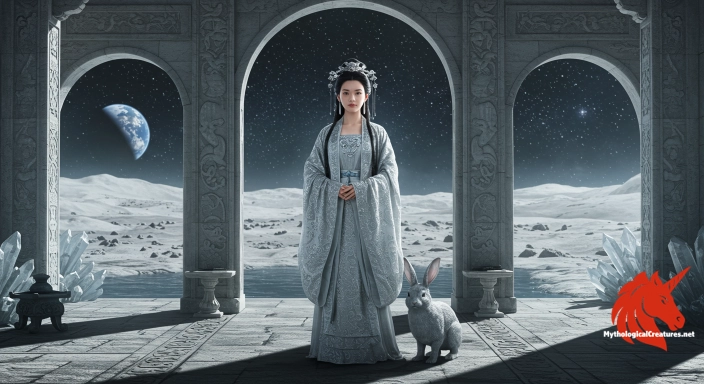
Chang'e
Chang'e - Chang'e is a central figure in Chinese lunar mythology and symbolizes immortality and beauty.
Origins & First Encounters
Chang'e stands immortal as one of the most celebrated lunar deities in Chinese myth, radiating timeless allure and mystery. Her origins are deeply entrenched in ancient narratives that have evolved over millennia, intertwining elements of love, loss, and celestial destiny. Initially known as Heng'e, she underwent a transformation both in name and essence, reflecting the dynamic nature of Chinese myth and its adaptation through time. In early legends, her union with the heroic archer Hou Yi not only underscored themes of romance but also symbolised the bridging of the mortal and divine realms. The tale of her ascension to the Moon, accompanied by her pet Moon Rabbit, imbues her story with both wonder and sorrow. Her myth forms a cornerstone in traditions spanning Chinese folk religion, Buddhism, Taoism, and Confucianism, where she is revered as an emblem of beauty and sacrifice. The legend has been woven into the fabric of community celebrations, most notably the Mid-Autumn Festival, which venerates the luminous mystery of the lunar realm. Her enduring appeal continues to inspire art, literature, and cultural practices, serving as a reminder of the eternal dialogue between heaven and earth. Chang'e’s narrative remains as compelling in the modern era as it was in ancient times, encapsulating the timeless human fascination with the moon.
Source Texts & Tale Variants
Ancient records and literary works preserve a diverse array of accounts detailing Chang'e’s extraordinary life and celestial journey. Canonical texts and mythological compendia have enshrined her narrative as a pivotal element of Chinese folklore, ensuring her presence in the collective cultural memory. Multiple story variants describe her fateful consumption of an elixir of immortality, each version adding nuanced layers to her character and destiny. Some renditions cast her as a reluctant guardian of immortality, while others portray her as an empowered sovereign of the lunar realm. Oral traditions and popular ballads further enriched her myth, weaving her tale into local and regional celebrations. The literary tradition, expressed in classical poetry and dramatic operas, has continuously reshaped her story to reflect evolving cultural values. Artistic depictions in ancient paintings resonate with these enduring themes, marrying visual splendour with narrative depth. The interplay between official annals and folk traditions underscores the mutable nature of her myth, as successive dynasties reinterpreted her role in society. Each variant reinforces the complexity of her character, ensuring that her myth remains a dynamic emblem within Chinese cultural heritage.
Form & Powers
Chang'e is typically rendered with an ethereal grace that captivates the eye and stirs the imagination. Her almond-shaped eyes are often depicted with a hint of melancholy, suggestive of a deep inner world wrought with both joy and sorrow. The goddess is commonly shown with porcelain-like skin that seems to glow softly under the silver light of the moon. Flowing, silky hair cascades around her shoulders, frequently adorned with delicate ornaments that echo traditional lunar motifs. Her attire is depicted in sumptuous, flowing garments that blend soft pastels with intricate embroidery, evoking the gentle luminescence of night skies. Classical artworks capture her in robes that mimic the phases of the moon, enhancing her image as a creature of both beauty and mystery. Artists frequently employ a subtle interplay of light and shadow around her form, creating an impression of both fragility and strength. The choice of colours—soft blues, silvers, and occasional hints of gold—reinforces her divine status and celestial origin. In some portrayals, a trace of wistful yearning is apparent in her expression, a poignant reminder of the sacrifices embedded in her myth.
Regional Faces
Across the diverse landscape of Chinese cultural traditions, the myth of Chang'e has been adapted in ways that reflect local beliefs and wilderness settings. In the northern regions, her narrative is often interwoven with wintry imagery and the crisp beauty of a clear, frost-kissed night, reinforcing her association with the luminous cold of the moon. Conversely, in southern China, local folklore sometimes emphasises her role as a guardian of fertility and prosperity, linking her celestial presence with the rhythms of agricultural life. The Jiangnan region, with its lush landscapes and poetic heritage, has its own cherished variations that portray her as a compassionate figure guiding human fortunes. In Taiwan and parts of Southeast Asia, her legacy is celebrated in folk dances and festivals that incorporate indigenous elements, merging classical myth with regional colour. Village celebrations and operatic performances reveal subtle local adaptations, such as unique stylistic adornments and slightly altered narrative details. In some local traditions, temples and community shrines honour her as a helper in times of both hardship and celebration. These regional renditions underline the flexibility of her myth, as each community reshapes her image to mirror its unique cultural context. The rich tapestry of these variations ensures that Chang'e remains a vibrant and enduring presence in the collective memory of diverse Chinese-speaking communities.
Cultural Parallels
Chang'e’s luminous narrative finds intriguing parallels in mythologies from around the world, creating a bridge between seemingly disparate cultural traditions. Her story shares similarities with the Greek lunar deity Selene, who, like Chang'e, embodies the ethereal beauty and mystique of the night sky. While Selene is often celebrated for her radiant journey across the heavens, Chang'e’s tale is imbued with both the brilliance of celestial light and the poignant undercurrents of mortal sacrifice. Comparisons can also be drawn with Japanese lunar motifs, where deities like Tsukuyomi similarly capture the delicate balance between the human and the divine. Both Eastern and Western lunar myths articulate the universal human fascination with the changing phases of the moon, which symbolise transformation, endurance, and renewal. Cultural expressions in art and literature often highlight these thematic resonances, emphasising a shared symbolic language that transcends geographical boundaries. Through such comparisons, the figure of Chang'e emerges not merely as a local deity, but as a part of a broader global tapestry of lunar worship and symbolism. Despite differences in narrative details and cultural context, her myth and those of her counterparts evoke enduring questions about beauty, destiny, and the celestial order. These cross-cultural connections enrich our understanding of how diverse civilizations interpret the profound mystery of the moon.
Legacy & Modern Evolution
Over the centuries, the portrayal of Chang'e has evolved from a mythic figure of tragic beauty to a modern cultural icon resonating with multiple generations. Early narratives cast her as a figure of noble sacrifice, whose personal loss and celestial ascension evoked deep philosophical meditations on immortality and human frailty. As dynastic eras changed, her image was continually reshaped in art, literature, and theatre, reflecting the shifting values and aesthetic sensibilities of the times. The Mid-Autumn Festival, now a vibrant celebration across Chinese communities, has ensured her legend remains woven into the fabric of cultural identity. In recent decades, her name and image have been embraced in new contexts, such as the Chinese Lunar Exploration Program, linking ancient myth with modern scientific ambition. Contemporary portrayals in film, television, and visual arts continue to explore the delicate interplay between her ethereal beauty and the poignant themes of exile and yearning. Modern reinterpretations have also imbued her story with a sense of empowerment, reimagining her not just as a tragic figure but as a symbol of resilience and transcendence. Her myth serves as a bridge between the ancient and the modern, inviting dialogue between traditional narratives and contemporary aspirations. The transformation of Chang'e from a classical goddess to a multifaceted emblem of cultural pride underscores her enduring legacy in a rapidly changing world.
Interesting Fact
Chang'e's legacy bridges ancient mythology and modern science, with the Chinese Lunar Exploration Program named in her honour.
Partner with us
Sponsor this space
Reach thousands of mythology enthusiasts with a curated placement on our creature pages.
Learn about sponsorshipQuick Creature Info
Associations:
Our Mythic Legendary Rating:

Also Sometimes Known As:
Habitat:
Supernatural Powers:
Physical Attributes:
Abilities:
Behavior:
Lore:
References
Discover Another Mythical Legend You May Not Have Heard Of?
Uncover the mysteries of ancient folklore and expand your knowledge of legendary beings from cultures around the world.
Dare to Meet the Zmeu....

Curated by the Mythological Creatures Team
Series editor: Mythological Creatures Directory
Primary desk: Asian & Pacific Myth Cycles Desk
(rev. November 2025)