
Dormarch: Dormarch is a mythological hound from Welsh folklore, used by hunters for tracking game.
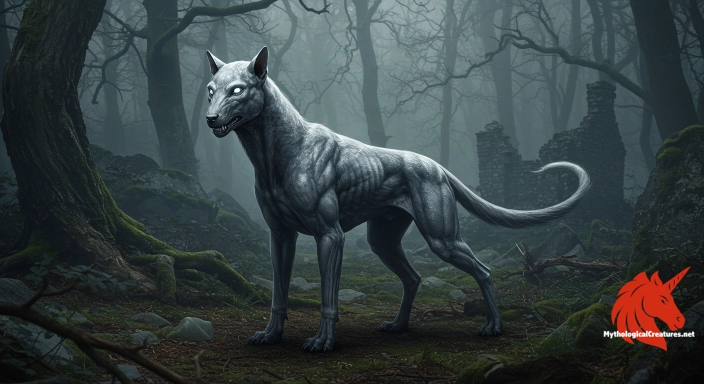
Dormarch
Dormarch - Dormarch is a significant mythological creature linking the natural and supernatural worlds, symbolising the passage from life to the afterlife through its association with the Wild Hunt.
the legend in five swipes.
the legend in five swipes.
Dormarch Origins: The Earliest Accounts
Dormarch emerges as a captivating embodiment of ancient Welsh lore, its mythic presence entwined with both the natural world and the realm of the supernatural. Born from the rich milieu of Celtic traditions, this mystical hound was reputedly used by hunters to track elusive prey while simultaneously serving as a bridge between mortal existence and a world beyond. Its early narrative is interwoven with the legacy of Gwynn ap Nudd, a sovereign of the otherworldly Tylwyth Teg and the ethereal Annwn, thus enriching Dormarch’s inherent significance. The creature’s mythic origins can be traced back to an era when oral traditions and royal patronage, such as that of King Maelgwn Gwynedd, played pivotal roles in immortalising its legend. Dormarch’s character encapsulates the duality of being both a loyal companion in the hunt and a spectral guide leading souls from the battlefield to the afterlife. This hound not only exemplifies the intimate connection between fauna and the mystical in ancient Welsh culture but also symbolises the eternal interplay of life and death. Its fabled existence underscores a period when the natural and the supernatural were seen as entwined, reflecting the depth of cultural and spiritual allegory. The enduring appeal of Dormarch continues to inspire a sense of wonder and reverence for the delicate balance between the tangible and the ethereal.
Who wrote down the legend of Dormarch?
The primary sources chronicling Dormarch are etched into the fabric of medieval Welsh folklore and later folkloristic compilations. Although direct mentions of Dormarch in ancient manuscripts are few, its presence is implicitly felt in texts that celebrate the lore of Gwynn ap Nudd and the spectral Wild Hunt. Early medieval records, intermingled with oral tradition, weave the tale of this hound into narratives that also recount the deeds of legendary kings and faerie lords. Variants of the story proliferated in local ballads and folklore, each adding layers of nuance and mystery to the creature’s character. Some accounts, preserved in manuscripts reminiscent of the Mabinogion, hint at the hound’s spectral attributes while also celebrating its role as a hunting aide. Later folkloric reconstructions have imbued Dormarch with qualities that oscillate between the benevolent and the foreboding, thus enriching its narrative complexity. Regional storytellers kept the essence of Dormarch alive by adapting its portrayal to resonate with the socio-religious milieu of their time. These diverse sources, though fragmentary, collectively augment the myth and maintain Dormarch’s place as a symbol of liminality and transcendence.
Dormarch: Form, Powers and Weaknesses
Traditional depictions of Dormarch offer a vivid portrait of a hound that straddles the barrier between the material and the mystical. The creature is often envisioned with a sleek, dark coat that shimmers subtly under moonlight, evoking an otherworldly luminescence. Its build is both agile and robust, suggesting a remarkable blend of physical prowess and spectral grace. The hound’s eyes are frequently described as radiating a deep, penetrating glow, capturing the attention of onlookers with their uncanny, almost sentient quality. Every line of its form—from its finely tuned ears to its elongated, expressive snout—speaks of a lineage steeped in ancient magic and earthly utility. Dormarch is occasionally depicted as being slightly larger than a typical hound, an attribute that lends it an imposing presence during nocturnal hunts. Shadows and mists seem to play upon its form, providing fleeting glimpses into its elusive, shape-shifting characteristics. Such detailed portrayals underscore a harmonious balance between physical fitness and an enigmatic spirit, elevating Dormarch from a mere hunting companion to an icon of mythic resonance.
How far did the story of Dormarch spread?
Regional interpretations of Dormarch enrich its mythic identity, reflecting the diverse cultural landscapes of Wales and neighbouring Celtic regions. In northwestern Wales, where the legends of Gwynn ap Nudd resonate deeply, Dormarch is predominantly seen as an emissary of the otherworld, closely linked to the customs of the Wild Hunt. Local lore often adapts its attributes to mirror the ambient mysteries of the landscape, sometimes portraying the hound as a benevolent guide and other times as a fearsome spectre. Across bordering areas, echoes of this myth appear in variations that blend Dormarch’s essence with similar spectral dogs, underscoring a pan-Celtic fascination with canine guardians. Regional narratives infuse the creature with qualities that adapt to local traditions, whether emphasising its role in shepherding souls or symbolising the protective forces of nature. Storytellers in distinct communities have tailored its tale to reflect both agrarian life and the mystical dimensions of their heritage. In some areas, Dormarch is celebrated during seasonal fêtes and ritualistic hunts, a testament to its embeddedness in local identity. Such regional adaptations deepen the creature’s mythological allure, making it a versatile symbol that transcends singular cultural confines.
Does another culture have a figure like Dormarch?
The legend of Dormarch shares intriguing similarities with other spectral hounds found throughout European and Celtic mythologies, thereby creating a rich tapestry of comparative folklore. Its ethereal qualities resonate with the ominous Black Shuck of English lore, whose ghostly presence has long troubled and fascinated local communities. Across the Celtic fringe, parallels can be drawn with creatures like the Cŵn Annwn, spectral canines that also operate as guides between the living world and the realm of the dead. In addition, figures akin to Dormarch appear in Northern European myths, where they often serve as harbingers of fate or companions in the eternal hunt. This cross-cultural motif of hounds as liminal figures underscores a shared human endeavour to comprehend the boundary between life and death. While Dormarch’s description is uniquely tied to the Welsh landscape and its deities, the underlying themes of loyalty, mystery, and otherworldly guidance are echoed widely. Such comparisons also reveal how symbols and narratives evolve, adapting motifs to fit local mythic frameworks while retaining a core existential intrigue. The rich interplay of these parallels not only binds disparate traditions together but also highlights a universal respect for the mystical and the unknown.
How did Dormarch survive into the modern world?
The myth of Dormarch has evolved in tandem with shifting cultural perspectives, transitioning from an ancient spectral guide to an emblematic figure in modern media and literature. Its early depictions as both a formidable hunting hound and a guardian of the otherworld have been reinterpreted over the centuries through the lens of romanticism and modern fantasy. Once a symbol of the ancient bond between the natural and the supernatural, Dormarch now also reflects contemporary themes of transformation, loss, and the enigmatic nature of identity. Over time, its portrayal has been enriched by artistic innovations, as painters, writers, and filmmakers have reimagined the hound with new layers of symbolism and emotional depth. The metamorphosis of Dormarch in cultural memory illustrates how myth can be both preserved in tradition and reshaped to meet modern sensibilities. Today, its image is frequently encountered in fantastical narratives that emphasise the enduring allure of the mysterious and the transcendent. The modern legacy of Dormarch is marked by its presence in various creative expressions, from literature and visual art to popular culture, where it serves as a bridge between ancient myth and contemporary storytelling. In this way, Dormarch continues to inspire awe and curiosity, ensuring that its legend endures as a timeless narrative of the interplay between the corporeal and the mystical.
Interesting Fact
Dormarch is one of the few hounds in mythology that directly connects historical figures with the supernatural, linking a 6th-century king with the eternal Wild Hunt.
Mythological Treasures
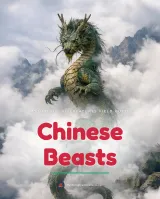
Chinese Beasts: A field guide to the dragons and demon kings of Chinese myth
From river dragons to demon kings, with the legends that shaped five thousand years of storytelling.
Japanese Yōkai: A field guide to the spirits and demons of Japanese folklore
Fifteen spirits, with the signs to watch for and what the old tales say to do if you meet one.
Greek Myths: A field guide to the monsters of ancient Greece
Every monster here earned its place in legend, and each gets a full page of artwork and the story behind it.
the legend in five swipes.
For indie creators
Give your myth project a permanent home
Indie authors, artists, small studios, and makers can secure an annual, non-intrusive sponsor slot that meets readers where they explore.
Obtain more informationQuick Creature Info
Our Mythic Legendary Rating:

Also Sometimes Known As:
Habitat:
Supernatural Powers:
Physical Attributes:
Abilities:
Behavior:
Lore:
Related Creatures, Tales or Lore
- CCŵn Annwn
- BBlack Shuck
- BBarghest
References
Discover Another Mythical Legend You May Not Have Heard Of?
Uncover the mysteries of ancient folklore and expand your knowledge of legendary beings from cultures around the world.
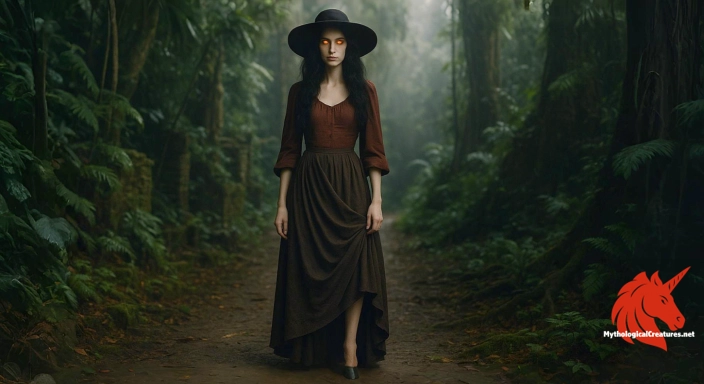
Dare to Meet the La Diablesse....
The Mythological Creatures Book Series
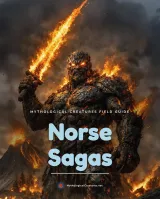
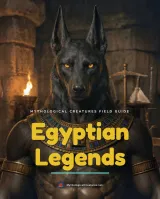
Yōkai, Greek, Norse, Egyptian & Chinese. Five illustrated field guides to the creatures the old stories either warned or told you about.
Curated by the Mythological Creatures Team
Series editor: Mythological Creatures Directory
Primary desk: Northern & European Folklore Desk
(rev. November 2025)