
Fulad-zereh: Fulad-zereh is a massive, horned Persian demon renowned for his near-invulnerable, steel-like body and aerial abilities.
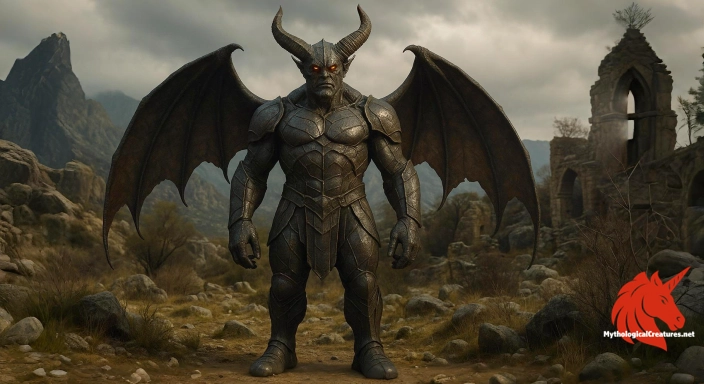
Fulad-zereh
Fulad-zereh - Fulad-zereh exemplifies the theme of unassailable power tempered by a singular fatal weakness, serving as a cautionary figure in Persian folklore.
Origins & First Encounters
Fulad-zereh is a figure of myth and dread, a huge horned demon whose very name speaks to his indomitable steel armour. His origins are rooted in the ancient Persian epic of Amir Arsalan, where early attestation shows him as a powerful, fearsome being. Emerging from a rich cultural tapestry, this demon was not only a supreme warrior but also a symbol of mystic defiance against mortal constraints. His early role as the chief general under the fairy king Malek Khazen in the storied land of Zahrgiah underlines his commanding presence in the supernatural hierarchy. The narrative presents him as one who roamed the skies with an eerie grace, turning his aerial wanderings into legendary exploits. He was notorious for venturing forth to seize beautiful women, a deed that added layers of both seduction and horror to his persona. Integral to his saga is the magical blessing—or curse—imparted by his mother, a potent witch whose charm rendered him nearly impervious to conventional weapons. This singular protection, however, was balanced by a fated vulnerability, weaving themes of invincibility and inevitable downfall into his story. Today, Fulad-zereh continues to captivate enthusiasts of Persian lore as a timeless symbol of heroic might clashing with supernatural destiny.
Source Texts & Tale Variants
Ancient manuscripts and oral recitations preserve the saga of Fulad-zereh as an enduring narrative within Amir Arsalan’s legendary exploits. Early texts vividly capture his role as the chief general serving Malek Khazen, the fairy king of Zahrgiah, thereby embedding him deeply in the mythic fabric of Persian literature. Multiple versions of his tale have been recorded, each adding distinct layers of magical prowess and grim foreboding. Some story variants embellish his fearsome aerial journeys and uncanny habit of abducting women, turning his actions into rich metaphors of beauty and terror. Other accounts place particular emphasis on the supernatural charm bestowed by his mother, highlighting how this magic granted him near-absolute resilience in battle. Oral traditions, passed down through generations, interlace these narratives with local colour and symbolic resonance. Variations in wording and detail across different texts have introduced delightful ambiguities that only serve to enhance his mysterious reputation. Later retellings have sometimes shifted focus to the tragic dimensions of his character, adding moral complexity to his otherwise demonic role. Through these diverse sources, Fulad-zereh’s legend has evolved into a multifaceted narrative that continues to inspire awe and debate.
Form & Powers
Fulad-zereh is depicted as a colossal entity whose very appearance exudes both raw power and an unearthly menace. His head is crowned with massive, curved horns that arch upward, signifying his demonic lineage and commanding presence. The steel-clad quality of his armour, from which his name is derived, appears almost as if forged by magical forces, encasing his robust body in a near-impenetrable shell. Every sinew and contour of his frame is rendered with an intensity that suggests both the vigour of a warrior and the foreboding nature of his curse. His eyes, deep and penetrating, seem to reflect the dark mysteries of the otherworld. In some depictions, subtle hints of broad, spectral wings or an inherent ability to soar through the heavens accentuate his aerial nature. The mystical charm, cast by his powerful mother, imbues his form with an ethereal glow, differentiating him markedly from ordinary creatures. His overall appearance is a masterful blend of elegance and terror, where each physical attribute, from his fearsome horns to his resilient armour, tells a story of both divine empowerment and tragic vulnerability. This elaborate physical portrayal remains central to his enduring allure in myth and art.
Regional Faces
Throughout the diverse regions of ancient Persia, the legend of Fulad-zereh has been continuously reshaped to reflect local traditions and cultural sensibilities. In the mystical heartlands near Zahrgiah, his image is interwoven with indigenous motifs, portraying him as a spectral force that is both awe-inspiring and deeply tragic. Local renditions often accentuate the duality of his character, shifting between the roles of a ruthless marauder and a sorrowful, cursed warrior. In some regional narratives, his monstrous traits are softened by an emphasis on his doomed fate, making his invulnerability seem as much a burden as a blessing. Artisans and storytellers in various locales have added unique details—from subtle alterations in his horn design to variations in the depiction of his impenetrable armour—to align his myth with local iconography. These adaptations underline a broader cultural tendency to interpret overpowering figures through the lens of local experiences and historical circumstances. The fluidity of his portrayal in regional folklore allows each community to project its own fears and aspirations onto his myth. Ultimately, while the core elements of his story remain intact, the regional variations in his appearance and attributes contribute to a richer, more diverse tapestry of mythological tradition.
Cultural Parallels
Comparative mythology reveals that Fulad-zereh stands alongside other archetypal figures whose formidable power is paradoxically balanced by a singular, defining vulnerability. His fabled resistance to all conventional arms, save for the enchanted sword Shamshir-e Zomorrodnegar, echoes the archetypal motif of a hero or villain with an Achilles’ heel. Similar themes are observed in Greek legends, where even the mightiest warriors have a subtle yet fatal imperfection. His horned, demonic appearance naturally invites comparisons with analogous figures in European and Middle Eastern mythologies, where beasts and deities often bridge the gap between man and monster. The interplay between his near-invincibility and the inevitable fatal flaw embodies a universal narrative of hubris and retribution. Figures from other cultures, whether they be the rebellious titans of ancient lore or dark entities from local folklore, share this compelling contradiction. By juxtaposing his physical and magical traits with those of similar beings in comparative studies, one can trace a common human fascination with the balance of strength and frailty. Such cross-cultural analyses underline the timeless allure of characters who are both superhuman and deeply flawed. In this light, Fulad-zereh’s narrative becomes not only a piece of Persian mythology but also a window into the shared storytelling traditions of disparate cultures.
Legacy & Modern Evolution
The myth of Fulad-zereh has transcended its origins as a mere antagonist in classical literature to become a profound symbol of invincibility intertwined with tragedy. Initially chronicled in ancient Persian epics, his story has evolved through the centuries, continually adapting to new artistic and cultural contexts. Modern reinterpretations often cast him in a more complex light—sometimes as a cautionary figure whose great strength is shadowed by an unavoidable doom. His myth has resonated with contemporary audiences through films, graphic novels, and theatrical works that explore the interplay between mystical power and human frailty. The legendary invulnerability granted to him has become a metaphor for the dangers of unchecked ambition and the inherent vulnerabilities that lie beneath even the strongest facades. As modern scholars and artists revisit his tale, Fulad-zereh emerges as a multidimensional character whose narrative challenges conventional dichotomies of good versus evil. His portrayal is now infused with a sense of tragic destiny, reflecting broader themes of cosmic balance and the price of power. The evolution of his legend mirrors the dynamic nature of myth itself, where ancient symbols are continually reimagined to speak to the concerns of each new generation. In this way, Fulad-zereh remains a captivating figure whose enduring legacy bridges the gap between the past and the modern quest for meaning in myth.
Interesting Fact
It is intriguing that a demon as nearly invulnerable as Fulad-zereh could be felled by the blow of one enchanted sword, underscoring a recurring mythological theme where ultimate power is balanced by a singular vulnerability.
Reach myth fans
Connect your myth-driven brand with this audience
Our readers are writers, educators, gamers, and collectors who care about mythology. Enquire about a limited sponsor placement on creature pages.
Enquire about sponsorshipQuick Creature Info
Origin:
Features:
Associations:
Our Mythic Legendary Rating:

Habitat:
Supernatural Powers:
Physical Attributes:
Abilities:
Behavior:
Weaknesses:
Lore:
Related Creatures, Tales or Lore
- DDiv-e Sepid
- AAži Dahāka
- IIfrit
References
Discover Another Mythical Legend You May Not Have Heard Of?
Uncover the mysteries of ancient folklore and expand your knowledge of legendary beings from cultures around the world.
Dare to Meet the Enceladus....
-80eb7eb8-198e-4da2-a15f-b32f21b9a2e9_small.webp "Depiction of Enceladus")
Curated by the Mythological Creatures Team
Series editor: Mythological Creatures Directory
Primary desk: Asian & Pacific Myth Cycles Desk
(rev. November 2025)