
Ifrit: Ifrit are powerful demon-like jinn from Islamic folklore, often associated with fire and the underworld.
Ifrit
Ifrit - Ifrit are emblematic of malevolent supernatural forces within Islamic tradition.
Origins & First Encounters
The ifrit stands as one of the most potent and enigmatic figures in Islamic mythological tradition, embodying both terror and awe. Born among the jinn, these entities have been woven into the cultural fabric of the Middle East since the earliest days of Islamic revelation. Their origins are entwined with ancient Arabian cosmologies, where the boundaries between the natural and the supernatural blur. Early scriptural references portray them as formidable beings, often associated with retribution and the elemental force of fire. Over time, their narrative has evolved to include complex moral symbolism, reflecting themes of pride, punishment, and the consequences of defiance. They are frequently linked to the underworld, or Jahannam, where their fiery essence mirrors the torment of those condemned. The multifaceted portrayal of the ifrit illustrates the rich interplay between religious dogma and folkloric embellishment. As a cornerstone of myth, they have transcended their initial roles to become enduring symbols of both cosmic power and moral warning. Their legacy continues to inspire diverse interpretations in literature and art. This enduring intrigue reinforces the ifrit’s position as a dynamic force within the broader spectrum of Islamic and global mythologies.
Source Texts & Tale Variants
The ifrit is prominently featured in early Islamic scriptures where it is invariably mentioned among the jinn in the Quran, hadith, and Mi'raj narratives. These sources set the foundation by presenting the ifrit as a powerful, otherworldly presence whose very mention commands respect and caution. Medieval Arabic manuscripts later expanded on these brief mentions, infusing the ifrit with a personality that ranged from vengeful demon to capricious spirit. Folkloric traditions across the Islamic world have further diversified its depiction, often tailoring its role to local cultural needs and cautionary tales. Some story variants even portray the ifrit as a guardian of hidden realms, or as a test of moral fortitude for those who dare to confront it. As these narratives developed, the ifrit began to transcend its initial scriptural outline, acquiring layers of symbolic significance. Both oral and written traditions have contributed to a rich tapestry that not only celebrates its might but also hints at an intricate moral complexity. The convergence of sacred text and folk storytelling continues to offer a dynamic view of an ever-evolving mythic persona. This multiplicity of sources and story variants has ensured that the ifrit remains a subject of fascination and scholarly debate. Its storied past serves as a testament to the power of myth in bridging the spiritual with the observable world.
Form & Powers
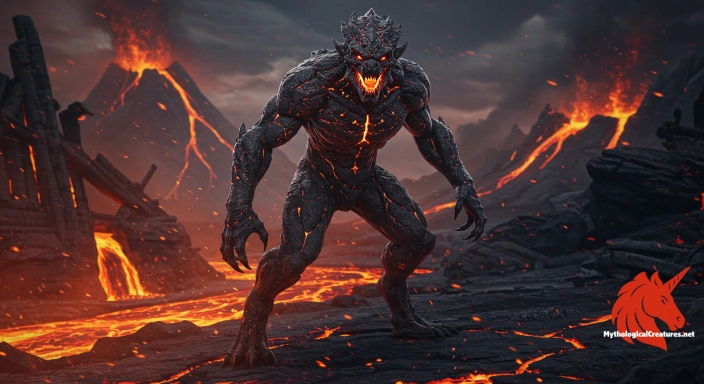
The physical portrayal of the ifrit is as dynamic as its reputation, often evoking the image of living, dancing flames. Legends depict its form as being composed of swirling fire and shifting shadows, creating an almost liquid appearance. Its eyes are frequently described as burning coals, emitting an intense gaze that can both mesmerise and terrify. Many depictions highlight rugged, horned features that lend an air of primal ferocity and otherworldly might. Some accounts include the presence of large, powerful wings, which hint at a supernatural ability to traverse both terrestrial and celestial realms. The size of an ifrit is portrayed with considerable variation, from towering giants capable of altering landscapes to more elusive, agile beings. Its skin or outer surface is typically rendered in hues of deep red, glowing amber, or even as luminous white flames. Luminous patterns of fire and smoke frequently play across its body, underscoring its elemental connection with fire. This vivid imagery serves as a visual metaphor for the chaotic yet mesmerizing forces of nature. In essence, the ifrit’s physical manifestation is designed to evoke both the beauty and terror of an untamed, elemental force.
Regional Faces
Across the Middle East and North Africa, regional traditions have imbued the ifrit with unique local characteristics that enrich its mythic identity. In many Arabian tales, it appears as a malevolent spirit haunting desolate deserts and ancient ruins, a constant reminder of nature’s untamed fury. North African lore sometimes portrays the ifrit with a dual edge, incorporating elements of mischief alongside its fearsome reputation. In the cultural narratives of Persia and Turkey, it is occasionally interwoven with stories of elemental chaos, aligning its essence with the unpredictable forces of nature. Variations in these accounts often extend to its visual depiction, with differences in colour, size, and even moral alignment emerging among local storytellers. In some communities, the ifrit is reimagined as a guardian of secret treasures or a test for those brave enough to venture into forbidden realms. These adaptations reflect the way in which the ifrit has been absorbed into the local cultural psyche, serving both as a symbol of danger and as an allegory for human hubris. Oral traditions further diversify its image by incorporating local dialects, customs, and environmental nuances. This regional multiplicity illustrates how a single mythic entity can thrive in diverse cultural landscapes while maintaining core elements of its identity. Such variations underscore the dynamic interplay between local heritage and the universal themes embodied by the ifrit.
Cultural Parallels
The ifrit finds fascinating parallels with other elemental and supernatural beings found throughout world mythologies. Similar to the fire spirits of European folklore, its essence captures the duality of fire as both a creative and a destructive force. In many Eastern traditions, comparable entities are revered as potent embodiments of nature’s volatile energy, thereby aligning the ifrit with a broader pantheon of elemental deities and monsters. The ifrit is often compared to other jinn in its region, yet it stands out due to its emphasis on fiery power and moral ambiguity. Some Western interpretations even draw a connection between the ifrit and the archetypal ‘demon of flame’, highlighting a cross-cultural preoccupation with fire as a symbol of uncontrollable strength. In a similar vein, the ifrit shares thematic resonances with trickster figures found in various indigenous legends, where mischief and retribution intermingle. The recurring motif of fire as a purifying yet destructive element bridges these diverse traditions and informs their respective mythic narratives. A comparative analysis reveals that whether depicted as a guardian, a tempter, or a vengeful force, the ifrit embodies universal themes of power and the human struggle against chaos. Its mythological kin across cultures remind us that the fascination with fire and the supernatural is a shared human experience. Ultimately, the ifrit serves as an exemplary case of how mythic figures can traverse cultural boundaries while resonating with a common symbolic language.
Legacy & Modern Evolution
Over the centuries, the ifrit has journeyed from its origins in sacred texts to become a multifaceted figure in global popular culture. Its early depictions as a fearsome denizen of the underworld have given way to more nuanced interpretations that explore themes of power, defiance, and moral complexity. Initially, the ifrit’s role was firmly anchored in religious and folkloric warnings about the dangers of hubris and disobedience. As narratives evolved in both literature and art, so too did its symbolism, blending elements of terror with a tragic, almost noble, quality. In modern fantasy literature, films, and video games, the ifrit is frequently reimagined as a dynamic antagonist or a misunderstood antihero, capable of evoking both dread and sympathy. Contemporary artists and storytellers have reinterpreted the ifrit in settings that mix traditional iconography with cutting-edge creative visions. This evolution mirrors broader cultural shifts in how the supernatural is portrayed and understood. The ifrit’s enduring power lies in its ability to adapt to changing aesthetic and moral sensibilities while retaining its core elemental identity. Today, it continues to inspire a diverse range of creative works, inviting reflections on the interplay between ancient myth and modern imagination. In this way, the ifrit remains a vibrant emblem of timeless mythological themes.
Interesting Fact
Ifrit in Arabic folklore is sometimes viewed as a reflection of humanity’s inner darkness, symbolising both destructive natural forces and moral failings.
Partner with us
Sponsor this space
Reach thousands of mythology enthusiasts with a curated placement on our creature pages.
Learn about sponsorshipQuick Creature Info
Origin:
Associations:
Our Mythic Legendary Rating:

Also Sometimes Known As:
Habitat:
Supernatural Powers:
Physical Attributes:
Abilities:
Behavior:
Weaknesses:
Lore:
References
Discover Another Mythical Legend You May Not Have Heard Of?
Uncover the mysteries of ancient folklore and expand your knowledge of legendary beings from cultures around the world.
Dare to Meet the Gloucester sea serpent....
Curated by the Mythological Creatures Team
Series editor: Mythological Creatures Directory
Primary desk: Hellenic & Ancient Mediterranean Desk
(rev. November 2025)