
Jinn: Jinn are supernatural beings from pre-Islamic Arabian religion and Islam, known for their natural invisibility and shapeshifting abilities.
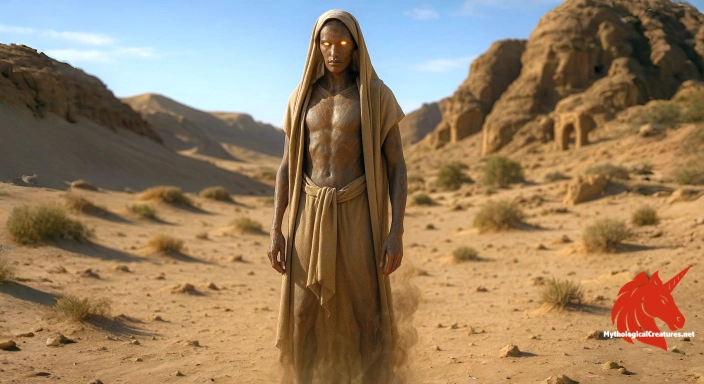
Jinn
Jinn - Jinn represent a complex aspect of the supernatural in Arabian belief systems, embodying a duality of morality and serving as a reminder of the unseen world.
Origins & First Encounters
The jinn have long occupied a unique space in Middle Eastern lore, embodying the mysteries of a world that lies just beyond human perception. Their origins are rooted in ancient pre-Islamic Arabian traditions, where nomadic tribes recognised an unseen realm filled with powerful, intangible forces. Early attestations of the jinn appear in poetic verses and oral storytelling, reflecting a cultural landscape steeped in mysticism and respect for the natural and supernatural. As Islam emerged, these beings were reinterpreted and integrated into a refined theological framework, yet they retained many of their earlier attributes. The jinn are portrayed as entities with free will, able to choose between benevolence and malevolence, which places them on a moral plane parallel to that of humankind. Their presence in myth has been used to symbolise the complexity of life’s unpredictable forces and the dual nature of existence. People of various eras have seen them as both cautionary figures and as representatives of an enigmatic power that bridges the earthly and the divine. Over time, the narrative of the jinn has enriched cultural dialogue, blending fear, wonder, and moral lessons into a lasting legacy that continues to fascinate scholars and storytellers alike.
Source Texts & Tale Variants
The body of texts mentioning the jinn extends from ancient oral traditions to seminal Islamic scripture, creating a tapestry of narratives that span centuries. Early references to these beings are woven into pre-Islamic poetry, where they are depicted as elusive spirits inhabiting a realm parallel to that of humans. The Quran provides one of the most authoritative sources, including entire passages that address their nature and responsibilities. Beyond scripture, various Hadith collections contribute detailed accounts of jinn interactions and their societal structures. Folktales circulating in diverse communities paint jinn as both helpers and hazards, lending a multifaceted dimension to their character. Story variants range from cautionary legends warning against their wrath to enthralling tales of mystical encounters that challenge everyday perceptions of reality. These traditional sources often intertwine with local lore, resulting in regional adaptations that enrich the overall mythos. Modern compilations have sought to catalogue these myriad accounts, ensuring that both scholarly research and popular imagination continue to explore the enigma of the jinn.
Form & Powers
Descriptions of the jinn are as fluid and transformative as the beings themselves, with accounts often emphasising their ethereal composition and shapeshifting abilities. Traditionally, they are believed to be fashioned from a subtle substance often described as smokeless fire, which endows them with the capacity to appear in various forms. Some narratives depict them as slender figures with an otherworldly glow, while others focus on their ability to assume the guise of animals such as snakes, scorpions, or lizards. Their inherent invisibility is frequently contrasted by their occasional manifestation in vivid, tangible forms that can both captivate and terrify the human eye. Physical characteristics such as luminous eyes, shifting silhouettes, and a transient presence are recurrent themes in these descriptions. Accounts also suggest considerable variation in size, with some jinn portrayed as towering beings of immense presence and others as diminutive, almost imperceptible entities. This mutable nature has allowed artists and writers alike to visualise the jinn in myriad ways, each interpretation reflecting the cultural and temporal context from which it arises. Ultimately, the physical depiction of the jinn serves as a compelling metaphor for the uncertain boundaries between the seen and unseen realms.
Regional Faces
Across the vast expanse of the Middle East and North Africa, regional interpretations of the jinn vary markedly in detail and emphasis. In the Arabian Peninsula, they are often envisioned as formidable spirits that mirror the tribal structures and social dynamics of ancient desert societies. North African traditions blend indigenous Berber beliefs with Islamic teachings, resulting in portrayals of the jinn that emphasise both their protective qualities and their potential for mischief. Within Persian and South Asian cultures, adaptations of the jinn myth have incorporated exotic narrative elements, recasting them as elusive forces that play critical roles in mystical and romantic tales. In many rural communities, the jinn are believed to inhabit specific locations—such as abandoned ruins or desolate landscapes—infusing physical places with an aura of ancient mystery. Urban legends in modern cities often reframe these spirits through the lens of contemporary anxieties, maintaining the jinn’s reputation as capricious and unpredictable. Local rituals and amulets continue to serve as cultural touchstones, reinforcing a belief in the jinn’s enduring influence over everyday life. Despite these regional variations, a shared core of traits—transformability, moral ambiguity, and an enduring presence—binds the diverse portrayals into a single, evolving mythic tradition.
Cultural Parallels
The jinn share intriguing similarities with a variety of supernatural entities found in other cultural mythologies, offering a rich field for comparative analysis. Much like the fairies or fae of Celtic folklore, jinn inhabit a liminal space between the mundane and the miraculous, capable of both benevolence and caprice. Elements of their character also resonate with the concept of nature spirits or elemental beings, as seen in various indigenous traditions around the world. In classical antiquity, figures such as the Greek daimones or even the Roman numina carried an ambiguous moral charge that mirrors the jinn’s dichotomous nature. Both jinn and their cross-cultural counterparts demonstrate a fluidity in identity and form, regularly shifting between roles that challenge human classifications of good and evil. This flexibility in depiction underscores a universal human impulse to give shape to the intangible aspects of existence. Moreover, the hierarchical structures and societal nuances ascribed to the jinn find parallels in other mythic traditions that detail complex spiritual orders. These cross-cultural connections reinforce the idea that despite geographical separation, many communities have sought to explain life's mysteries through the lens of supernatural, often transformative, presences.
Legacy & Modern Evolution
The historical evolution of the jinn reflects a fascinating transition from ancient animistic beliefs to sophisticated religious symbolism and modern pop-culture adaptations. Initially rooted in pre-Islamic myth, the jinn gradually became embedded in the fabric of Islamic theology, serving as both a reminder of life’s unpredictable forces and a symbol of moral duality. Medieval narratives expanded upon these early accounts, portraying jinn as agents of fate whose actions were intertwined with divine judgement and human responsibility. During subsequent centuries, artistic and literary reinterpretations enriched the mythos, merging elements of traditional lore with contemporary cultural narratives. In the modern era, the depiction of jinn has undergone a significant transformation, with popular media reimagining them as both enchanting wish-granters and dark, enigmatic forces. This evolution is evident in films, literature, and even urban legends, where the jinn are frequently cast in roles that reflect current societal concerns. Contemporary interpretations also explore psychological themes, viewing these spirits as metaphors for internal conflict and the elusive nature of identity. Despite the shifts in portrayal, enduring practices—such as the use of amulets inscribed with divine names—continue to echo the ancient belief in the jinn’s power. Today, the legacy of the jinn is not only a testament to a rich historical tradition but also an invitation to explore the complex interplay between faith, folklore, and the human imagination.
Interesting Fact
Unlike many mythological entities that are strictly good or evil, jinn exhibit a complex moral spectrum, reflecting the intricate nature of free will and the unseen world in Arabian folklore.
For serious mythcraft
Your project belongs among the legends
If your work deepens how people understand, play with, or teach mythology, a sponsor placement here keeps it in front of the right readers all year.
Submit a sponsorship enquiryQuick Creature Info
Origin:
Our Mythic Legendary Rating:

Also Sometimes Known As:
Habitat:
Supernatural Powers:
Physical Attributes:
Abilities:
Behavior:
Weaknesses:
Lore:
References
Discover Another Mythical Legend You May Not Have Heard Of?
Uncover the mysteries of ancient folklore and expand your knowledge of legendary beings from cultures around the world.
Dare to Meet the Kallikantzaros....
Curated by the Mythological Creatures Team
Series editor: Mythological Creatures Directory
Primary desk: Hellenic & Ancient Mediterranean Desk
(rev. November 2025)