
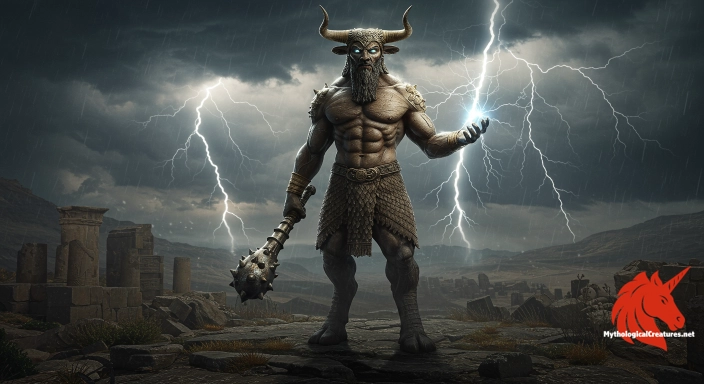
Hadad: Hadad, also known as Adad or Baal, is the ancient storm and rain god worshipped in Canaanite and Mesopotamian religions.
Hadad
Hadad - A central figure in ancient Near Eastern religion, symbolising the natural forces of storms, rain, and agricultural fertility.
the legend in five swipes.
the legend in five swipes.
Who first told stories about Hadad?
Hadad stands as a central figure in ancient myth, revered as the storm and rain god in Canaanite and ancient Mesopotamian cultures. His earliest attestation in the Ebla texts, dating to around 2500 BCE, marks him as one of the most enduring deities of the Near East. Emerging from a milieu where natural phenomena were personified, his origins are deeply entwined with the elemental forces of nature. Hadad’s divine persona symbolises both the life-giving aspects of rain and the destructive power of tempests. His myth evolved as his worship spread from the Levant into neighbouring cultures, absorbing new dimensions while retaining a core association with the sky and its fury.
In subsequent traditions, his identity was further refined through the intermingling of local and foreign theological ideas. The imagery attached to him—including the thunderbolt, club, and bull-horned headdress—reinforces his role as a mediator between chaos and order. His enduring legacy is a testament to the human need to understand and personify the forces that shape the natural world.
Where can you read about Hadad?
Primary sources documenting Hadad’s narrative include a diverse array of ancient inscriptions, texts, and literary compositions from the Near East. The Baal Cycle, or Epic of Baal, stands out as a remarkable text composed between 1400 and 1200 BCE, rediscovered at Ugarit, which features his exploits and divine struggles. This epic narrative casts him in conflicts that symbolise the eternal battle between order and chaos. In addition, texts from Ebla and other Mesopotamian sources record his various names, such as Hadda, Adad, and Iškur, highlighting a complex and evolving identity.
These sources also reveal that Hadad’s myth was not static, as different regions adapted his story to their own cultural contexts. Variants of his narrative illustrate his roles in the cyclical renewal of life, seasonal change, and the regulation of natural disasters. In some accounts, his association with oracles and divination is emphasised as he is paired with other significant deities like Shamash. Altogether, the extant primary sources present a multifaceted portrait of Hadad that has been shaped by centuries of oral and written tradition.
How powerful did people believe Hadad to be?
Hadad is frequently portrayed with a commanding physical presence that mirrors the tumultuous nature of the storms he controls. Artistic depictions commonly reveal him as a robust, bearded figure whose intense gaze and muscular form exude both wisdom and raw elemental power. In many representations, he is seen wielding a thunderbolt and a club, emphasising his authority over natural and supernatural forces. One of his most distinctive features is the bull-horned headdress, a symbol that not only evokes strength but also suggests fertility and vitality.
Further artistic renditions illustrate him in dynamic postures, capturing the swift and unpredictable energy of a raging tempest. Variations in his size and stance suggest that some portrayals envision him as a larger-than-life figure, reinforcing his supreme divine status. Intricate adornments, such as detailed engravings and ceremonial accessories, often accompany his image, enriching his iconography. Over the centuries, these detailed visual motifs have been adapted by successive cultures, continually reaffirming Hadad’s connection to the primal forces of nature.
The Local Faces of Hadad
Regional interpretations of Hadad offer a fascinating glimpse into how varied cultures adapted his myth to align with local religious beliefs. In the Levant, he is celebrated as the quintessential storm god, closely linked to the rhythms of agricultural fertility and the awe-inspiring power of nature. His imagery in this region is typically imbued with motifs that emphasise both benevolence and inexorable force. Meanwhile, in Mesopotamia, his identity intermingles with that of Adad and Iškur, expanding his role to include elements of oracular divination and cosmic order.
Local adaptations in areas like Hurrian society further enriched his portrayal, blending his narrative with indigenous myths of thunder and weather deities. Artistic and architectural depictions vary—some emphasising the prominence of his bull horns, others highlighting his menacing facial features—to reflect the region’s aesthetic traditions. This fluidity in representation underscores the capability of his myth to traverse geographical boundaries while being reshaped by local cultural sensibilities. Ultimately, the regional variations of Hadad stand as a testament to the enduring human connection with, and reverence for, the forces of nature across ancient civilizations.
Hadad: Counterparts Around the World
Comparative analysis of mythological traditions often positions Hadad alongside other powerful storm deities from across the ancient world. He is notably paralleled with figures such as Zeus in Greek mythology, Jupiter in the Roman pantheon, and Teshub in Hurrian narratives, all of whom share domains over thunder, lightning, and rain. These comparisons underscore a common archetype wherein societies venerate the chaotic beauty of nature. Through such cross-cultural lenses, the storm god becomes a universal symbol of both creative and destructive power.
Shared iconographic elements—like the thunderbolt, the bull, and commanding gestures—reinforce the notion that the tempestuous qualities attributed to these deities resonate on a global scale. The interweaving of Hadad’s attributes with those of deities in other mythologies highlights the perennial human effort to find order within the natural world’s inherent unpredictability. Although each culture imbues their storm god with distinct local characteristics, the underlying themes of power, transformation, and renewal remain consistent. This rich tapestry of mythic parallels not only amplifies Hadad’s significance but also reflects the shared human experience of living in awe of nature’s might.
How has Hadad changed over time?
Throughout history, Hadad’s image has undergone profound transformations that mirror the evolving cultural landscapes of the ancient Near East. Initially revered as a raw embodiment of nature’s capricious energy, his myth later absorbed elements from diverse cultural streams, leading to syncretism with deities such as Adad, Zeus, and Jupiter. This process of amalgamation reflects how his attributes were continuously reshaped to suit new religious and philosophical contexts. In classical antiquity, temples and ritual sites dedicated to his worship celebrated his role as mediator between the chaotic forces of the heavens and the stabilising order of human civilisation.
In modern times, renewed scholarly interest and archaeological discoveries have revitalised interest in Hadad, prompting contemporary reinterpretations in literature, art, and even film. His enduring iconography—marked by the thunderbolt and bull symbolism—continues to inspire creative representations that capture the timeless interplay between creation and destruction. As a symbol of the human struggle to harness and understand nature’s power, Hadad remains both a potent reminder of our past and a vibrant thread in the fabric of modern myth-making. His evolving legacy underscores how ancient deities can transcend time, continuing to speak to the core of human experience through ever-changing cultural narratives.
Interesting Fact
Hadad's multitude of names and cross-cultural equivalences, from Adad to Zeus, illustrate the dynamic evolution of mythological identities in the ancient world.
Mythological Treasures
Greek Myths: A field guide to the monsters of ancient Greece
Every monster here earned its place in legend, and each gets a full page of artwork and the story behind it.
Chinese Beasts: A field guide to the dragons and demon kings of Chinese myth
From river dragons to demon kings, with the legends that shaped five thousand years of storytelling.
Japanese Yokai: A field guide to the spirits and demons of Japanese folklore
Fifteen spirits, with the signs to watch for and what the old tales say to do if you meet one.
the legend in five swipes.
Partner with Mythological Creatures
Bring your myth-based world into ours
From game settings to narrative worlds, we work with partners who treat myths with care. Share your project for a potential sponsor slot.
Partner with usQuick Creature Info
Associations:
Our Mythic Legendary Rating:

Also Sometimes Known As:
Habitat:
Supernatural Powers:
Physical Attributes:
Abilities:
Behavior:
Lore:
References
Discover Another Mythical Legend You May Not Have Heard Of?
Uncover the mysteries of ancient folklore and expand your knowledge of legendary beings from cultures around the world.
Dare to Meet the Sihuanaba....

The Mythological Creatures Book Series
Yokai, Greek, Norse, Egyptian & Chinese. Five illustrated field guides to the creatures the old stories either warned or told you about.



Curated by the Mythological Creatures Team
Series editor: Mythological Creatures Directory
Primary desk: Hellenic & Ancient Mediterranean Desk
(rev. November 2025)