
Hitotsume-kozō: Hitotsume-kozō are Japanese yōkai that appear as bald-headed, one-eyed child-like figures.

Hitotsume-kozō
Hitotsume-kozō - Hitotsume-kozō embody the mysterious and unpredictable aspects of the spirit world in Japan, reminding people that not all apparitions are malevolent.
the legend in five swipes.
the legend in five swipes.
Who first told stories about Hitotsume-kozō?
Hitotsume-kozō is a captivating figure in Japanese folklore, embodying a blend of the eerie and the playful. Born from the imaginative world of yōkai, this creature emerges as a symbol of the mysterious and unpredictable nature of the spirit realm. Its origins can be traced back to the illustrators and storytellers of the Edo period, who skilfully wove elements of mischief and the supernatural into everyday life. The apparition, depicted as a bald-headed child with a singular, central eye, has long intrigued audiences, inviting both fear and amusement. Stories of Hitotsume-kozō are entwined with the cultural tapestry of Japan, often reflecting societal attitudes towards the unknown and the uncanny. Its early attestations appear in woodblock prints and folk tales, which have cemented its place as a memorable yōkai. Over time, the creature has come to embody both caution and curiosity in the human encounter with otherworldly forces. The narrative of Hitotsume-kozō encapsulates the tension between innocence and mischief, suggesting that the youthful guise masks a deeper, more enigmatic nature.
Where can you read about Hitotsume-kozō?
The primary sources for the Hitotsume-kozō myth are diverse, ranging from classical woodblock prints to oral narrative traditions passed down through generations. Edo period compilations of yōkai, such as those illustrated by Toriyama Sekien, feature interpretations of this one-eyed spirit, contributing significantly to its iconography. Traditional manuscripts, diaries, and regional folktales further enrich our understanding of its character and the various contexts in which it appeared. Many of these texts capture the creature in ambiguous roles that oscillate between a benign trickster and a portent of misfortune. Some versions of the tales suggest that encounters with Hitotsume-kozō serve as warnings or omens, while others portray it as merely a mischievous figure with little harm intended. The transmission of these stories through literature and visual art allowed for subtle variations and reinterpretations over time. Local storytellers also played a key role in adapting and modifying its narrative to suit regional tastes and beliefs. As a result, the multitude of story variants has helped preserve a rich legacy that continues to inspire contemporary interpretations.
The Described Form of Hitotsume-kozō
Physically, Hitotsume-kozō is depicted with striking simplicity and surreal detail, characterised primarily by its solitary eye that dominates its forehead. The creature’s head is notably bald, underscoring its otherworldly nature when seen against human expectations of infantile exuberance. Its size is typically rendered as small and childlike, conveying an image of both vulnerability and uncanny presence. The absence of hair and the prominent single eye have frequently been highlighted in artistic renditions, creating an immediate visual impact that distinguishes it from other yōkai. Many illustrations emphasise a slight, almost ethereal, quality to its form which hints at its transient existence in the boundary between the natural and the supernatural. Some depictions also include hints of traditional Japanese clothing, suggesting a connection to the human realm despite its fantastical features. There is often an impression of movement and mischief in its stance, as if it is perpetually on the verge of either playfulness or a sudden spectral act. These physical attributes combine to form a memorable visage that remains one of the most iconic among Japanese spirit lore.
The Local Faces of Hitotsume-kozō
Regional variations of the Hitotsume-kozō myth reflect the rich diversity found in Japan’s local traditions and the evolving interplay between folklore and community identity. In some rural areas, the entity is portrayed as a benign figure whose unexpected appearance is interpreted as a playful tease rather than a harbinger of doom. Urban centres might offer a slightly darker narrative, casting the creature as an enigmatic watcher or even a minor nuisance in the bustling environment. These differing portrayals underline how local climates, historical contexts, and community sentiments influence the interpretation of supernatural figures. Variations in the creature’s attire, demeanor, and even the contexts in which it appears highlight its adaptability to regional storytelling. Some local legends even imbue the Hitotsume-kozō with qualities that align it more closely with protective spirits, while others stress its role as an agent of mischief. Such fluid regional reinterpretations allow the myth to serve as a cultural mirror, reflecting the unique fears, hopes, and humour of each community. The diversity in its portrayals underscores the enduring flexibility of folklore to evolve with the changing social landscape.
The Global Cousins of Hitotsume-kozō
The singular eye of Hitotsume-kozō invites comparison with other mythological entities across cultures, most notably the cyclopes of ancient Greek lore. Unlike the often brutish or divine cyclopes, however, Hitotsume-kozō occupies a niche that balances trickster humour with subtle warnings about the supernatural. Its portrayal as a small, youthful figure contrasts sharply with the gargantuan figures in Western mythology, offering a fresh perspective on the symbolism of the one-eyed motif. Similar to other cultural tricksters, it challenges the boundaries between innocuous mischief and the unsettling otherworldly. The creature also invites comparisons with other yōkai that blur the line between benevolence and malevolence, reflecting a uniquely Japanese ambivalence towards the unknown. In several East Asian traditions, single-eyed beings appear as figures of both mockery and caution, underscoring a broader thematic resonance. These cultural parallels enhance our understanding by showing how different societies utilise similar iconographic elements to express their attitudes towards the mysterious. Overall, Hitotsume-kozō serves as a fascinating case study in how a single motif—a lone eye—can carry diverse symbolic meanings across disparate mythological systems.
What happened to the legend of Hitotsume-kozō?
Over the centuries, the image of Hitotsume-kozō has evolved from a cautionary figure in dimly lit folk tales to a celebrated character in modern media and art. The creature, once confined to eerie scrolls and whispered tales, has re-emerged in manga, anime, video games, and contemporary literature, where its quirky appearance continues to capture the public imagination. Modern reinterpretations often emphasise its enigmatic charm, blending traditional elements with new-age aesthetics. This transformation reflects a broader trend in which historical yōkai are embraced as cultural treasures, valued as much for their artistic merit as their mythological roots. Illustrators and storytellers now explore its dual identity, combining aspects of innocence with an undercurrent of the occult. Educational programmes and cultural festivals frequently invoke Hitotsume-kozō as a representative figure of the rich, imaginative legacy of Japanese folklore. The enduring appeal of the creature also speaks to the universal human fascination with the mysterious and the fantastical. Contemporary discussions regularly highlight how traditional supernatural entities can be reinterpreted to address modern themes such as identity, change, and the boundaries between reality and fantasy.
Interesting Fact
Despite their potentially frightening appearance, Hitotsume-kozō are typically benign and are remembered more as playful, mischievous apparitions than as malevolent spirits.
Mythological Treasures
Japanese Yokai: A field guide to the spirits and demons of Japanese folklore
Fifteen spirits, with the signs to watch for and what the old tales say to do if you meet one.
Chinese Beasts: A field guide to the dragons and demon kings of Chinese myth
From river dragons to demon kings, with the legends that shaped five thousand years of storytelling.
Greek Myths: A field guide to the monsters of ancient Greece
Every monster here earned its place in legend, and each gets a full page of artwork and the story behind it.
the legend in five swipes.
For indie creators
Give your myth project a permanent home
Indie authors, artists, small studios, and makers can secure an annual, non-intrusive sponsor slot that meets readers where they explore.
Obtain more informationQuick Creature Info
Features:
Our Mythic Legendary Rating:

Habitat:
Supernatural Powers:
Physical Attributes:
Abilities:
Behavior:
Lore:
Related Creatures, Tales or Lore
- NNurarihyon
- KKasa-obake
- NNurikabe
References
Discover Another Mythical Legend You May Not Have Heard Of?
Uncover the mysteries of ancient folklore and expand your knowledge of legendary beings from cultures around the world.
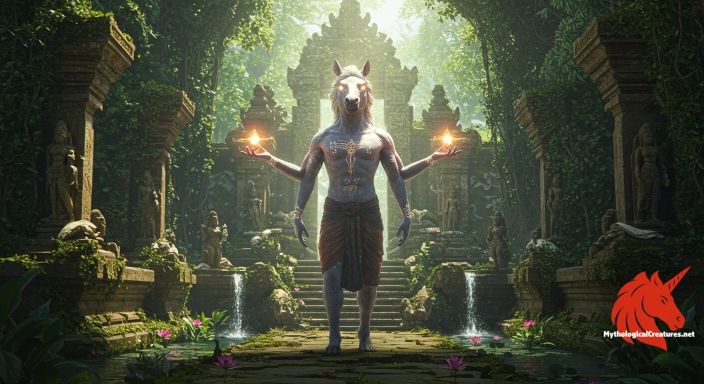
Dare to Meet the Hayagriva....
The Mythological Creatures Book Series
Yokai, Greek, Norse, Egyptian & Chinese. Five illustrated field guides to the creatures the old stories either warned or told you about.
Curated by the Mythological Creatures Team
Series editor: Mythological Creatures Directory
Primary desk: Asian & Pacific Myth Cycles Desk
(rev. November 2025)