
Khonsu: Khonsu is an ancient Egyptian moon god renowned for his role in marking time and fostering new life.
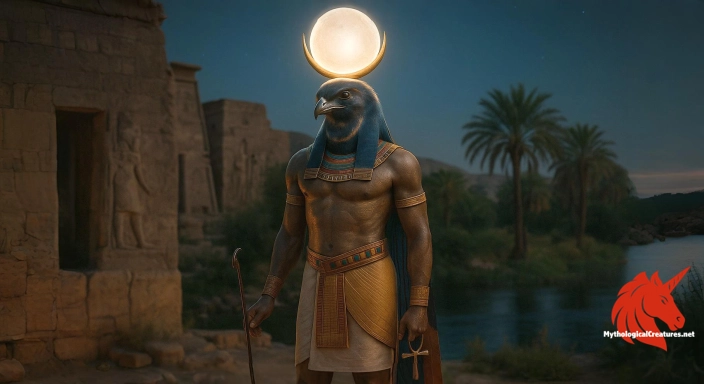
Khonsu
Khonsu - Khonsu is significant for his role in the Theban Triad and his influence on life creation and time measurement.
Origins & First Encounters
Khonsu emerges as one of the most intriguing figures of ancient Egyptian cosmology, his essence intertwined with the subtle mysteries of the lunar cycle. His name, meaning 'traveller', poetically captures the nightly voyage of the moon as it journeys across the star-studded canvas of the sky. Born into the divine lineage of the Theban Triad, he stands in close relation with Mut as his mother and the mighty Amun as his father, which underscores his central role in a sacred familial pantheon. Enigmatic and potent, his character was believed to be responsible for ushering in new life and fostering the growth of all living creatures. His presence provided a celestial rhythm that influenced both natural phenomena and the ritual practices of his devotees. With a strong association to timekeeping and the cyclical renewals of life, Khonsu was revered not only as the moon god but also as a symbol of transformation and continuity. The mystery of his nocturnal path symbolised transitions, both in the concrete laws of nature and the spiritual domains of rebirth. His legacy, steeped in symbolism and ritual, continues to captivate the imagination of those who explore the depths of ancient myth and spirituality.
Source Texts & Tale Variants
Ancient records that mention Khonsu are found in a wide array of temple inscriptions, ritual papyri, and carved reliefs that have been meticulously preserved over the millennia. His presence is substantiated by the wealth of archaeological evidence at religious sites around Thebes, where detailed hieroglyphics and artistic depictions illustrate his divine role. The inscriptions on temple walls not only document his function as the lunar deity but also subtly allude to his part in the cosmic narrative of time and life. Various ritual texts, such as portions of the funerary literature, incorporate his image as a protector and guide for souls journeying through the underworld. Story variants in these texts reveal differing aspects of his personality, emphasising both his benevolence and his formidable power over the night. In some accounts, his capabilities extend to warding off chaos and safeguarding the delicate balance between light and dark. An array of ancient manuscripts records him as a critical figure in the regeneration of life, linking the phases of the moon with the rebirth of nature. The diverse sources that reference Khonsu highlight a rich tapestry of tradition in which myth and ritual coalesce to celebrate the enduring mystery of the moon.
Form & Powers
Artistic portrayals of Khonsu are rich with symbolism, capturing both his divine nature and the celestial attributes that set him apart. He is frequently depicted as a youthful and vigorous figure, often adorned with a distinctive sidelock that signifies eternal youth and divine favour. A prominent crescent or disk resting above his head accentuates his close association with the moon, marking him as the celestial traveller of the night. His features, while human-like, are rendered with an idealised grace that elevates him beyond mortal bounds, imbuing his visage with an ethereal quality. In temple reliefs and statuary, his form is detailed with finely carved lines that evoke both strength and compassion, a duality that highlights his role in both protection and creation. Clothing and accessories, imbued with intricately designed symbols, further testify to the divine craftsmanship of his representation. Variations in size and form occasionally appear in artistic depictions, reflecting the flexibility of myth to adapt and convey the multifaceted nature of the divine. The careful integration of iconographic elements such as lunar symbols, sacred regalia, and sometimes even baboon imagery, creates a vivid portrait that is as much a work of art as it is a manifestation of sacred myth.
Regional Faces
While Khonsu is centrally associated with the religious heartland of Thebes, his influence radiated far beyond the confines of a single city. In Upper Egypt, local cults celebrated him not only as the moon god but also as a powerful healer, a role that resonated with the agrarian cycles and seasonal rhythms of the region. Within neighbouring Nubian communities, his attributes were sometimes merged with indigenous traditions, resulting in a syncretic cult that emphasised both cosmic order and the nurturing aspects of nature. In the Greco-Roman period, as Egyptian religious traditions encountered new cultural influences, Khonsu’s iconography was adapted to align with similar lunar deities of the Mediterranean world. Artistic reinterpretations in these areas often accentuated his mystical qualities and the transformative power inherent in the cycles of night and day. Localised myths sometimes introduced additional epithets and narrative layers, catering to the particular needs and spiritual sensibilities of different communities. Even beyond the borders of Egypt, his influence can be discerned in hybrid cultural representations that sought to reconcile diverse religious traditions. Through these regional adaptations, Khonsu maintained a dynamic and multifaceted presence that allowed him to continuously evolve while remaining firmly anchored in his ancient origins.
Cultural Parallels
The character of Khonsu offers a fascinating point of comparison with lunar deities from a variety of cultural traditions around the world. While Khonsu presides over the night with a distinctly Egyptian flair, figures such as the Mesopotamian Sin or the Japanese Tsukuyomi similarly embody the potent energies of the moon. In many of these traditions, lunar deities serve as custodians of time, cyclic renewal, and the mysterious interplay between light and darkness, much like Khonsu himself. His role as both a life-giver and a guardian against the forces of chaos finds echoes in other mythologies where the moon symbolises both protective and regenerative qualities. The dynamism of Khonsu’s narrative, particularly his integration within a divine family triad, offers intriguing parallels to the intricate family structures seen in other ancient pantheons. Comparative analysis underscores that despite cultural and geographic differences, the moon’s eternal cycle has universally inspired symbolic systems that celebrate continuity and rebirth. In cross-cultural discourse, his identity becomes a link in the chain of human attempts to understand celestial phenomena and its impact on life on earth. Thus, his myth is not isolated but part of a broader dialogue where lunar deities overall play a central role in explaining the mysteries of existence.
Legacy & Modern Evolution
The evolution of Khonsu’s depiction over millennia reflects the dynamic interplay between tradition and innovation in ancient religious practice. His imagery, which originally focused on the stark brilliance of the lunar disc, later absorbed elements from Hellenistic art and philosophy, enriching his iconography with new layers of symbolism. Over time, the attributes of healing, transformation, and celestial guidance associated with Khonsu allowed him to remain relevant even as cultural paradigms shifted. In the later periods of Egyptian history, his role expanded beyond the confines of the religious elite to become a staple in popular devotional practice. Today, modern enthusiasts, scholars, and artists continuously reimagine Khonsu, drawing inspiration from his dual aspects as both a cosmic wanderer and a nurturing guardian. Contemporary interpretations in literature, film, and visual arts capture his mystique by blending ancient symbolism with modern narrative techniques. His image has also been adopted in digital media and modern occult traditions, where the themes of rebirth and cyclical change resonate with current cultural sensibilities. The enduring legacy of Khonsu thus serves as a living bridge between the ancient, the mystical, and the modern, attesting to the timeless allure of celestial myth and spiritual renewal.
Interesting Fact
Many ancient depictions of Khonsu feature him with a distinctive lunar disc headdress, reinforcing his title as 'traveller' and highlighting his role in guiding the moon across the night sky, while his association with baboons hints at deeper ties with divine wisdom.
For authors, artists, and makers
Created something from the realm of myth?
If your book, deck, game, or artwork draws from legendary creatures and lore, you can showcase it here in a tasteful, year-round placement.
Share your projectQuick Creature Info
Origin:
Associations:
Our Mythic Legendary Rating:

Also Sometimes Known As:
Habitat:
Supernatural Powers:
Physical Attributes:
Abilities:
Behavior:
Lore:
Related Creatures, Tales or Lore
- SSelene
- TTsukuyomi
- CChandra
References
Discover Another Mythical Legend You May Not Have Heard Of?
Uncover the mysteries of ancient folklore and expand your knowledge of legendary beings from cultures around the world.
Dare to Meet the Struthopodes....

Curated by the Mythological Creatures Team
Series editor: Mythological Creatures Directory
Primary desk: Hellenic & Ancient Mediterranean Desk
(rev. November 2025)