
Krun: Krun, also known as Akrun, is a Mandaean lord of the underworld.

Krun
Krun - Krun is a central figure in Mandaean cosmology, embodying the underworld's role in upholding creation and maintaining cosmic order.
the legend in five swipes.
the legend in five swipes.
Who first told stories about Krun?
Krun emerges as a striking figure in Mandaean mythology, embodying the profound forces that reside beneath the surface of creation. He is revered as the enigmatic lord of the underworld, whose presence supports the very fabric of the physical world. His origins are steeped in ancient Mandaean tradition, where early religious texts introduce him as a necessary pillar in the cosmic order. Over time, his character has come to symbolise the dark, mysterious forces that underwrite both life and decay. His dual identity, sometimes rendered as Akrun, reflects the complex interplay of nomenclature and symbolism within Mandaean lore. The earliest attestations of Krun appear within classical Mandaic inscriptions, bridging the early mythic narrative with later religious interpretation. His role is not only cosmic but also deeply metaphysical, linking the visible world with the profound depths of the underworld. Community rituals and liturgical recitations have preserved his legacy as both a guardian and an essential support to creation. The cultural context surrounding his myth underscores an ancient world view where the forces of light and darkness coexist in a delicate balance.
Which versions of the Krun story survive?
The narratives detailing Krun are primarily rooted in Mandaean scripture, where he is portrayed as a central guardian of the nether realms. A variety of ancient manuscripts provide glimpses into his role, each contributing layers of meaning to his mythic persona. While some texts focus on his ominous power, others illustrate his function in maintaining the cosmic equilibrium. Oral traditions have further enriched his story, with intergenerational retellings adding nuance to his multi-faceted character. Manuscripts discovered in regions once inhabited by Mandaean communities reveal subtle variations and rich allegorical elements. Some versions depict him with an almost tangible presence in the physical realm, while others emphasise his ethereal, otherworldly nature. The consistency of his portrayal across texts reflects the deep cultural roots of his narrative within Mandaean belief. Despite the fragmentary nature of some sources, the enduring themes surrounding his existence underscore his significance as a mythic force. Diverse story variants invite modern readers to explore both the tangible and metaphorical dimensions of his existence.
Krun: Powers, Strengths and Vulnerabilities
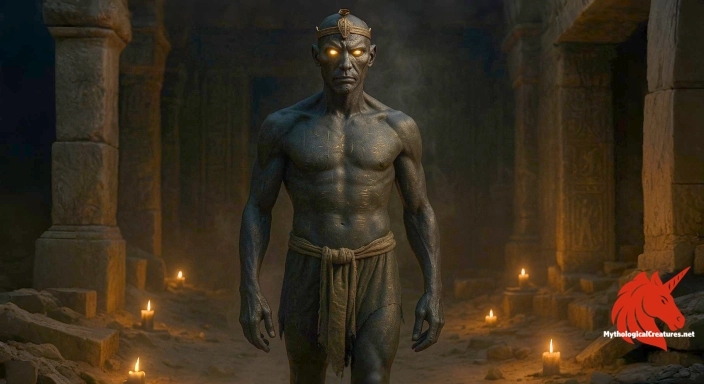
The physical depictions of Krun often evoke a sense of awe and dread, with his form suggested to be both colossal and enigmatic. Imagery surrounding this underworld lord sometimes portrays him as emerging from the very elements of darkness and primordial matter. His visage is occasionally imagined as having features that blend human and monstrous qualities, with shadowed eyes that mirror the abyss. Artists and storytellers have, at times, attributed horns or other symbolic adornments to his form, enhancing an aura of ancient power. The descriptions are rich with metaphor, suggesting that his body might be formed from the chaotic materials of the underworld itself. Variations in his size and shape, seen in different depictions, symbolise the ever-changing nature of darkness and creation. His appearance is not fixed, often reflecting the symbolic language of decay, rebirth, and the natural cycles of existence. Some traditions even describe him with multiple limbs or features that transcend human anatomy, suggesting a multidimensional presence. Ultimately, his physical form remains as elusive as the cosmic forces he governs, inviting ongoing reinterpretation by artists and scholars alike.
Which communities kept the Krun tradition alive?
Regional accounts of Krun reveal a layered tapestry of local adaptations and nuanced interpretations. In the heartlands where Mandaean communities have flourished, his image is convolved with indigenous symbols of both peril and protection. Variations in the narrative often highlight different aspects of his character, from his malevolent strength to his role as a cosmic stabiliser. In certain communities, he is depicted with attributes that echo local environmental motifs, such as desert landscapes and stony terrains. Others have integrated his myth with neighbouring traditions, where underworld lords share common themes of decay and regeneration. These regional variations further speak to the dynamic nature of myth transmission as it crosses cultural and geographical boundaries. Some accounts offer a more anthropomorphic depiction, while others render him as an amorphous force that defies mortal comprehension. The interplay of local customs with Mandaean theological principles ensures that his portrayal remains both culturally specific and universally resonant. Thus, regional diversity enriches the overall mythos, broadening our understanding of his essential role in cosmology.
What makes Krun different from similar figures?
The figure of Krun invites compelling comparisons with underworld deities and chthonic figures across diverse mythologies. Similar to the Greek Hades, he occupies a realm that is both feared and revered as essential to the continuation of life. In Mesopotamian traditions, echoes of deities like Nergal resonate with the destructive yet regenerative nature attributed to Krun. Across various cultures, the notion of a subterranean lord who governs the forces of death and rebirth appears as a common thematic element. Comparisons can also be drawn with figures such as Yama in Indian mythology, whose dominion over the afterlife reinforces universal concepts of cosmic balance. While each culture tempers these characters with its unique historical and environmental influences, the core idea remains consistent: an underworld ruler who is central to the maintenance and order of the cosmos. These parallels serve to reconnect disparate mythologies, illustrating shared human concerns with mortality, transformation, and the mysteries of existence. The cross-cultural dialogue empowers modern mythology, offering fresh perspectives on ancient archetypes. In this light, Krun stands not in isolation, but as part of a broader tradition of underworld deities whose legacies continue to inform our understanding of life and death.
How is Krun remembered today?
The evolution of Krun’s myth over the centuries demonstrates a rich interplay between tradition and modern reinterpretation. Early Mandaean texts firmly anchored him as the ominous protector of the underworld, a role that has persisted despite changes in cultural milieu. As modern interest in mystical and ancient traditions has grown, his image has undergone nuanced transformations in literature, art, and even digital media. Contemporary depictions often blend traditional iconography with abstract expressions, reflecting the timeless themes of chaos, order, and the cyclical nature of existence. Discussions in modern spiritual circles sometimes cast him as a metaphor for internal transformation and the balance between light and dark. Artistic reinterpretations have expanded his legacy beyond strictly religious texts, positioning him as a symbol of existential mystery and cosmic endurance. His enduring legacy speaks to a continual fascination with the underworld and the enigmatic forces that govern it. Contemporary scholarship and creative expression continue to unearth new facets of his character, ensuring that Krun remains relevant in modern cultural discourse. The ongoing reimagining of this ancient figure highlights the adaptive power of myth and its capacity to transcend historical boundaries.
Interesting Fact
An intriguing aspect of Krun is his role in physically supporting the entire world from beneath—a unique cosmological feature that distinguishes him from other underworld deities.
Mythological Treasures
Japanese Yokai: A field guide to the spirits and demons of Japanese folklore
Fifteen spirits, with the signs to watch for and what the old tales say to do if you meet one.
Greek Myths: A field guide to the monsters of ancient Greece
Every monster here earned its place in legend, and each gets a full page of artwork and the story behind it.
Norse Sagas: A field guide to the beasts of the Viking world
Drawn from the saga accounts themselves, with the powers, weaknesses and doom of each being set out.
the legend in five swipes.
Partner with us
Sponsor this space
Reach thousands of mythology enthusiasts with a curated placement on our creature pages.
Learn about sponsorshipQuick Creature Info
Origin:
Associations:
Our Mythic Legendary Rating:

Also Sometimes Known As:
Habitat:
Supernatural Powers:
Abilities:
Behavior:
Lore:
References
Discover Another Mythical Legend You May Not Have Heard Of?
Uncover the mysteries of ancient folklore and expand your knowledge of legendary beings from cultures around the world.
Dare to Meet the Ba-Pef....
The Mythological Creatures Book Series
Yokai, Greek, Norse, Egyptian & Chinese. Five illustrated field guides to the creatures the old stories either warned or told you about.
Curated by the Mythological Creatures Team
Series editor: Mythological Creatures Directory
Primary desk: Hellenic & Ancient Mediterranean Desk
(rev. November 2025)