
Mangar-kunjer-kunja: Mangar-kunjer-kunja is a revered lizard ancestral being in Arrernte mythology, credited with the creation of humans.
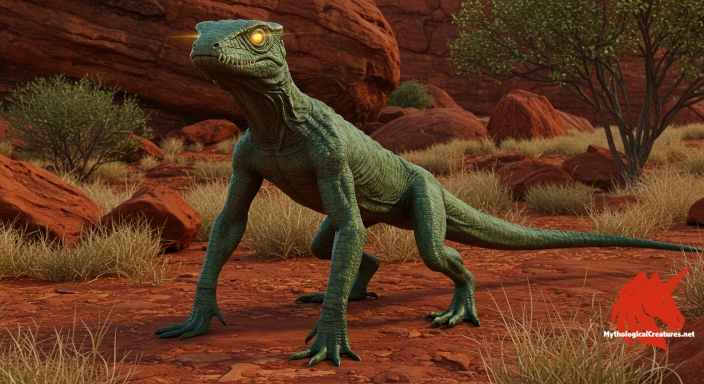
Mangar-kunjer-kunja
Mangar-kunjer-kunja - Mangar-kunjer-kunja is central to the Arrernte creation narrative, credited with forming humanity and establishing cultural practices such as marriage and tool use.
the legend in five swipes.
the legend in five swipes.
Who first told stories about Mangar-kunjer-kunja?
Mangar-kunjer-kunja stands as a central figure in Arrernte cosmology, celebrated as a lizard Ancestral Being responsible for the creation of human life. His narrative, steeped in the lore of central Australia, has shaped the spiritual identity and cultural practices of the Arrernte people for countless generations. Believed to be a formidable spirit imbued with both creative and transformative powers, he is revered for the way he sculpted the human form from a primordial unity. His myth begins with the discovery of the first fused beings on the side of a hill, a moment that reflects both the tangible and metaphysical interconnections in nature. With precision and care, he separated these beings using a sacred knife, an act that symbolises the dawning of individuality and self-awareness. The carving of specific openings for mouths, ears, and noses not only established the framework of human anatomy but also introduced the capacity for communication and sensory experience. Beyond the physical reformation, his bestowal of essential tools such as the knife, spear, shield, and boomerang, along with the sacred tjurunga, underscores his role as a provider of civilised culture and order. His gift of a system of marriage further cemented social structures and the continuity of life among his people. Even today, his myth continues to resonate, bridging the ancient past with contemporary cultural identity and spiritual practice.
Which versions of the Mangar-kunjer-kunja story survive?
The earliest accounts of Mangar-kunjer-kunja are rooted in the oral traditions of the Arrernte people, passed down through generations with deep reverence. These narratives, preserved in both story and song, have long served as the cornerstone of Arrernte creation mythology. Elements of his tale are also shown in traditional rock art and ceremonial performances, where visual symbolism reinforces his transformative deeds. Over time, diverse renditions have emerged as different communities emphasise particular aspects of his creative role. Some versions elaborate on the meticulous methods by which he separated the primal fused beings, while others focus on the importance of the tools he gifted to humankind. Occasional references in early anthropological writings add fragments of a recorded history to his oral legacy, although much remains embedded in intangible cultural memory. The interplay of these varied sources enriches the myth, ensuring that each version contributes a unique layer of insight to his character. As custodians of this sacred narrative, the indigenous storytellers continue to keep alive a myth that is both ancient and dynamically interpreted across time.
How powerful did people believe Mangar-kunjer-kunja to be?
Artistic depictions of Mangar-kunjer-kunja often render him as a majestic lizard whose form blends the raw vitality of nature with a sense of otherworldly power. His body is illustrated with sinuous, elongated contours that evoke both agility and an almost supernatural grace. The creature’s scaled skin is portrayed in a palette of earthy ochres and vibrant greens, mirroring the rugged terrain and spiritual essence of the Central Australian landscape. Intricate markings, reminiscent of ancient symbols, frequently adorn his body, suggesting a deep connection to the cosmic order and the mysteries of creation. Emphasis is placed on his penetrating eyes, which seem to shimmer with wisdom and a profound understanding of life’s enigmas. His powerful limbs and flexible tail are often highlighted, indicating both the strength and fluidity required to shape the forces of life. In several interpretations, his claws and fanged features offer a dual impression of both nurturing craftsmanship and formidable might. Some artistic renditions even incorporate ethereal radiance around his form, setting him apart as a divine architect of existence. Collectively, these visual details encapsulate a complex blend of natural and supernatural qualities that define his role in the cosmic order.
Where in the world is Mangar-kunjer-kunja known?
While the core myth of Mangar-kunjer-kunja remains consistent among the Arrernte, regional interpretations have gradually introduced subtle adaptations that reflect local cultural and environmental influences. In certain areas, storytellers integrate specific natural landmarks or indigenous flora and fauna, thereby linking his essence more closely with regional landscapes. Some communities recount variations in the sequence of his creative acts, incorporating local geographical myths that enhance the narrative’s relevance to their surroundings. The physical portrayal of the ancestral lizard may also differ, with some art traditions introducing additional symbolic adornments that are unique to a particular group. These differences illustrate how oral traditions evolve, as neighbouring clans infuse the myth with elements that resonate with their own experiences of the land. In some instances, his role is expanded to include aspects of seasonal change or water symbolism, thereby diversifying his representation as both creator and guardian of natural cycles. Such regional diversity highlights the dynamic nature of indigenous storytelling, where each version contributes to a richer, multifaceted understanding of his spiritual power. Ultimately, these local adaptations reaffirm the myth’s enduring significance and its capacity to bridge communal identities with the broader natural and spiritual world.
Mangar-kunjer-kunja: Echoes in Other Mythologies
Mangar-kunjer-kunja’s figure finds interesting parallels with ancestral deities in various mythological traditions around the world. His dual role as creator and cultural benefactor echoes the narratives found in other indigenous mythos, such as the Rainbow Serpent, who also embodies life-giving natural forces. Like many creator beings, his myth embodies themes of separation, organisation, and the establishment of social order. The act of differentiating fused beings to give rise to individuality can be compared to other cultural tales where primordial unity is partitioned to establish distinct living forms. His reptilian characteristics share a symbolic kinship with other animal deities, where the animal form is revered as a natural embodiment of divine qualities. This interplay of form and function is also reminiscent of figures in diverse mythologies who merge the physical with the spiritual, serving as bridges between nature’s raw power and human civilisation. Despite these similarities, Mangar-kunjer-kunja retains unique attributes, such as the specific cultural tools and marriage system that he imparted, setting him apart from analogous myths. His story, therefore, not only connects with broader global themes of creation and cosmic order but also highlights the singular innovations of Arrernte spiritual thought.
Why is Mangar-kunjer-kunja still popular?
The myth of Mangar-kunjer-kunja has steadily evolved from its ancient oral roots to a robust symbol in modern indigenous identity. Traditionally, his story was transmitted through songs, dance, and ritual, ensuring that each generation maintained a living connection to their ancestral past. As the dynamics of modern life and external influences began to interweave with traditional practices, his narrative adapted by embracing new artistic expressions, from contemporary paintings to digital storytelling. His image now appears in cultural festivals and educational programmes, reinforcing the profound connection between the past and present. Contemporary Arrernte artists and storytellers have reinterpreted his legacy, often using the myth to comment on issues of cultural preservation and environmental stewardship. This evolution of imagery and symbolism has allowed his figure to remain both timeless and adaptable, serving as a vibrant reminder of the origin of cultural practices. His continuing significance is evident in the way modern indigenous communities utilise his story to articulate current social and spiritual concerns. Ultimately, Mangar-kunjer-kunja’s enduring legacy underscores a narrative of resilience and creative empowerment that remains relevant in today’s rapidly changing world.
Interesting Fact
An interesting aspect of Mangar-kunjer-kunja is that his creative act involved both physically shaping human forms and instituting cultural practices, illustrating the inseparable link between nature and society in Arrernte mythology.
Mythological Treasures
Egyptian Legends: A field guide to the gods and monsters of ancient Egypt
Guardians of the living and devourers of the dead, with the role each played in judgement.
Chinese Beasts: A field guide to the dragons and demon kings of Chinese myth
From river dragons to demon kings, with the legends that shaped five thousand years of storytelling.
Japanese Yōkai: A field guide to the spirits and demons of Japanese folklore
Fifteen spirits, with the signs to watch for and what the old tales say to do if you meet one.
the legend in five swipes.
Partner with us
Sponsor this space
Reach thousands of mythology enthusiasts with a curated placement on our creature pages.
Learn about sponsorshipQuick Creature Info
Origin:
Associations:
Our Mythic Legendary Rating:

Habitat:
Supernatural Powers:
Physical Attributes:
Abilities:
Behavior:
Lore:
Related Creatures, Tales or Lore
- RRainbow Serpent
- BBaiame
References
Discover Another Mythical Legend You May Not Have Heard Of?
Uncover the mysteries of ancient folklore and expand your knowledge of legendary beings from cultures around the world.
Dare to Meet the Azeban....
The Mythological Creatures Book Series
Yōkai, Greek, Norse, Egyptian & Chinese. Five illustrated field guides to the creatures the old stories either warned or told you about.
Curated by the Mythological Creatures Team
Series editor: Mythological Creatures Directory
Primary desk: Asian & Pacific Myth Cycles Desk
(rev. November 2025)