
Mokoi: Mokoi is an evil spirit from Australian Aboriginal Yolngu mythology known for killing sorcerers and abducting children.
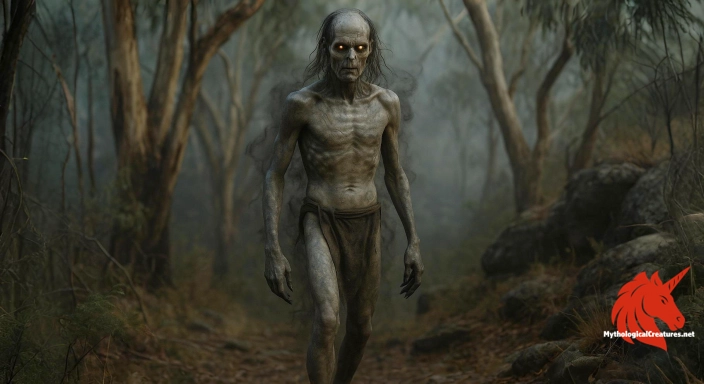
Mokoi
Mokoi - Represents the embodiment of retributive justice against dark magic and serves as a cautionary figure in the mythology.
Origins & First Encounters
Mokoi emerges as a formidable presence within Aboriginal mythologies, embodying a spirit of retribution linked to the cosmic balance of life and death. His origins are intimately connected with the Yolngu traditions, where the figure is invoked to explain the untimely demise of those who engage in dark sorcery. The lore positions him as a vengeful force against magicians who misuse forbidden knowledge, transforming his role into that of a moral enforcer. His actions—ranging from the elimination of black magic practitioners to the abduction of children—reflect a deep-seated cultural anxiety about the disruption of natural order. Embedded within these narratives is a curious paradox of a being that, although dead, seeks to harness the elixir of life through nefarious means. The myth, evolving over generations, mirrors societal efforts to explain sudden illness and fatal accidents. Mokoi’s legacy is interwoven with the community’s understanding of mortality, a tool to illustrate that death often stems from sinister forces rather than the natural progression of age. Through these tales, his character not only punishes transgressions but also serves as a stark reminder of life’s fragility and the boundaries of human endeavour.
Source Texts & Tale Variants
The earliest accounts of Mokoi are preserved in the rich oral traditions of the Yolngu and Murngin peoples, where his story was passed down during communal gatherings and ritual ceremonies. While there is a scarcity of written records, anthropological studies have captured fragments of his myth, offering insights into his enigmatic persona. Storytellers have long recounted variations in his narrative, with some versions concentrating solely on his role as an executor of dark magic practitioners. In a number of retellings, his function as a child abductor and life force extractor is emphasised, adding layers of horror to his character. These diverse portrayals illustrate how different communities used his myth to caution against the corrupting allure of supernatural power. The narrative variants reveal subtle differences in his motivations and methods, indicating that his character evolved based on local values and experiences. Over time, additional elements—such as his indebtedness to malevolent forces—became interwoven into the tales. Each rendition, though distinct, reinforces his association with misfortune and moral transgression. In this way, the multiple versions of his story serve as a unifying cultural reference that underlines shared fears and societal taboos. The oral transmission of these accounts ensures that his legacy remains a dynamic and integral part of Aboriginal mythological heritage.
Form & Powers
Visual depictions of Mokoi invoke an unsettling impression, often rendered as a shadowy figure that blurs the lines between corporeal form and spectral existence. Descriptions typically suggest an amorphous, almost shifting outline that makes him appear both elusive and menacing. Some depictions include the vision of a gaunt, elongated form with features that hint at a skeletal structure, evoking a sense of imminent decay. There are accounts that describe his eyes as aglow with an eerie light, capable of instilling dread in anyone who dares meet his gaze. His body is often portrayed as mutable, with forms that seem to dissolve into the darkness of the night. Artists and storytellers occasionally embellish his appearance with ghostly wisps or fog-like characteristics, thereby reinforcing his otherworldly nature. This fluid depiction allows Mokoi to exist in a liminal space between the tangible and the supernatural. Variations in the narrative sometimes illustrate him as both diminutive and immense, suggesting that size is as transient as his form. Such imagery encapsulates the mysterious and volatile forces that his presence is meant to represent. Overall, his visual representation serves as a stark embodiment of the fears and moral lessons inherent in Aboriginal spiritual traditions.
Regional Faces
Across the vast tapestry of northern Australia, the figure of Mokoi is subject to regional reinterpretation, reflecting the diverse ecological and cultural landscapes. In the Yolngu communities, he is primarily understood as a guardian against the misuse of black magic, while other groups may see him as a broader symbol of unnatural death and misfortune. Variations in narrative detail, such as his method of extracting life essence, highlight the localised emphases of each community's moral values. Some tribal versions accentuate his connection to diseases and fatal accidents, using his myth to rationalise the occurrence of sudden calamities. In contrast, other renditions offer a more complex portrayal, where his actions are seen as both punitive and sacrificial, maintaining a cosmic equilibrium. Local legends often merge his identity with other notorious spirits, thereby diversifying his character and role within the pantheon. The linguistic adaptations in different Aboriginal languages contribute further to the nuances of his myth, ranging from outright malevolence to ambiguous trickster-like qualities. These regional adaptations illustrate how environmental factors and social dynamics influence the representation of supernatural forces. Through this lens, Mokoi’s narrative becomes a versatile framework that accommodates local experiences of fear and hope. His evolving portrayal underscores the adaptability of myth as a tool for communal identity and moral instruction.
Cultural Parallels
Mokoi shares several thematic links with other dark entities across world mythologies, where the boundary between life and death is manipulated through supernatural means. His function as an executor of those who meddle with forbidden forces mirrors the cautionary roles played by similar figures such as the Boogeyman or certain vampiric beings. The concept of a spirit that extracts life essence resonates with global images of vampires and life-draining succubi, revealing a common human preoccupation with the loss of vitality. Just as many cultures have devised embodiments of fear to explain unaccountable deaths, Mokoi stands as a symbolic representation of moral and metaphysical transgression in Aboriginal thought. His ambiguous nature—both a punisher and a remnant of ancient pacts—draws comparisons with trickster figures found in various indigenous traditions. These parallels illustrate how societies around the world employ mythic figures to enforce social norms and explain the inexplicable. The intermingling of cultural motifs further highlights the universality of themes such as betrayal, retribution, and the allure of dark power. Moreover, the comparative analysis of his myth with those from other cultures reinforces the idea that indigenous narratives are part of a broader dialogue about the existence of malevolent forces. In observing these cross-cultural similarities, one gains insight into the shared human experience of confronting the unknown. Ultimately, Mokoi’s myth adds a distinctive voice to the global chorus of tales that wrestle with the nature of evil and the consequences of its engagement.
Legacy & Modern Evolution
The historical evolution of Mokoi reflects a gradual transformation from a narrowly defined enforcer of moral transgression to a multi-dimensional symbol within modern cultural discourse. Early versions of his myth were tightly bound to the immediate concerns of death, disease, and retribution in tightly knit Aboriginal communities. With the passage of time, his narrative has been reshaped under the influence of both indigenous reinterpretations and external cultural exchanges. Contemporary retellings frequently portray him as a complex character, embodying both the dread associated with malevolent forces and a tragic inevitability that questions the nature of justice. Indigenous artists and writers have reimagined his figure, often imbuing him with new layers of symbolic meaning that resonate with modern audiences. His appearances in literature, visual arts, and community theatre underscore a sustained fascination with his role as a mediator between moral order and chaos. Modern depictions tend to explore the inherent paradox of a being cursed to exist in limbo—neither fully alive nor entirely dead. This transformation mirrors a broader shift in perspectives regarding traditional mythology when confronted with contemporary existential dilemmas. In many cultural festivals and educational settings, his story continues to spark reflection on the delicate interplay between ancient beliefs and modern realities. In this re-envisioned light, Mokoi remains a powerful emblem of the enduring relevance of myth in exploring the deeper truths of human experience.
Interesting Fact
An intriguing aspect of Mokoi is the paradox of his existence—relying on the elixir of life to gain strength despite being dead, which highlights the complex interplay between life, death, and supernatural power in myth.
Reach myth fans
Connect your myth-driven brand with this audience
Our readers are writers, educators, gamers, and collectors who care about mythology. Enquire about a limited sponsor placement on creature pages.
Enquire about sponsorshipQuick Creature Info
Origin:
Associations:
Our Mythic Legendary Rating:

Habitat:
Supernatural Powers:
Physical Attributes:
Abilities:
Behavior:
Weaknesses:
Lore:
Related Creatures, Tales or Lore
- PPontianak
- PPishacha
- LLa Llorona
References
Discover Another Mythical Legend You May Not Have Heard Of?
Uncover the mysteries of ancient folklore and expand your knowledge of legendary beings from cultures around the world.
Dare to Meet the Mania....
-e4347416-f662-48c6-aa63-85a407e4bd74_small.webp "Depiction of Mania")
Curated by the Mythological Creatures Team
Series editor: Mythological Creatures Directory
Primary desk: Asian & Pacific Myth Cycles Desk
(rev. November 2025)