
Nelisa: Nelisa is a divine nymph from Greek mythology, renowned as one of the seven Hesperides.
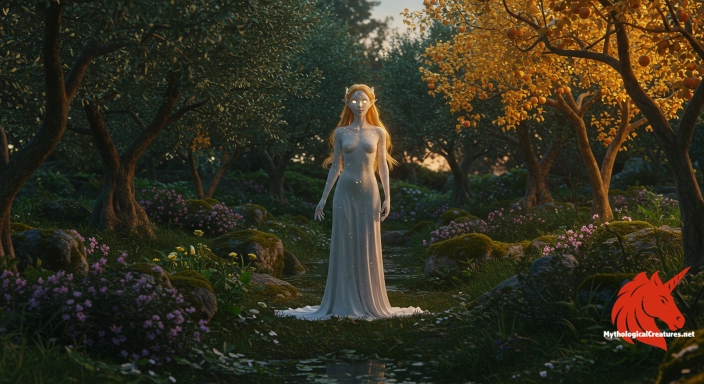
Nelisa
Nelisa - Nelisa embodies the divine interplay between nature and immortality, representing eternal beauty and the mystery of the setting sun.
Origins & First Encounters
Nelisa emerges in the tapestry of Greek mythology as one of the seven Hesperides, whose mystical guardianship protects a sacred orchard at the edge of the known world. Born from divine and enigmatic origins, she embodies the ephemeral beauty of twilight, a time when light and darkness dance in delicate balance. Her presence, although only briefly alluded to in surviving texts, has captured the imagination of both ancient storytellers and later poets. As a member of this illustrious group, Nelisa is revered not only for her beauty but also for the wisdom and purity symbolised by the golden apples she and her sisters guard. The legends of Nelisa hint at a celestial connection with the waning day, marking her as a figure bridging the mortal realm and the divine. Even though details about her life are scarce, the allure of her character reflects timeless themes of mystery and nurturing grace. Her myth continues to intrigue those who delve into the subtleties of ancient folklore, where every mention enriches her character. Through varied artistic interpretations, Nelisa is portrayed as a luminous being whose existence resonates with the eternal cycles of nature and the heavens.
Source Texts & Tale Variants
The primary sources that mention Nelisa are few and fragmented, with references scattered across obscure Hellenistic texts and lost classical manuscripts. Ancient chronicles and poetic fragments seldom single her out, instead grouping her with her sisters as part of the revered Hesperides. In some rare literary accounts, she is indistinguishably interwoven with the collective mythos that celebrated the guardianship of divine orchards. Oral traditions, later recorded by Byzantine scholars, provided additional layers of narrative—albeit with variations—that have enriched the myth over time. Certain artistic representations found on ancient pottery and frescoes also hint at her presence, though they seldom provide detailed accounts of her personal attributes. In many story variants, the focus shifts between the group and individual traits, leaving room for modern reinterpretations of her myth. These variant stories offer contrasting details about her character and role, often reflecting regional influences and the evolution of mythic traditions. Despite the scarcity of comprehensive ancient texts dedicated solely to her, the multiple strands of narrative attest to her enduring, if elusive, nature in Greek mythology.
Form & Powers
Artistic portrayals of Nelisa reveal her as a figure of ethereal beauty, with features that glow with the soft luminescence of twilight. She is often depicted with long, flowing hair that takes on the warm hues of a setting sun, seamlessly blending with the natural palette of the evening sky. Her eyes, deep and contemplative, mirror the serene and mysterious ambience of dusk, inviting observers into the quiet depths of her character. Nelisa’s form is slender and graceful, her physique reflecting the idealised beauty that was celebrated in ancient Greek art. Delicate floral motifs—often intertwined around her hair or adorning her garments—serve as visual metaphors for her connection to nature and eternal cycles. In some depictions, subtle hints of wings or ethereal auras are added to her image, suggesting a fleeting presence that transcends the ordinary. The inclusion of golden apple and ivy motifs in her iconography further emphasises her role as a guardian of nature’s bountiful gifts. Through generations of artistic reinterpretation, her portrayal has varied, yet the enduring vision of an otherworldly, radiant nymph remains central to her mythic identity.
Regional Faces
The portrayal of Nelisa has undergone subtle yet significant transformations as her myth travelled beyond the confines of mainland Greece. In classical Greece, she was intimately linked with sacred groves and divine orchards, where the golden light of the west symbolised hope and renewal. Across the Mediterranean, local interpretations began merging her image with regional deities of harvest and seasonal change, each adding distinct local colour to her narrative. In Aegean communities, festivals celebrating the autumn harvest sometimes incorporated tales of Nelisa as a benevolent spirit who nurtured the land. Rural traditions in parts of Southern Italy and Sicily absorbed elements of her mystique, portraying her as a gentle guardian whose influence extended into everyday life. Local storytellers and artists adapted her image to echo the beauty of their native landscapes, infusing her with traits that celebrated both the mystique of the twilight and the vitality of nature. Despite these regional adaptations, the core symbolism of her eternal connection with the fading light remained consistent. The regional variations underscore the adaptability of myth, where Nelisa’s essence is reimagined to resonate with diverse cultural sentiments while retaining her fundamental role as a keeper of sacred beauty.
Cultural Parallels
Nelisa’s myth finds interesting parallels with various mythological figures across cultures who guard sacred groves or embody the ephemeral beauty of nature. Comparable to other Greek nymphs such as the Charites, she personifies both nurturing grace and the alluring mystery found at the boundary between the divine and the mortal. Her guardianship of the golden apples resonates with Roman deities like Pomona, whose association with fruit and harvest highlights similar themes of fertility and life. Analogous figures can also be found in Eastern traditions, where goddesses overseeing orchards and gardens serve as emblems of renewal and eternal beauty. The concept of a twilight guardian appears in several cultures, reflecting a universal fascination with the transient moments between day and night. These cross-cultural parallels underscore the common human quest to symbolise nature’s bounty and the cycles of growth, decay, and rebirth. Both artistic and literary comparisons reveal that Nelisa and her counterparts share a perennial role in mythological narratives as custodians of the natural world. Such comparative explorations enrich our understanding of how myth and metaphor transcend geographical boundaries, uniting disparate cultures in a shared celebration of life, beauty, and the mysteries of twilight.
Legacy & Modern Evolution
The evolution of Nelisa’s myth illustrates the changing dynamics of cultural interpretation from antiquity to the modern era. While early references to her were brief and fragmentary, later artistic and literary movements embraced her as a symbol of ethereal beauty and the eternal allure of nature. During the Renaissance, her image was revived and reimagined in paintings, sculptures, and literary works, where she came to embody both the mystery of twilight and the gentle power of feminine divinity. Modern reinterpretations have expanded her character, casting her as a muse for contemporary fantasy literature and visual art. Her enduring legacy is seen in the subtle inclusion of her motifs in modern narratives that explore themes of ecological balance and the interplay between darkness and light. Contemporary artists often highlight her association with golden apples and lush, mystical landscapes, linking her ancient symbolism with modern environmental and spiritual ideals. The transformation of her image over the centuries illustrates the fluidity of myth, where even the most obscure figures can gain new life and significance over time. Today, Nelisa stands as a testament to the lasting power of ancient mythologies, continuing to inspire and captivate those who seek to explore the intersections of art, nature, and divine mystery.
Interesting Fact
Despite her lesser-known status compared to major Olympian deities, Nelisa's sacred duty as one of the Hesperides highlights the indispensable role of natural beauty and order in Greek mythology.
Partner with Mythological Creatures
Bring your myth-based world into ours
From game settings to narrative worlds, we work with partners who treat myths with care. Share your project for a potential sponsor slot.
Partner with usQuick Creature Info
Origin:
Associations:
Our Mythic Legendary Rating:

Habitat:
Supernatural Powers:
Physical Attributes:
Abilities:
Behavior:
Lore:
Related Creatures, Tales or Lore
- AAegle
- HHespera
- EErytheia
References
Discover Another Mythical Legend You May Not Have Heard Of?
Uncover the mysteries of ancient folklore and expand your knowledge of legendary beings from cultures around the world.
Dare to Meet the Bolbe....
Curated by the Mythological Creatures Team
Series editor: Mythological Creatures Directory
Primary desk: Hellenic & Ancient Mediterranean Desk
(rev. November 2025)