
Nüba: Nüba is a Chinese drought deity, also known as Ba and Hanba, who embodies the force behind prolonged dryness.
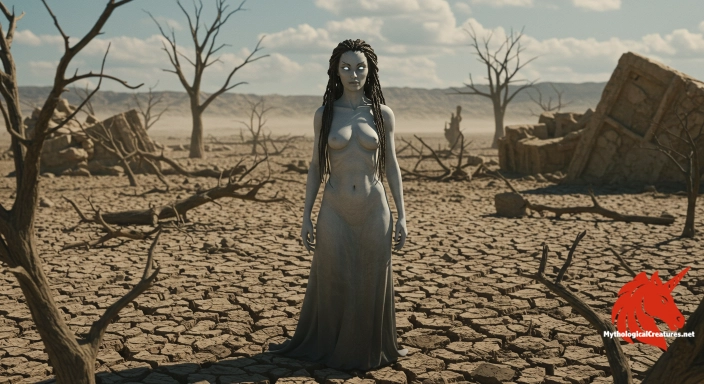
Nüba
Nüba - Nüba embodies the natural cycle of drought, serving as a personification of water scarcity in ancient Chinese belief systems.
Origins & First Encounters
Nüba appears in Chinese mythology as a potent embodiment of drought, a deity whose presence was both revered and feared by agrarian communities. Her very name, merging the feminine marker 'nü' with 'Ba' and the modifier 'han', signifies her direct association with the desolation wrought by prolonged dryness. She is rooted in ancient folklore where natural disasters were personified, imbuing the landscape with divine influence. In early epochs of Chinese civilisation, her figure stood as a reminder that the power of nature was vast and uncontrollable. Her myth was interwoven with the lives of those who depended on seasonal rains, and human fortunes were believed to hinge on her mercurial grace.
The narrative of Nüba evolved from oral traditions to early written records, reflecting the cyclical confrontation between human endeavour and nature’s wrath. Communities, vulnerable to the ravages of drought, created rituals and ceremonies centred around her, both placating her ire and seeking her favour. Her story encapsulates a rich interplay between fear and respect—a duality that has allowed her legend to endure over centuries. Gradually, she came to represent not only the physical hardship of drought but also the symbolic battle between life and a barren world. Through her, ancient peoples articulated their deep-rooted connection to, and dependence upon, the unpredictable forces of the natural world.
Source Texts & Tale Variants
Ancient texts, though few in number, provide fragmented insights into the myth of Nüba, often referring to her simply as 'Ba'. These early sources capture the essence of her role as the instigator of drought, embedding her in the collective memory of rural societies. Oral transmissions and regional treatises preserve a variety of narratives, each adding distinct layers to her persona. In some early manuscripts and local scrolls, her identity is conflated with the broader cosmic forces that governed weather and fertility. The sparse literary fragments, while not exhaustive, offer snapshots that have been elaborated in subsequent folk traditions.
Over time, her myth acquired variant features as bards and storytellers adapted her tale to local circumstances. Some recitations highlighted her wrath and the catastrophic consequences of her displeasure, while others infused her tale with the possibility of renewal following hardship. Ritual chants, incantations, and symbolic performances also feature elements of her character, underscoring her influence on both spiritual and practical aspects of daily life. This multiplicity of accounts demonstrates how her legend was continuously re-interpreted to meet the evolving needs and experiences of different communities. The story of Nüba, therefore, stands as a composite of layered historical memories and artistic embellishments.
Form & Powers
Artistic renderings of Nüba are as varied as the regions that celebrate her, yet a set of distinctive features consistently emerges. She is often depicted as an ethereal figure with long, flowing hair that billows like the arid winds across barren plains. Many portrayals suggest a delicate yet austere beauty, with eyes that sparkle with a fierce, inner light reminiscent of the glaring sun over cracked earth. Her complexion is sometimes shown in muted, earthen tones that evoke the parched soil affected by drought. These visual elements work together to provide a sense of both ominous power and fragile allure.
Additional illustrations present her adorned in flowing garments that mimic the shifting patterns of dust and cloud. Some artists incorporate motifs such as fragmented clouds or streaks of lightning into her attire, subtly symbolising her dominion over the weather. Her expression is typically one of solemn determination, reflecting a spirit that embodies both the beauty and the severity of nature’s harsher moods. Variations in her stature—from statuesque and imposing to slender and graceful—reflect the flexible nature of myth and the diverse artistic traditions that have venerated her. Each detail in her iconography reinforces the narrative of a deity who is as much a mirror of nature’s splendour as it is an embodiment of its fury.
Regional Faces
Regional interpretations of Nüba’s myth reveal a remarkable adaptability to local landscapes and cultural concerns. In northern areas where droughts often inflicted severe hardship, she is portrayed with a fiercer aspect, a dread spectre whose arrival signals both punishment and the imminent need for communal vigilance. Local legends in these regions emphasise her wrathful management of the skies, capturing the brutal inevitability of an unyielding sun and parched fields. Rituals and local festivals dedicated to her aimed at coaxing mercy from a deity whose temper was as unpredictable as the weather itself. In these narratives, her presence is inextricably linked with the survival strategies of the community.
Conversely, southern traditions sometimes imbue her character with a subtler combination of beauty and sorrow, reflecting areas where drought was interspersed with periods of much-needed rain. Here, her face is sometimes softened into a more compassionate, albeit enigmatic, expression that symbolises hope for eventual rejuvenation. Artistic depictions and performance arts in these regions often celebrate her as both a harbinger of hardship and a muse for resilience. The regional variations not only highlight local environmental challenges but also illustrate the capacity of myth to adapt, ensuring that her essence remains relevant in diverse cultural landscapes. Thus, Nüba’s evolving image mirrors the dynamic interplay between local environmental realities and the timeless human quest for balance with nature.
Cultural Parallels
Nüba’s figure resonates with a broader global mythological canon where deities embody the capricious forces of nature. Her role as a personification of drought invites comparisons with similar spirits and deities found both in neighbouring East Asian lore and in distant cultures facing the ravages of dry spells. While distinct in her cultural lining, she mirrors the essence of natural forces seen in other traditions, such as spirits invoked during periods of environmental stress in arid regions of the world. The inherent duality in her character—combining destructive power with the latent possibility of renewal—finds echoes in various mythic archetypes worldwide. Such parallels suggest that early societies, regardless of geographical separation, often sought to encapsulate the unpredictable moods of nature in divine form.
This comparative view also reveals how civilizations intertwine the themes of vitality and decay within their mythologies. In similar fashion to drought deities elsewhere, Nüba’s story is a narrative of both lament and warning, reflecting a universal human response to the cycles of hardship and regeneration. Although the symbols and rituals differ, many traditions share a belief in the power of nature personified as a divine guardian of life's rhythms. Her myth stands as a cultural bridge, linking ancient wisdom traditions that venerate both the Earth's bounty and its occasional desolation. In this way, her enduring image is part of a larger, interconnected tapestry of human efforts to understand and respect the forces that shape existence.
Legacy & Modern Evolution
Throughout history, the legacy of Nüba has undergone a gradual transformation, mirroring shifts in societal attitudes toward nature and the environment. Early portrayals emphasised her role as a fearsome agent of drought, a deity whose unpredictable temperament demanded solemn rituals and deep reverence. As Chinese society entered modernity, her myth was reinterpreted to reflect emerging concerns about environmental vulnerability and the impact of climatic extremes. Traditional ceremonies gradually gave way to literary and artistic expressions that capture her as a symbol of ecological fragility and human resilience. This evolving narrative has allowed her legend to bridge the ancient with the contemporary, maintaining relevance in a rapidly changing world.
Modern depictions of Nüba often incorporate a nuanced blend of her classical attributes with contemporary ecological metaphors, presenting her as a cautionary emblem in discussions about sustainability. Artists, writers, and cultural commentators now invoke her imagery to explore the complex relationships between industrial growth, environmental degradation, and natural renewal. Her once fearsome aspect has grown into a multifaceted symbol that invites both lamentation for what is lost and hope for what might be recovered. The ongoing cultural dialogue around her myth reflects an enduring commitment to understanding nature’s immense power and the need for harmony between human endeavors and the environment. In this manner, Nüba remains a timeless reminder of the delicate balance that sustains life, ever relevant in an era marked by environmental uncertainty.
Interesting Fact
An intriguing aspect of Nüba is how her very name combines a feminine marker with the concept of drought, revealing a deep cultural symbolism that links gender with natural phenomena in Chinese mythology.
Mythology-aligned partners
Showcase your myth-friendly brand here
Run a store, studio, or platform that lives in the world of myth and folklore? A curated sponsor panel on these pages may fit.
Explore partnership optionsQuick Creature Info
Associations:
Our Mythic Legendary Rating:

Also Sometimes Known As:
Habitat:
Supernatural Powers:
Physical Attributes:
Abilities:
Behavior:
Weaknesses:
Lore:
References
Discover Another Mythical Legend You May Not Have Heard Of?
Uncover the mysteries of ancient folklore and expand your knowledge of legendary beings from cultures around the world.
Dare to Meet the Hræsvelgr....
Curated by the Mythological Creatures Team
Series editor: Mythological Creatures Directory
Primary desk: Asian & Pacific Myth Cycles Desk
(rev. November 2025)