
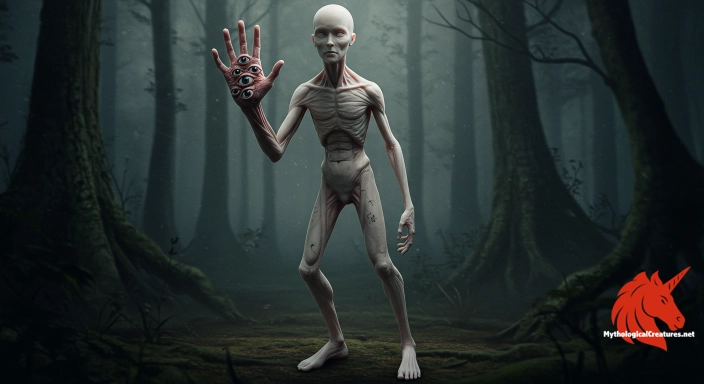
Tenome: Tenome is a Japanese yōkai famously depicted in the Gazu Hyakki Yagyō.
Tenome
Tenome - Tenome exemplifies the Edo-period artistic fascination with the supernatural, challenging conventional anatomical norms.
the legend in five swipes.
the legend in five swipes.
Where does Tenome come from?
Tenome emerges as one of the most enigmatic figures within Japanese yōkai, its bizarre appearance challenging our conventional perceptions of the human form. Its very name, meaning 'hand eyes', immediately intrigues with the notion of sensory organs in unexpected places. First drawn into the folkloric canon through its depiction in the celebrated Gazu Hyakki Yagyō by Toriyama Sekien, Tenome has captivated the imagination of both the artistic and popular realms. This creature was conceived during a period when the boundaries between the natural and supernatural were fluid, inspiring creators to explore the strange and uncanny. The illustration offers a window into the Edo period’s fascination with the grotesque, where art and myth intertwined to produce compelling images. Tenome’s design symbolically challenges the idea of normality by placing eyes where hands should be, a motif that blurs the separation between observer and instrument. Its debut in this influential compendium helped establish a template for later interpretations and adaptations. Over time, the creature has become a symbol of the unexpected, evoking both wonder and discomfort. In essence, Tenome stands as a vivid reminder of how imaginative reinterpretations of the human form can expand our understanding of vision and identity.
Which versions of the Tenome story survive?
The primary textual reference for Tenome is found in the influential work Gazu Hyakki Yagyō, where the creature is rendered with a mix of whimsy and mystique. This seminal illustration by Toriyama Sekien provided the initial framework that has fueled further explorations and commentaries in Japanese folklore. Subsequent Edo period texts and interpretative essays have revisited Sekien’s depiction, adding layers of meaning related to perception and the supernatural. While early records are sparse, various oral traditions and minor regional documents have hinted at alternative narratives surrounding the creature. In some accounts, Tenome is imbued with attributes that extend its role beyond a mere visual oddity to a keeper of hidden knowledge. These additional sources have sporadically portrayed it as a spectral observer, whose hand eyes serve as an unusual means of vigilance. As artists and scholars reinterpreted the original depiction, multiple story variants emerged that possessed divergent tones ranging from benign guardian to eerie harbinger. The richness of these narratives, though varied, consistently underscores the creature’s otherworldly allure. Ultimately, the interconnectedness of these sources highlights the dynamic nature of folklore and the fertile ground it provides for creative reinterpretation.
The Appearance and Powers of Tenome
The physicality of Tenome is as arresting as it is unconventional, centring on a humanoid form in which traditional facial features are replaced by eyes on the hands. This artistic choice suggests a reordering of sensory perception, where the act of seeing ceases to be confined to the face alone. The eyes themselves are often depicted as large, luminous orbs that impart an unsettling vibrancy to the creature’s overall appearance. Some illustrations reveal additional details, such as extra ocular features scattered along the limbs, deepening the sense of uncanny surveillance. The hands, reimagined as canvases for these watchful eyes, are rendered with intricate detail that combines both fragility and an otherworldly potency. Subtle variations in size and coloration have been noted in different depictions, with some portrayals highlighting an ethereal glow or strikingly vivid hues. Every aspect of Tenome’s anatomy seems designed to invoke both fascination and revulsion. The overall form is lean and agile, as if built for silent movement in shadowed realms. In its entirety, the physical depiction of Tenome encapsulates the essence of a creature that defies natural order, merging human familiarity with supernatural aberration.
The Local Faces of Tenome
As the legend of Tenome spread beyond the confines of the Edo urban milieu, regional adaptations infused the character with diverse local flavours. Local storytellers across Japan have adopted the core motif of hand eyes, sometimes softening its menacing aura to suit community beliefs or festival themes. In some rural areas, Tenome is portrayed as a benevolent spirit that silently watches over villages, while in other regions its appearance carries a more forbidding and ominous tone. Variations often include subtle differences such as altered eye arrangements or additional features that reflect local environmental influences and cultural nuances. These regional renditions have been integrated into folklore festivals and community rituals, where symbolic representations serve as reminders of the unknown. Certain coastal and mountainous areas even imbue the creature with elements drawn from local legends, enhancing its dual reputation as both protector and ominous observer. Despite these divergences, the central concept of dislocated sensory organs remains consistent. The adaptability of Tenome across regions underscores the fluidity of yōkai myths in mirroring regional preoccupations and artistic styles. In this way, the creature has evolved into a multifaceted symbol, rooted in local tradition yet universal in its ability to captivate the imagination.
Tenome: Echoes in Other Mythologies
Tenome occupies a distinctive niche within the corpus of mythological creatures that challenge conventional bodily norms, inviting comparisons with other beings whose forms defy typical human anatomy. Its signature features, especially the concept of eyes placed on the hands, bring to mind the broader motif of dislocated perception found in various global legends. In Japanese folklore, parallels may be drawn to creatures like hitotsume-kozō, which similarly disrupt traditional visual expectations. Beyond the confines of Japanese myth, numerous cultures have recounted legends involving unusual ocular placements or multiple eyes as symbols of hidden wisdom or supernatural prowess. These comparative narratives often serve to underscore a universal fascination with the act of seeing and the mysteries it conceals. The motif of mislocated sensory organs is used both to convey ominous forewarnings and to suggest an enhanced perceptual ability. While European and Middle Eastern traditions sometimes interpret such anomalies as markers of malevolent or demonic influence, Tenome embodies a more ambiguous role that is simultaneously unsettling and enigmatic. This cross-cultural dialogue highlights how varied mythological traditions use bodily irregularities to explore themes of insight and otherness. Thus, Tenome not only enriches Japanese yōkai lore but also contributes to a global tapestry of myth where vision and perception are central to the supernatural.
How is Tenome remembered today?
From its origins in the Edo period’s vibrant world of yōkai, Tenome has undergone a gradual transformation as societal attitudes towards myth and the supernatural have evolved. Its initial appearance in the Gazu Hyakki Yagyō set a precedent that influenced both scholarly discourse and popular imagery in subsequent centuries. Over time, the unsettling charm of Tenome has found a new audience, especially within modern manga, anime, and video games that draw upon yōkai traditions for inspiration. Contemporary artists have reinterpreted the creature with a blend of traditional aesthetics and modern sensibilities, often highlighting the dual themes of altered perception and surreal observation. The visual motif of hand eyes continues to inspire both commercial and independent creatives, serving as a powerful symbol in discussions on identity and the nature of insight. Modern reinterpretations frequently adopt a tone that celebrates the creature’s enigmatic qualities while also probing the limits of the human sensory experience. In academic circles, Tenome is studied as part of a broader investigation into the ways folklore transforms over time to mirror societal change. Its lasting appeal is a testament to the enduring nature of myth and the continuous reimagining of cultural icons. Today, Tenome not only serves as a relic of historical artistry but also as a dynamic participant in the ongoing evolution of modern folklore.
Interesting Fact
Tenome’s unique portrayal—with eyes replacing the expected features on a hand—continues to inspire modern interpretations of yōkai and challenges conventional ideas about vision and identity.
Mythological Treasures
Japanese Yokai: A field guide to the spirits and demons of Japanese folklore
Fifteen spirits, with the signs to watch for and what the old tales say to do if you meet one.
Chinese Beasts: A field guide to the dragons and demon kings of Chinese myth
From river dragons to demon kings, with the legends that shaped five thousand years of storytelling.
Greek Myths: A field guide to the monsters of ancient Greece
Every monster here earned its place in legend, and each gets a full page of artwork and the story behind it.
the legend in five swipes.
Mythology-aligned partners
Showcase your myth-friendly brand here
Run a store, studio, or platform that lives in the world of myth and folklore? A curated sponsor panel on these pages may fit.
Explore partnership optionsQuick Creature Info
Features:
Our Mythic Legendary Rating:

Also Sometimes Known As:
Habitat:
Supernatural Powers:
Physical Attributes:
Abilities:
Behavior:
Lore:
Related Creatures, Tales or Lore
References
Discover Another Mythical Legend You May Not Have Heard Of?
Uncover the mysteries of ancient folklore and expand your knowledge of legendary beings from cultures around the world.
Dare to Meet the Barghest....

The Mythological Creatures Book Series
Yokai, Greek, Norse, Egyptian & Chinese. Five illustrated field guides to the creatures the old stories either warned or told you about.


Curated by the Mythological Creatures Team
Series editor: Mythological Creatures Directory
Primary desk: Asian & Pacific Myth Cycles Desk
(rev. November 2025)