
Tianlong: Tianlong, the Heavenly Dragon, is a celestial being in Chinese mythology known for its majestic flight and symbolic presence in Chinese astrology.

Tianlong
Tianlong - Represents divine authority and celestial order, symbolizing power and balance in Chinese culture
Origins & First Encounters
Tianlong is a revered figure in Chinese mythology that embodies the majesty of the celestial realm, traditionally seen as a symbol of power and benevolence. Its name, meaning 'heavenly dragon', reflects a deep connection to the forces of nature and the cosmos, blending the earthly with the supernatural. The origins of Tianlong trace back to ancient traditions where dragons were seen as mediators between heaven and earth, and this creature quickly became an emblem of divine authority. Early records and iconography often linked Tianlong with imperial legitimacy, with its image gracing palaces and ceremonial artefacts of ruling dynasties. As a mythological archetype, it has been celebrated in poetry, art, and ritual practices, capturing the imagination of both the learned and the common folk. The celestial dragon’s presence in myth provided a narrative that underscored the harmony between nature and the cosmos. Over time, Tianlong came to represent more than just a guardian of the heavens; it evolved into a cultural symbol interwoven with ideals of wisdom, strength, and providence. Its depiction in various traditional forms highlights the intricate interplay between spiritual belief and natural phenomena. The prominence of this celestial creature in Chinese thought reflects an enduring tradition that marries myth with the lived experience of generations.
Source Texts & Tale Variants
The ancient texts and court records of China provide a multifaceted backdrop for the stories of Tianlong, even though no single source presents a definitive account. Early inscriptions and ritual manuscripts hint at the Heavenly Dragon’s role as a cosmic sentinel, a figure that monitored the natural order of the universe. Classical compendiums, passed down through generations, embed the creature within a broader tapestry of astronomical and divine symbolism. Over centuries, lore collected from Daoist scriptures, poetic anthologies, and regional folklore has contributed to a diverse corpus of narratives, each offering a unique perspective on Tianlong’s character. Variants of the tale often emerge from local oral traditions, where different communities attribute distinct supernatural feats to the celestial dragon. Some narratives present Tianlong as a benevolent guardian who ensures the equilibrium of natural forces, while others imbue it with a fiercer, more authoritative demeanour. These multiple versions underscore the adaptability of myth in capturing the volatile dynamics between humanity and nature. The dynamic interplay among textual evidence and artistic portrayals has enriched the mythology surrounding Tianlong. As a result, the story of Tianlong remains a vibrant and evolving legend that continues to be retold in myriad forms.
Form & Powers
Tianlong is frequently depicted with a sinuous, elongated form that captures the elegance of a celestial river flowing through the skies. Its scales are often described as iridescent and luminous, appearing almost otherworldly in their shimmer and colour. The creature’s head is typically adorned with spiralling horns and delicate, expressive eyes that seem to mirror the wisdom of the heavens. Flowing whiskers and an elegantly curved snout add to its regal and enigmatic appearance. In artistic renditions, slender and ethereal wings are sometimes shown, suggesting an effortless grace as the dragon navigates the cosmic expanse. The body of Tianlong is portrayed as both robust and fluid, interweaving elements of strength with a mystic, almost weightless quality. These physical attributes are depicted with great variance depending on the era and regional artistic conventions, yet they continuously evoke an image of divine refinement. Detailed brushstrokes, intricate carvings, and vibrant colours have all played a role in enhancing its otherworldly aesthetic. Overall, the Heavenly Dragon’s physical portrayal serves as a visual metaphor for its transcendent power and its role as a bridge between the earthly and the divine.
Regional Faces
Across different regions of China, the representation of Tianlong has undergone adaptations that reflect local aesthetic traditions and cultural priorities. In southern provinces, for instance, depictions of the heavenly dragon are often intertwined with motifs of water and rain, emphasising its role as a bringer of fertility and seasonal renewal. In northern areas, the creature is more frequently associated with the celestial sphere and the governance of cosmic order, aligning closely with imperial iconography. Regional artists have embraced distinct visual nuances, sometimes accentuating elongated, sinuous forms, while in other depictions the dragon exhibits a bold, stately presence. Local festivals and cultural celebrations have incorporated Tianlong as a symbol of protection and auspicious change, thus reinforcing its significance within the community. Variations in its depiction also extend to mythological narratives, where stories of celestial battles or benevolent interventions have been tailored to local lore. These adaptations reflect the broader socio-cultural landscape, where one's understanding of the divine often mirrors regional customs. Despite these differences, the essential characteristics of Tianlong remain intact, adapting gracefully to reflect both universal themes and local sentiment. Such regional variations enrich the tapestry of Chinese mythology and highlight the versatility of the Heavenly Dragon as a symbol.
Cultural Parallels
When comparing Tianlong with similar mythological dragons encountered in other cultures, its unique blend of celestial attributes and benevolent authority becomes particularly evident. The Heavenly Dragon of Chinese lore shares some commonalities with the serpentine dragons of East Asia, such as the Japanese Ryū and the Korean Yong, each embodying a harmonious connection with nature. In contrast to the malevolent or hoarding dragons of European mythology, Tianlong is predominantly a symbol of power, wisdom, and the maintenance of cosmic balance. This cross-cultural examination reveals that while dragons universally represent formidable forces of nature, the Chinese iteration is celebrated for its role as a divine intermediary. In many Western narratives, dragons are often depicted as adversaries to be overcome; however, Tianlong instead serves as a guardian whose intervention is both expected and revered. Artistic and literary traditions across cultures reaffirm the notion that dragons, whether benevolent or fearsome, play key roles in expressing humanity’s relationship with the metaphysical world. The nuanced differences between these cultural portrayals underscore a world view that favours integration with nature rather than domination over it. Comparative studies highlight that while regional dragons may differ in appearance and narrative role, they all reflect a universal fascination with the mysteries of the cosmos. Ultimately, Tianlong stands as a testament to the rich diversity of mythological thought and the capacity for one mythic creature to transcend cultural boundaries.
Legacy & Modern Evolution
Historically, Tianlong has evolved from a potent emblem of imperial power to a timeless icon deeply embedded in popular imagination. Early dynasties revered the celestial dragon as a sign of divine favour, and its image was integral to the symbolism of the Mandate of Heaven. With each successive era, artistic interpretations of Tianlong grew more refined, blending traditional motifs with innovative techniques to capture its ethereal magnificence. Its symbolism has also endured beyond the confines of official state rituals, permeating the realms of folklore, literature and visual arts. In modern times, contemporary media has reimagined the Heavenly Dragon with a blend of ancient symbolism and digital innovation, bringing it to life in films, animations, and graphic novels. This evolution reflects broader shifts in cultural expression, where myth and modernity intersect to create new narratives. Tianlong today often embodies hope, resilience and the timeless aspiration to reach beyond mortal limits. Its enduring presence in cultural festivals, architecture and branding demonstrates the continuing resonance of traditional myth in a rapidly modernising society. The majestic legacy of Tianlong, therefore, not only honours its historical roots but also inspires future artistic endeavours and cultural reinterpretations.
Interesting Fact
An intriguing aspect of Tianlong is its dual representation as both a celestial creature and an astronomical phenomenon, bridging myth and the stars in Chinese culture.
Partner with Mythological Creatures
Bring your myth-based world into ours
From game settings to narrative worlds, we work with partners who treat myths with care. Share your project for a potential sponsor slot.
Partner with usQuick Creature Info
Associations:
Our Mythic Legendary Rating:

Also Sometimes Known As:
Habitat:
Supernatural Powers:
Physical Attributes:
Abilities:
Behavior:
Lore:
Related Creatures, Tales or Lore
- QQinglong
- YYinglong
- FFucanglong
References
Discover Another Mythical Legend You May Not Have Heard Of?
Uncover the mysteries of ancient folklore and expand your knowledge of legendary beings from cultures around the world.
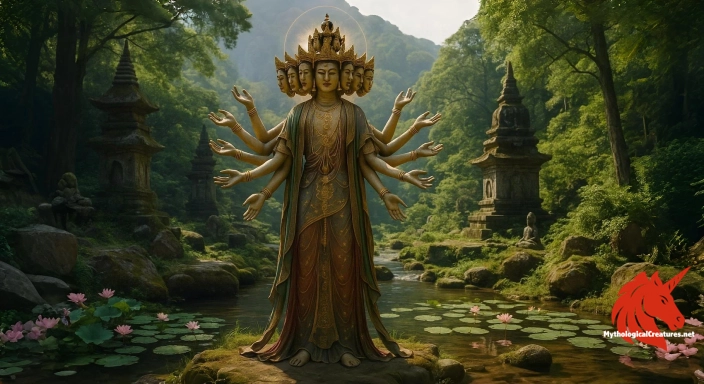
Dare to Meet the Ekādaśamukha....
Curated by the Mythological Creatures Team
Series editor: Mythological Creatures Directory
Primary desk: Asian & Pacific Myth Cycles Desk
(rev. November 2025)