
Tishpak: Tishpak is a Mesopotamian war god associated with the ancient city of Eshnunna.
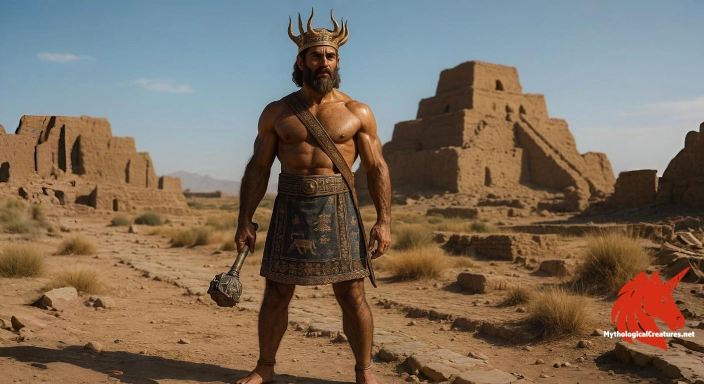
Tishpak
Tishpak - Tishpak was a central figure in Eshnunna, symbolising both warfare and kingship, and played a key role in displacing the earlier tutelary god Ninazu.
Origins & First Encounters
Tishpak emerged as one of the distinctive deities of ancient Mesopotamia, combining a formidable warlike spirit with an intriguing association to serpentine symbolism. He was primarily worshipped in the city of Eshnunna, where his cult quickly gained importance amid the region’s martial and political dynamics. His origins stand apart from the canonical Sumerian and Akkadian traditions, which makes his appearance in myth particularly compelling. As a god of war, his character symbolised the power and protection required by kingship and military command in tumultuous times. Early attestations found in local inscriptions indicate that Tishpak was revered as a powerful guardian, whose presence was believed to bestow victory and stability. The integration of snake imagery into his mythos not only bespeaks danger but also hints at hidden wisdom and regenerative forces. His mythological persona reflects the complex interplay between divine strength and cosmic order. The assimilation of these diverse elements in his character underlines the adaptive nature of Mesopotamian religious expression. Over time, Tishpak’s identity continued to evolve, reflecting broader cultural and political transformations in the ancient Near East.
Source Texts & Tale Variants
The narrative of Tishpak has been documented through a variety of ancient texts, ranging from administrative records to ritual hymns that celebrated his martial might. Inscriptions discovered in Eshnunna serve as primary sources, offering insights into his role as both a war deity and a symbol of regal authority. Variations in his story can be found in different cuneiform tablets, where certain accounts emphasise his serpent-like attributes while others highlight his association with kingship. Local mythic cycles often situate him in stories of divine conflict and transformation, suggesting that his portrayal was intimately linked with the societal needs of the period. Despite the fragmentary state of these sources, a consistent theme emerges that positions him as a protector and a warrior. Some texts even juxtapose his figure with that of Ninazu, revealing a competitive dynamic in the divine hierarchy of Eshnunna. The existence of multiple versions of his myth indicates a rich, orally transmitted tradition that later found expression in written form. His legend has therefore been subject to reinterpretation over time, mirroring the complexities of regional religious practices. These diverse textual sources together construct a multifaceted portrait of a deity whose narrative defies simple categorisation.
Form & Powers
Artistic representations of Tishpak reveal a striking admixture of human and reptilian features that underscore his dual nature as both a warrior and a mystical serpent deity. His depictions often show a robust, muscular figure endowed with a fierce countenance, which underscores his commanding presence in battle. The inclusion of serpentine motifs—like scaled textures and curling patterns—is evidence of his profound connection with creatures such as the mushussu and bashmu. In various reliefs and sculptures, he is portrayed wearing elaborate regalia that sometimes includes horned elements, symbolising his divine authority and martial status. The intricate detailing found in his iconography suggests that ancient artists sought to capture both the raw power of nature and the refined aspects of kingship in his form. His eyes, frequently rendered with an intense, focused glare, contribute to the overall impression of a deity who is both watchful and formidable. Some depictions indicate a fusion where human features blend seamlessly with reptilian attributes, hinting at his transcendent origin. The portrayal of Tishpak frequently focuses on a balance between elegance and ferocity, an embodiment of the orderly yet unpredictable forces he represents. Overall, his visual imagery stands as a testament to the sophisticated artistic and symbolic lexicon of Mesopotamian culture.
Regional Faces
The veneration of Tishpak varied significantly across different locales, reflecting a regional adaptability that enriched his mythic character. In the heartland of Eshnunna, his identity as a war deity was emphasized through both ritual practice and royal iconography, aligning him with the city's military and political ambitions. In surrounding regions, local cults often integrated Tishpak into their own pantheons, resulting in subtle shifts in emphasis—ranging from a protector of agricultural cycles to a guardian against chaos. This regional diversification is also evident in artistic representations, where the serpent motifs were sometimes exaggerated to align with local religious symbolism. The variations found in temple inscriptions and ritual texts suggest that different communities moulded his attributes to mirror their own cultural narratives and existential challenges. Some areas embraced his martial aspects while others highlighted his role in conferring divine legitimacy on rulers. The fluidity in his depiction across regions served to affirm the interconnected nature of ancient Near Eastern religious practices. As local traditions intermingled with broader Mesopotamian influences, Tishpak's persona was enriched with a multiplicity of meanings. Thus, his regional variations provide an insightful glimpse into how deities were adapted to meet the unique spiritual requirements of each community.
Cultural Parallels
In comparative mythology, Tishpak stands out as an intriguing figure whose attributes echo those of other deities across various cultures. His sharp martial characteristics and deep ties to serpentine iconography draw clear parallels with similar war gods whose images are intertwined with the symbolism of snakes and dragons in the ancient world. While he supplanted Ninazu as the tutelary deity in Eshnunna, his overall thematic complex resonates with deities like Baal, whose power over nature and battle echoes similar dualities. The integration of warrior aspects with elements of regenerative serpentine symbolism is a motif that recurs in diverse mythological traditions, underscoring a shared symbolic language among neighbouring cultures. His dualistic nature, where destructive force coexists with a protective capacity, finds echoes in hybrid deities present in adjacent cultures such as the Hittite or even certain Egyptian figures. By merging aspects of earthly kingship with mythic strength, Tishpak fits into a larger pattern where divine authority is often symbolised through animalistic motifs. His iconography thus becomes a point of convergence in cross-cultural analyses of divine martial power. Furthermore, his evolving narrative illustrates the adaptive processes by which ancient societies integrated external influences into their religious frameworks. Comparative exploration reveals that Tishpak’s complex identity not only reflects internal cultural dynamics but also participates in the broader dialogue of ancient Near Eastern religious thought.
Legacy & Modern Evolution
Despite the gradual decline of his cult in the wake of shifting political powers, Tishpak’s legacy continues to captivate both scholars and enthusiasts of ancient mythology. His transformation over time reflects the fluid boundaries of divine archetypes in the ancient world, as his character was continually reshaped to mirror changing social and political realities. The recontextualisation of his myth—from a fearsome war deity to a more nuanced symbol of kingship and cosmic order—demonstrates the dynamic nature of myth-making in Mesopotamia. Later periods saw his iconography absorbed into broader cultural narratives, where his reptilian and martial features were celebrated in diverse artistic media. In modern times, academic investigations have revived interest in Tishpak as a prime example of cultural syncretism and adaptive theology. His enduring image has found resonance in contemporary literary and artistic representations that explore themes of power, chaos, and regeneration. The reinterpretation of his myth serves as a reminder of the lasting impact that ancient religious figures can have on cultural memory. Present-day discussions often draw on the historical evolution of Tishpak to illustrate how ancient deities can transcend their immediate religious contexts. His legacy, continuing to inspire reinterpretation and debate, underscores the timeless allure of myth and the persistent power of ancient symbolism.
Interesting Fact
Tishpak’s unique blend of martial might and serpentine symbolism underscores a dual role as both a war deity and a legitimiser of kingship, marking him as a distinctive figure in Mesopotamian mythology.
Partner with us
Sponsor this space
Reach thousands of mythology enthusiasts with a curated placement on our creature pages.
Learn about sponsorshipQuick Creature Info
Origin:
Features:
Associations:
Our Mythic Legendary Rating:

Also Sometimes Known As:
Habitat:
Supernatural Powers:
Physical Attributes:
Abilities:
Behavior:
Lore:
References
Discover Another Mythical Legend You May Not Have Heard Of?
Uncover the mysteries of ancient folklore and expand your knowledge of legendary beings from cultures around the world.
Dare to Meet the Jack o' Legs....
Curated by the Mythological Creatures Team
Series editor: Mythological Creatures Directory
Primary desk: Hellenic & Ancient Mediterranean Desk
(rev. November 2025)