
Anathan: Anathan is a demon and warlike giant from Mandaean mythology who inhabits the World of Darkness.
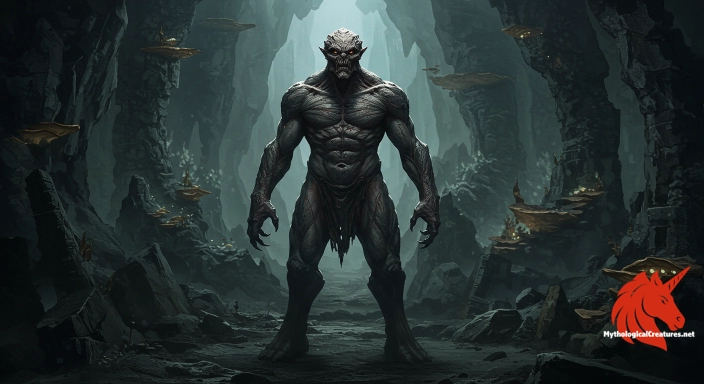
Anathan
Anathan - Represents the dark, combative forces in the underworld and serves as an obstacle to divine figures such as Hibil Ziwa
Origins & First Encounters
Anathan emerges as a compelling figure within the intricate tapestry of Mandaean myth, embodying formidable forces that inhabit the World of Darkness. His narrative roots trace back to a tradition where the interplay between light and shadow holds profound spiritual significance. His earliest attestation is found within the Right Ginza, a revered text that establishes his enigmatic role in the underworld. The character is depicted as not only a demon but also as a warlike giant, whose presence commands both fear and admiration. His association with the demoness Qin, and his connection to other notable figures such as Ruha and Zahreil, further deepens the complexity of his myth. The nuances of his persona highlight a dual nature that combines martial prowess with the dark, mysterious aspects of existence. His legend is interlaced with themes of cosmic conflict and redemption, reflecting an ancient understanding of the forces that shape the universe. The enduring fascination with his character shows that he remains central to discussions about the struggle between order and chaos within Mandaean cosmology.
The layered narrative of Anathan, enriched by symbolic and ritualistic significance, continues to captivate both ancient and modern audiences as a manifestation of dark, untamed power.
Source Texts & Tale Variants
The primary narrative of Anathan is detailed in the Right Ginza, where his formidable presence is recorded during Hibil Ziwa’s dramatic descent into the underworld. The text portrays him as a warrior of darkness whose encounter with the divine messenger sets the stage for a wider cosmic confrontation. In this account, his role as a guardian and emissary of the underworld is emphasised, creating a vivid picture of his martial attributes. The Right Ginza’s depiction cements his status as a key character in the spiritual hierarchy of Mandaeism. Beyond this canonical source, various oral traditions and hymns contribute fragments that offer additional variations of his story. These alternative versions occasionally adjust his role, emphasising different aspects of his nature, from sheer physical might to enigmatic wisdom. The diversity of these accounts ensures that his legend remains both dynamic and multifaceted. Intertwined with the broader mythological narrative, the numerous sources collectively enrich the tapestry of his identity.
This multiplicity of textual variants underscores how the story of Anathan has been preserved, transmitted, and reinterpreted across generations.
Form & Powers
In depictions of his form, Anathan is invariably portrayed as a towering giant whose physical presence exudes both power and mystery. His immense stature is complemented by a form that appears sculpted by the very essence of darkness, with muscles and contours that evoke an unearthly strength. His eyes are often imagined as burning with a spectral intensity, signifying the martial vigour and ancient fury that reside within him. The warrior’s visage marries nobility with menace, featuring a countenance marked by both solemnity and the scars of relentless cosmic battles. His skin and overall appearance are sometimes rendered with subtle gradations that mimic the shifting shadows of his underworld domain. In certain artistic representations, hints of horn-like appendages and intricate, almost armour-like markings accentuate his otherworldly nature. These visual cues serve to reinforce his dual role as both a vigorous combatant and a symbol of the ever-present darkness. The cumulative effect of these features is that of a being whose physicality is as formidable as it is enigmatic, combining both human traits and monstrous grandeur.
The detailed portrayals of his form resonate with an audience attuned to the mythic interplay of beauty and terror inherent in the underworld.
Regional Faces
Although Anathan is rooted in Mandaean tradition, his myth has found echoes in the broader cultural landscapes of the ancient Near East. Regional adaptations have occasionally merged his characteristics with local motifs, representing him as part of a larger pantheon of dark forces that govern the underworld. In these contexts, his warlike attributes are emphasized, often aligning him with regional beliefs about cosmic struggle and the supernatural order. Artistic depictions across different communities have incorporated indigenous symbols, lending him a distinctive local flavour alongside his canonical identity. His narrative occasionally intertwines with local legends that recount titanic beings and spirits tasked with maintaining the balance between creation and destruction. These retellings adapt his characteristics to suit the prevailing cosmologies of neighbouring cultures. As such, his evolving image reflects a fluid mythological tradition where a single figure can be reinterpreted to encompass broader, regional conceptions of darkness and power. The mutual exchange of ideas between communities underlines the universality of the themes his character represents.
Thus, the regional variations in his depiction enhance the richness of his myth, mirroring the diverse interpretations of similar dark and formidable entities across ancient cultures.
Cultural Parallels
Anathan’s character invites intriguing comparisons with similar figures across various mythological traditions, where dark titanic beings embody the forces of chaos and might. His depiction as a warlike giant resonates with images of formidable adversaries such as the titans of Greek mythology and the giants found in ancient Near Eastern lore. This shared archetype, of a colossal warrior who straddles the boundary between order and disorder, highlights a universal symbolism that transcends specific religious frameworks. His role mirrors that of other mythic adversaries who challenge the divine or cosmic order, serving as a necessary counterpoint in the eternal struggle of light versus dark. In comparative analysis, his figure is reminiscent of demonic entities in both Jewish mysticism and Zoroastrian traditions, where beings of immense size and power articulate the chaos inherent in the cosmos. The thematic clarity of a dark warrior, encased in both physical might and existential ambiguity, makes him a bridge between disparate mythological canons. His narrative, much like those found in other cultures, underscores the recurring motif of an eternal conflict that is essential for defining the moral and metaphysical landscape. Such cultural parallels shed light on a shared human tendency to personify the unknown and the fearsome aspects of our world in the form of mythic giants.
Through these cross-cultural connections, Anathan stands as a testament to the widespread allure of archetypes that grapple with the forces of darkness and destruction.
Legacy & Modern Evolution
The historical evolution of Anathan’s myth reveals a long-standing interplay between ancient tradition and modern reinterpretation. His image, rooted in early Mandaean texts, has gradually transcended its original religious context to become a symbol of the eternal struggle between order and chaos. Over time, depictions of him have evolved from stark, scriptural descriptions to increasingly elaborate portrayals in art, literature, and contemporary media. His portrayal as a warlike giant has inspired modern adaptations that explore themes of resilience, defiance, and the enigmatic nature of darkness. In recent decades, scholars and artists have re-assessed his role, drawing parallels with modern narratives that delve into the complexities of good versus evil. His myth has also found resonance within popular culture, where the archetype of the dark warrior continues to capture the imagination of a diverse audience. The reinterpretation of his character reflects broader cultural shifts, as ancient symbols are recontextualised to address modern dilemmas and existential queries. As a legacy that bridges ancient mysticism with contemporary thought, Anathan remains a potent emblem of how myth can evolve and inspire across the ages.
His enduring presence in both academic discourse and creative expression ensures that the narrative of Anathan will continue to be reimagined, serving as a powerful reminder of the timeless dialogue between light and darkness.
Interesting Fact
Anathan’s depiction as both a warlike giant and a spiritual demon highlights the dual nature of mythological beings in representing both physical strength and profound metaphysical influence.
For myth educators and toolmakers
Built a resource for mythology learners?
If you offer courses, teaching tools, or research platforms focused on myth and folklore, consider a discrete placement on our reference pages.
Introduce your resourceQuick Creature Info
Origin:
Features:
Associations:
Our Mythic Legendary Rating:

Also Sometimes Known As:
Habitat:
Supernatural Powers:
Physical Attributes:
Abilities:
Behavior:
Lore:
References
Discover Another Mythical Legend You May Not Have Heard Of?
Uncover the mysteries of ancient folklore and expand your knowledge of legendary beings from cultures around the world.
Dare to Meet the Furaribi....
Curated by the Mythological Creatures Team
Series editor: Mythological Creatures Directory
Primary desk: Hellenic & Ancient Mediterranean Desk
(rev. November 2025)