
Ornea: Ornea is a mythological nymph from Greek mythology, believed to be the eponymous spirit of the town of Orneae in Argolis.
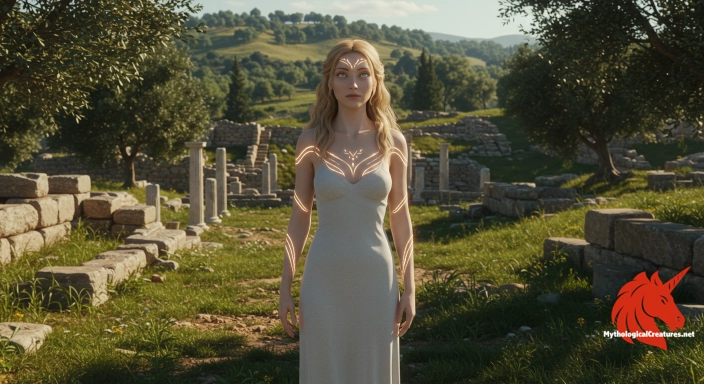
Ornea
Ornea - Represents the personification of the natural spirit of Orneae and reflects the local mythological traditions, with an alternative attribution to Orneus highlighting the complexities of local lore.
the legend in five swipes.
the legend in five swipes.
Ornea Origins: The Earliest Accounts
Ornea emerges as an enigmatic figure from ancient Greek mythology, embodying a delicate link between nature and civilization. In the myths, she is celebrated as the possible eponymous nymph of Orneae, a quaint town in the region of Argolis. Her origins are interlaced with the early traditions that sought to divine the spirit of the land and bind it to local identity. Emerging from a time when geographical locations were often personified by divine beings, her presence was thought to bless the community with fertility and harmony. Intricate narratives surrounding her suggest that she was a guardian of the natural surroundings, a role that resonated deeply with those who revered the earth and its bounty. Alternative traditions conflate her identity with that of Orneus, the Athenian son of King Erechtheus, thereby adding layers of royal and heroic significance to her story. This duality reflects the fluid nature of mythmaking in ancient Greece, where divine and mortal legacies often intermingled. The enduring charm of her myth lies in its ability to evoke a sense of wonder about the natural world and its mysterious ties to human destiny. Her tale provides a window into the ancient mindset that imbued the environment with sacred importance and a timeless allure. Overall, Ornea stands as a symbol of the intricate interplay between local heritage and the expansive tapestry of Greek myth.
Ornea: Variants Across the Sources
Ancient literary fragments and local inscriptions offer the first glimpses into the world of Ornea, even though the sources are sparse and fragmentary. Some of these early texts link her to the geographical identity of Orneae, suggesting her pivotal role in the town’s founding myth. There are subtle references in classical records that evoke the presence of a divine figure, whose influence may have extended into local religious practices. In certain accounts, her story is intertwined with that of Orneus, implying an alternative mythic narrative that has puzzled scholars for centuries. These diverse versions are testament to the oral traditions that shaped and reshaped her myth across generations. The surviving narratives hint at her role in rituals and local festivals, although specific details have faded with time. Over the centuries, the attenuation of these primary sources has led to an evolving tapestry of interpretations. Each retelling, influenced by regional storytelling and local cult worship, has enriched the lore surrounding her legacy. Variations in her portrayal illustrate the dynamic and mutable nature of myth-making. The interplay between these sources and their evolving interpretations reveals the richness of ancient Greek storytelling.
Ornea: Physical Form and Supernatural Powers
Artistic and literary depictions of Ornea paint her as a figure of ethereal beauty, reflecting the timeless grace typical of nature spirits. Her form is often envisioned as delicate and slender, embodying the soft elegance of a gentle breeze. The luminous quality of her skin is said to capture the light of dawn, evoking both radiance and subtle mystery. Flowing tresses, imagined as streams of liquid silver or gold, cascade in a manner that mirrors the natural waterways of the countryside. Her eyes, deep and reflective, evoke the serene and boundless blue of a clear sky. Classical representations, though few, have allowed room for creative interpretation, with some artists blending her image with aspects of floral and arboreal motifs. The overall impression is one of fragile yet resilient beauty, a physical echo of the nurturing power of nature. In later artistic expressions, her attire is sometimes depicted as being woven from the elements themselves—mist, leaves, and the vibrant hues of blooming flora. Such visual elements work in concert to underline her role as a nurturing guardian of the natural landscape. The narrative of her physical presence reinforces her status as an emblem of the eternal grace found in nature.
How does the Ornea legend change from place to place?
Within the diverse cultural landscape of ancient Greece, the figure of Ornea takes on distinctive traits that are shaped by local traditions and regional pride. In Orneae, her identity as a nymph is closely linked with the environmental richness of the area, celebrated in local rites and folklore. The Argolic tradition nurtured her image as a benevolent guardian whose presence ensured both agricultural fertility and communal well-being. In contrast, the Athenian association through Orneus introduces a heroic dimension, reflecting the city’s penchant for integrating myth with civic lineage. Myths in different regions have adapted her story to highlight the unique characteristics of their local environment, from pastoral serenity to urban heroism. Local festivals and rituals have often commemorated her with symbolic gestures that reflect the agricultural cycles and the vitality of nature. Artistic renditions found on regional pottery and in temple friezes further underscore these local nuances, revealing a tapestry of beliefs that enriched her narrative. These regional variations not only enhance the character of Ornea but also illustrate how ancient communities imbued their landscapes with divine significance. The multiplicity of her portrayals affirms the adaptive nature of myth, ensuring that her story resonated with diverse audiences. Her legacy is a vivid reminder that local identity and myth were deeply entwined in the ancient world.
How does the Ornea legend compare worldwide?
When considered alongside similar mythic figures, Ornea’s character reveals fascinating parallels across various cultural traditions. Her depiction as a nature-bound spirit aligns with a host of nymphs and minor deities found throughout the ancient Mediterranean. Like many of her contemporaries, she embodies the transient beauty of nature and the delicate balance between the mortal and the divine. The ambiguity in her origin, straddling the roles of both a nurturing nymph and a figure of heroic lineage, finds echoes in other mythologies where deities transcend simple categorisation. Roman lore, for instance, also features nature spirits that are both protectors of the land and bearers of local identity, underscoring a cross-cultural reverence for the natural world. Comparable narratives can be seen in Celtic and Norse traditions, where chthonic and animistic spirits reflect the same intrinsic connection to the land. In each culture, these figures serve as symbols of renewal, fertility, and the inexorable link between nature and community. The evolving interpretation of Ornea, therefore, not only reflects regional peculiarities but also resonates with a universal motif of human interaction with the environment. By drawing these parallels, one can appreciate how diverse cultures have harnessed similar myths to articulate their relationship with nature. Her story is a testament to the enduring appeal of natural divinities across the mythological spectrum.
Ornea: Then and Now
Over the ages, the myth of Ornea has journeyed from the intimate confines of local cult tradition to broader cultural expressions in art and literature. In antiquity, she was venerated as a divine presence that enriched the soil and inspired the communal spirit of Orneae. As time passed, her ethereal image was celebrated by Renaissance and later artists, who drew upon classical motifs to reinterpret her as an emblem of natural grace. The evolution of her myth reflects the changing attitudes toward nature and divinity, mirroring shifts in artistic, philosophical, and religious thought. Modern reinterpretations often cast her as a symbol of environmental authenticity, encapsulating the delicate balance between human civilisation and the natural world. Contemporary literature and visual arts have incorporated her essence into works that speak to ecological awareness and the revival of ancient wisdom. Her myth has also found a place in local festivals and cultural events, where the ancient narrative is re-envisioned to celebrate regional heritage. The enduring legacy of Ornea speaks to the timeless human need to connect with the forces of nature. As new generations look towards sustainable futures, her tale—the union of beauty, mystery, and the vitality of the land—continues to inspire and provoke contemplation. Ultimately, the story of Ornea remains a living thread in the rich tapestry of myth, bridging the gap between ancient belief and modern sensibility.
Interesting Fact
A notable aspect of Ornea's mythology is the alternative attribution of the town's eponym to Orneus, a mortal hero, which reflects the layered nature of myth-making and the diverse traditions within Greek mythology.
Mythological Treasures
Greek Myths: A field guide to the monsters of ancient Greece
Every monster here earned its place in legend, and each gets a full page of artwork and the story behind it.
Japanese Yōkai: A field guide to the spirits and demons of Japanese folklore
Fifteen spirits, with the signs to watch for and what the old tales say to do if you meet one.
Norse Sagas: A field guide to the beasts of the Viking world
Drawn from the saga accounts themselves, with the powers, weaknesses and doom of each being set out.
the legend in five swipes.
Sponsor this space
Tasteful, fixed-fee placements for myth projects
No bidding wars or flashing banners. We offer simple placements for a small set of creators and brands aligned with our readers.
Request further detailsQuick Creature Info
Origin:
Associations:
Our Mythic Legendary Rating:

Also Sometimes Known As:
Habitat:
Supernatural Powers:
Physical Attributes:
Abilities:
Behavior:
Lore:
References
Discover Another Mythical Legend You May Not Have Heard Of?
Uncover the mysteries of ancient folklore and expand your knowledge of legendary beings from cultures around the world.
Dare to Meet the Vanapagan....

The Mythological Creatures Book Series
Yōkai, Greek, Norse, Egyptian & Chinese. Five illustrated field guides to the creatures the old stories either warned or told you about.


Curated by the Mythological Creatures Team
Series editor: Mythological Creatures Directory
Primary desk: Hellenic & Ancient Mediterranean Desk
(rev. November 2025)