
Teakettler: The Teakettler is a small, elusive creature from American lumberjack folklore known for its backward walking and kettle-like whistle.
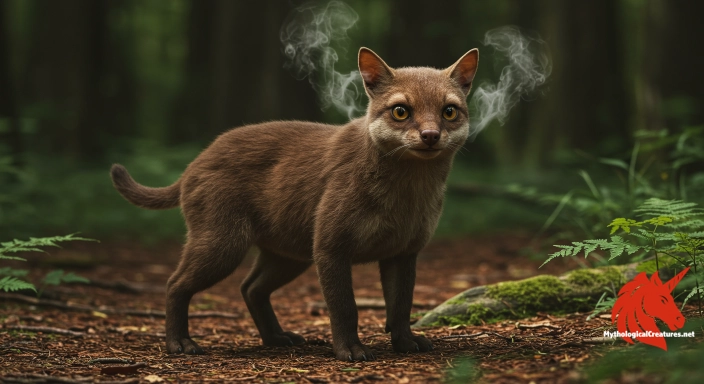
Teakettler
Teakettler - Represents the quirky and enigmatic side of American wilderness lore, sparking imagination and tall tales among lumberjacks.
Origins & First Encounters
The Teakettler emerges from the rich oral tradition of American folklore and has its roots in the rustic life of lumber camps in Minnesota and Wisconsin. Its legend grew among the hardworking lumberjacks who sought both amusement and a touch of mystery during long, arduous days in the forest. The creature is deeply embedded in a cultural context that blends humour with the natural challenges of frontier life, forming an essential part of the Fearsome Critters mythos. Stories of the Teakettler have been shared around campfires, becoming a symbol of the imaginative spirit inherent in the lumberjack community. The myth has evolved over time, transitioning from a simple campfire tale to a notable instance of regional folklore. Early accounts are scarce, yet they offer colourful descriptions that weave together elements of natural phenomena and supernatural whimsy. The Teakettler represents a subtle interplay between reality and fantasy, where everyday objects like teapots inspire legendary creatures. The narratives surrounding it encapsulate both caution and entertainment, reflecting the unpredictable nature of life in the wilderness. Its persistence in folklore underscores the enduring human need to personify and mythologise the mysterious sounds and sights of the deep woods.
Source Texts & Tale Variants
Traditional storytelling played a central role in the preservation and evolution of the Teakettler legend, with accounts being passed down through generations of lumberjacks. Oral histories recounted in rugged logging camps form the backbone of its primary sources, even though no single text can claim exclusive authority over its details. Various regional anthologies of Fearsome Critters include mentions of the Teakettler, often as part of a motley assortment of peculiar forest inhabitants. The creature is sometimes referenced within collections of tall tales that served to entertain and educate those living on the margins of society. Multiple story variants contribute to the richer tapestry of its mythology, with subtle differences emerging as the legend travelled from camp to camp. In some versions, the Teakettler’s appearance and behaviour are slightly altered to suit the local humour and environmental peculiarities. Despite the scarcity of formal literary records, folklore experts have pieced together a composite view of its narrative through oral testimonies and regional compilations. This body of tradition has allowed the Teakettler's mystique to persist well into modern retellings of North American myth.
Form & Powers
The physical attributes of the Teakettler are as singular as they are evocative, fashioned from a blend of animalistic and inanimate characteristics. The creature is commonly described as having a compact, stout body reminiscent of a small dog with unusually stubby, sturdy legs that amplify its quirky mode of locomotion. Its head is adorned with ears that mirror those of a cat, lending an air of alertness and whimsy to its overall countenance. An exceptional feature is its distinctive mode of movement—it is reputed to only walk backwards, a trait that adds to its air of mystery and unpredictability. The creature’s mouth is said to emit steam much like a boiling tea kettle, a detail that reinforces the connection between its name and its unusual auditory signature. Variations in the descriptions sometimes include subtle differences in size, with some accounts suggesting a slightly larger build than others, though always maintaining a diminutive, almost toy-like appearance. Its fur and skin, when mentioned at all, are generally portrayed as blending into the misty, wooded surroundings where it is most often sighted. The unique combination of traits—a backward gait, a vaporous whistle, and a curious mix of canine and feline features—ensures that the Teakettler stands apart in the catalogue of mythical creatures.
Regional Faces
The legend of the Teakettler is most deeply rooted in the specific cultural landscapes of Minnesota and Wisconsin, where the ethos of the logging community permeates local lore. Despite these origins, similar narratives have found resonance in neighbouring regions where lumberjacks and rural communities have their own versions of mysterious forest creatures. Within these northern forests, slight adaptations to the Teakettler’s character emerge, reflecting the varied natural environments and social contexts. Some local tales emphasise an even more elusive nature, describing the creature as vanishing into dense fog or the shadows of towering pines. Regional adaptations sometimes incorporate indigenous elements, blending local natural phenomena with the tall tale tradition. In more remote logging camps, the Teakettler is sometimes conflated with other enigmatic critters, resulting in mixed descriptions that enhance its mythical status. These regional iterations contribute to a rich mosaic of folklore, where the creature’s auditory cues become symbolic of imminent surprise or mystery. The adaptability of its legend across regional lines is testimony to the vibrant and ever-changing landscape of American campfire storytelling.
Cultural Parallels
The Teakettler shares thematic and narrative similarities with a number of mythical creatures found in disparate cultural traditions, often serving as a metaphor for nature’s unpredictability. Like its counterparts in various North American tall tales, it embodies the curious intersection of natural phenomena and imaginative interpretation, similar in some respects to other Fearsome Critters such as the Snallygaster and the Jackalope. While European folklore sometimes celebrates creatures that mimic commonplace objects, the Teakettler’s analogy to a boiling kettle is uniquely tied to Middle American working life. In many ways, it parallels the spirit of other animal hybrids in global mythology, where natural characteristics are blended with aspects of everyday utilitarian items. Comparative analysis reveals that both the Teakettler and similar creatures serve to encapsulate the experiences of communities living on the edges of wild, unpredictable landscapes. Some Native American tales also feature inexplicable noises and elusive presences in the wilderness, echoing the Teakettler’s association with steam and sound. This confluence of features across cultures hints at a shared human impulse to decode and narrate the mysteries of the natural world. Ultimately, the Teakettler stands as a distinct yet allied figure within the broader cross-cultural panorama of myth, symbolising both the marvels and the quirks found in the depths of nature.
Legacy & Modern Evolution
Over the decades, the Teakettler has evolved from a whispered campfire story into a compelling emblem of lumberjack folklore and rural American myth. Its depiction has gradually shifted from a mere anecdotal oddity to a celebrated figure in the pantheon of Fearsome Critters, embraced by enthusiasts of tall tales and wilderness legends alike. As modern retellings continue to emerge, the creature’s backward gait and steaming whistle have become iconic symbols often referenced in literature and visual arts. Contemporary interpretations sometimes cast it as a mischievous spirit, whose elusive nature prompts reflections on the transient boundary between tradition and innovation. The spirit of the Teakettler has found new expressions in digital media, cartoons, and even local festivals, reinforcing its cultural significance in the modern era. Its legacy is one of creative resilience, capturing the inventive spirit of those who live close to nature and its inherent mysteries. The evolution of its portrayal has mirrored changes in societal attitudes towards nature—shifting from utilitarian hardship to a celebration of imaginative folklore. Today, the Teakettler endures as a cherished myth, reflecting the enduring bond between human ingenuity and the enigmatic beauty of the wilderness.
Interesting Fact
An intriguing observation about the Teakettler is its exclusive backward movement, which defies normal animal behaviour and fuels its legendary status among lumberjacks.
For serious mythcraft
Your project belongs among the legends
If your work deepens how people understand, play with, or teach mythology, a sponsor placement here keeps it in front of the right readers all year.
Submit a sponsorship enquiryQuick Creature Info
Origin:
Our Mythic Legendary Rating:

Habitat:
Supernatural Powers:
Physical Attributes:
Abilities:
Behavior:
Weaknesses:
Lore:
Related Creatures, Tales or Lore
References
Discover Another Mythical Legend You May Not Have Heard Of?
Uncover the mysteries of ancient folklore and expand your knowledge of legendary beings from cultures around the world.
Dare to Meet the Qiqirn....
Curated by the Mythological Creatures Team
Series editor: Mythological Creatures Directory
Primary desk: Americas & Indigenous Traditions Desk
(rev. November 2025)