
Aristaeus: Aristaeus is a formidable giant from Greek mythology, born as one of Gaia's earth-born children.
-9c77b94a-04ba-47a8-80ab-7cf93be6483f_small.webp "Aristaeus - Represents the fierce and rebellious nature of Gaia's offspring and the clash between ancient earth and Olympian order.")
Aristaeus
Aristaeus - Represents the fierce and rebellious nature of Gaia's offspring and the clash between ancient earth and Olympian order.
the legend in five swipes.
the legend in five swipes.
How did the legend of Aristaeus begin?
Aristaeus emerges from the depths of Greek mythology as one of the awe-inspiring Giants, birthed from the very flesh of Gaia herself. His origins lie in a time when the earth was still young and the forces of nature clashed with divine powers, setting the stage for epic battles and unforgettable legacies. Aristaeus is particularly notable for his participation in the monumental struggle against the Olympian gods, a conflict that marked the transition between primordial chaos and the establishment of celestial order. Despite the overwhelming odds and the haunting demise of his giant kin, he stands out as the sole survivor of the legendary Gigantomachy. His singular endurance elevates his status, casting him as a symbol of resilience in the face of divine retribution. Though many ancient accounts leave his narrative fragmented, his survival has been interwoven into the tapestry of myth, underscoring an intrinsic connection between earth and the forces that shaped it. Aristaeus’s tale not only captivates due to its dramatic context but also reflects the ancient Greek fascination with the colours of rebirth and transformation amid destruction. The legend of this solitary warrior continues to echo through the ages, offering a glimpse into a past where mortal defiance met the might of the gods and emerged as enduring lore.
What sources tell us about Aristaeus?
The story of Aristaeus is preserved in a diverse array of ancient texts, artistic depictions, and oral traditions that reveal the multifaceted nature of his myth. Fragments of epic poetry and scattered references in classical literature occasionally hint at his exploits during the cataclysmic battles with the Olympian deities. Votive offerings and vase paintings have also captured fleeting glimpses of his valorous presence, suggesting that his narrative was significant in local cultic practices. In certain Sicilian traditions, his tale is richly elaborated as the lone giant who defied the gods, intertwining his legacy with regional rites and ceremonies. Some later mythographers recast his story within the broader framework of survival against divine wrath, thus embellishing an already compelling legend. Variations in his story depict him not only as a warrior but also as a symbolic embodiment of earth’s unyielding spirit, influenced by the fluctuating fortunes of fate. The rich, albeit fragmentary, primary sources illustrate an evolution from fearsome myth to a narrative of solitary endurance. The fluidity of these accounts reflects the dynamic interplay between written texts and oral recitations in ancient society. Moreover, discrepancies between different versions underscore the role of local and temporal influences in shaping his story. Such diverse portrayals have allowed his myth to endure, inviting modern reinterpretation while maintaining a connection to its ancient roots.
What did Aristaeus look like?
Aristaeus is often envisioned as a colossal figure whose very stature speaks to the formidable power of the earth. His immense frame is typically depicted with an extraordinary robustness and muscularity, setting him apart from ordinary mortals. Ancient artistic renditions suggest that his skin carries the rough, textured quality of weathered stone, as if carved by time itself. His eyes are portrayed as deep-set and fiercely luminous, reflecting an inner fire that mirrors the tumultuous battles of his era. Flowing, coarse hair often appears in these depictions, imbued with hints of earthen hues and the rugged terrain he represents. His broad features, including a pronounced brow and a powerful jawline, contribute to an expression of steadfast determination. Some sculptures even incorporate natural motifs, such as swirling patterns that mimic the chaotic connection between the land and the sky. Despite the scarcity of exhaustive descriptions in the primary sources, the imaginative accounts consistently portray him as both a warrior and a living emblem of the raw forces of nature. Each artistic detail, from his mighty arms to his commanding silhouette, has contributed to a legacy steeped in both strength and mystique. This vivid portrayal serves to amplify his identity as a creature forged in the crucible of battle and intimately linked with Gaia’s enduring power.
How far did the story of Aristaeus spread?
Local adaptations of Aristaeus’s myth have given rise to distinctive portrayals that vividly contrast with the more generic narratives found in classical texts. In the rugged landscapes of Sicily, he is celebrated as the solitary survivor of the divine onslaught, a narrative that fosters a sense of local pride and resilience. The Sicilian tradition integrates his story with seasonal rituals and community celebrations, thereby reinforcing his role as a guardian of the land. Elsewhere in Greece, his character sometimes merges with broader themes of humankind’s tenuous relationship with nature and divine authority. Such regional variations have seen him depicted with subtle differences in physical attributes, emphasizing either his ferocity or his enduring connection to the earth. Local artists often imbue his image with elements reflective of the natural environment, such as motifs drawn from the local flora and rugged landscapes. Folk traditions further transform his legacy by interweaving it with cautionary tales and allegories on the limits of mortal defiance against the divine. These local narratives not only vary in detail but also imbue his story with unique moral and metaphysical dimensions. The result is a rich tapestry of cultural interpretations that highlight how myth adapts to serve the needs and values of distinct communities. In this way, Aristaeus becomes not just an ancient warrior, but a dynamic symbol interlaced with regional identity and pride.
Aristaeus: Shared Themes in World Myth
Aristaeus’s myth resonates with themes found in the wider corpus of global mythological traditions, where figures of immense power survive cataclysmic divine conflicts. His story of solitary endurance bears a striking resemblance to various cultural narratives that honour the lone survivor as a beacon of resistance and natural power. Similar motifs can be found in Norse legends, where titanic beings persist through apocalyptic battles and serve as harbingers of rebirth. Like many mythic outliers, his narrative explores the tension between the primordial forces of nature and the imposed order of the divine realm. The duality of his existence, merging the qualities of a warrior with those of an elemental force, mirrors parallels in myths where nature itself is personified. Across different cultures, figures with overwhelming physical presence often embody the struggle between chaos and civilisation, much like Aristaeus’s defiant stance during the Gigantomachy. Comparative analyses reveal how diverse societies have cultivated similar archetypes to express the universal theme of survival after cosmic upheaval. His portrayal as both venerable and formidable invites reflections on the nature of power, legacy, and the often-blurry lines between heroism and monstrosity. These cross-cultural connections underscore the role of myth in articulating humanity’s enduring fascination with the forces that shape both the natural world and the divine order. Ultimately, Aristaeus’s narrative sits comfortably alongside other mythological figures who are celebrated for their resilience and symbolic strength in the face of overwhelming odds.
Aristaeus: The Legend's Second Life
The myth of Aristaeus has experienced a remarkable evolution from its ancient origins to a contemporary symbol of resilience and transformation. Initially portrayed as a fearsome combatant in the epic clashes with the Olympian gods, his narrative has been reinterpreted over the ages to reflect shifting cultural values and artistic sensibilities. In the medieval and renaissance periods, his character was often reimagined as a metaphor for nature’s untamed spirit and the eternal struggle against overwhelming power. Modern retellings in literature, graphic novels, and even cinematic works have revived his image as a solitary yet enduring figure, appealing to audiences with a taste for heroic defiance. Contemporary scholarship frequently highlights his myth as an allegory of survival, where the remnants of a bygone era continue to influence and inspire. This enduring legacy has allowed Aristaeus to transcend the boundaries of traditional myth, entering dialogues around themes of environmental continuity and the human condition. Modern reinterpretations often blend classical elements with fresh, imaginative insights, rendering him a multifaceted symbol in today’s cultural landscape. As new media reexamine the ancient narrative, his story is used to explore the interface between myth and modern identity. The continual reinvention of his myth demonstrates how age-old stories can adapt, leading to varied portrayals that resonate across different times and contexts. In this way, Aristaeus remains a captivating figure whose myth, though rooted in ancient conflict, continues to evoke enduring questions about survival, nature, and the legacy of the past.
Interesting Fact
Aristaeus's status as the sole survivor of the Gigantomachy renders him a unique study in resilience and the unpredictable outcomes of divine conflicts. Though his parentage and the Gigantomachy place Aristaeus firmly within Greek myth, one late tradition has him flee to Greek-colonised Sicily—specifically Mount Etna—where Gaia conceals him, making ‘Sicilian Aristaeus’ a regional offshoot of the broader Greek narrative.
Mythological Treasures
Greek Myths: A field guide to the monsters of ancient Greece
Every monster here earned its place in legend, and each gets a full page of artwork and the story behind it.
Norse Sagas: A field guide to the beasts of the Viking world
Drawn from the saga accounts themselves, with the powers, weaknesses and doom of each being set out.
Egyptian Legends: A field guide to the gods and monsters of ancient Egypt
Guardians of the living and devourers of the dead, with the role each played in judgement.
the legend in five swipes.
Mythology-aligned partners
Showcase your myth-friendly brand here
Run a store, studio, or platform that lives in the world of myth and folklore? A curated sponsor panel on these pages may fit.
Explore partnership optionsQuick Creature Info
Origin:
Features:
Associations:
Our Mythic Legendary Rating:

Habitat:
Supernatural Powers:
Physical Attributes:
Abilities:
Behavior:
Lore:
Related Creatures, Tales or Lore
References
Discover Another Mythical Legend You May Not Have Heard Of?
Uncover the mysteries of ancient folklore and expand your knowledge of legendary beings from cultures around the world.
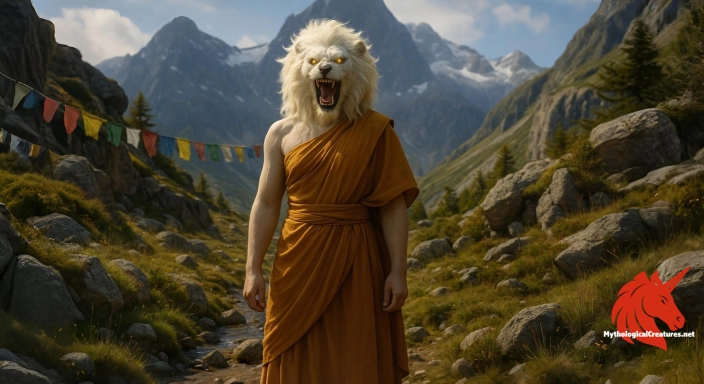
Dare to Meet the Simhamukha....
The Mythological Creatures Book Series
Yokai, Greek, Norse, Egyptian & Chinese. Five illustrated field guides to the creatures the old stories either warned or told you about.

Curated by the Mythological Creatures Team
Series editor: Mythological Creatures Directory
Primary desk: Hellenic & Ancient Mediterranean Desk
(rev. November 2025)