
Kubera: Kubera is the Hindu god of wealth and the supreme king of the semi-divine yakshas.
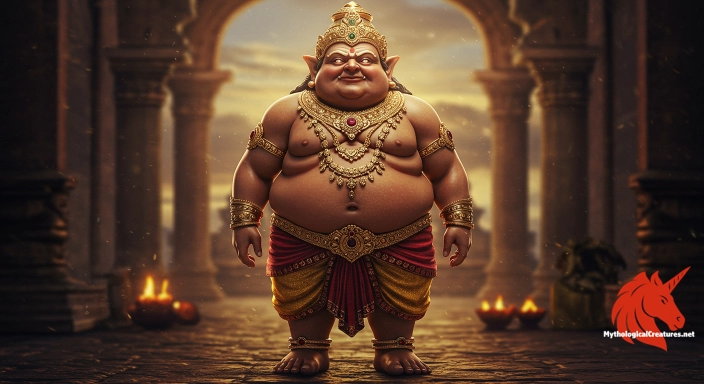
Kubera
Kubera - Kubera is revered as the guardian of wealth and treasures, playing a crucial role in multiple Asian religious traditions.
the legend in five swipes.
the legend in five swipes.
How did the legend of Kubera begin?
Kubera is a striking figure revered as the god of wealth and a guardian of earthly treasures within Hindu mythology, embodying both opulence and divine justice. His origins can be traced back to early Vedic texts, where he was initially depicted as the chief of dark, enigmatic spirits. Over time, his narrative evolved into that of a deva, signifying a rich transformation from a spirit of lesser repute to a celebrated celestial regent. His role as the sovereign of the semi-divine yakshas and the protector of the north underscores his integral place within the ancient cultural and religious panorama. His early depictions were enriched in later scriptures such as the Puranas and the great Hindu epics, where the complexities of his character were further unveiled. Kubera’s mythology interlaces themes of power, wealth, and moral responsibility, set against a backdrop of divine politics and cosmic order. His legendary tenure over Lanka and subsequent exile to the fabled city of Alaka serves as a powerful narrative of rise and fall intermingled with redemption. The myth serves as an enduring symbol of material abundance that is interwoven with the higher ideals of cosmic guardianship and ethical prosperity.
Kubera: The Written Sources
The multifaceted narrative of Kubera is drawn from a rich tapestry of ancient texts and oral traditions that span several religious traditions. Early Vedic writings first mention him as a potent overseer of malevolent forces before his character was later redefined in the Puranas and epic narratives. In these later texts, his identity as the custodian of wealth and the ruler of a host of semi-divine beings is elaborated with greater detail and symbolism. Multiple textual strands recount his rise to power, his regal reign in Lanka, and the subsequent loss of his temporal dominion to his half-brother. The variations in these stories underline the diverse cultural milieu in which his legend was cultivated. Beyond the Hindu canon, his lore finds resonance within Buddhist and Jain literature, where distinct yet convergent narratives further enrich his mythos. These texts explore his divine attributes, offering an intersectional view of wealth and guardianship that transcends a single religious framework. The intermingling of these sources has cemented Kubera’s role as a timeless emblem of prosperity and cosmic balance.
Kubera: Form, Powers and Weaknesses
Kubera is traditionally depicted with a notably plump and robust physique, an image that symbolises the boundless nature of wealth and prosperity. His form is often rendered in exuberant detail, with every curve and ornament echoing the lavishness he governs. Artists consistently portray him with a rich array of jewels and opulent regalia, each piece symbolically representing the treasure he commands. In many depictions, he is shown holding a money-pot filled with riches along with a club, which serves as a reminder of his assertive role in maintaining cosmic order. His visage, frequently adorned with a crown or elaborate headgear, exudes a sense of benevolence and majesty that underscores his status as the divine regent of wealth. Variations in artistic tradition may highlight different aspects of his iconography, be it through more intricate detailing of his sumptuous attire or the vivid colours used to accentuate his form. The visual representation of Kubera serves not only as a depiction of physical abundance but also as a metaphorical illustration of spiritual and material generosity. His dynamic portrayal in sculpture and painting continues to inspire reverence for both his divine attributes and his role as a cultural archetype of wealth.
How do regional versions of Kubera differ?
The myth of Kubera has traversed geographical and cultural boundaries, adapting uniquely to the regional traditions of various communities. In the heart of India, he is venerated as the quintessential custodian of wealth, with temples and shrines that highlight his benevolent yet powerful nature. His assimilation into Buddhist traditions, where he is known as Vaisravana, has led to a distinctive retelling of his narrative that emphasises luck and protection. In Jainism, his identity is recast as Sarvanubhuti, interweaving his portrayal with themes of renunciation and moral discipline. Meanwhile, in Southeast Asia, particularly in Indonesia, his figure is embraced under the name Daneswara, reflecting local artistic sensibilities and mythological adaptations. These regional variations often see subtle changes in his attire, iconographic accessories, and the symbolic elements associated with his divine persona. Local adaptations not only modify his narrative but also merge indigenous beliefs with overarching themes of prosperity and guardianship. The versatility of Kubera’s myth highlights a universal reverence for wealth and abundance, while also celebrating the rich cultural tapestries that have preserved and transformed his legend over centuries.
Kubera: Cross-Cultural Comparisons
Kubera’s myth bears an intriguing resemblance to various wealth deities found across different cultural and mythological traditions. His role as the guardian of treasure and the arbiter of economic fortune invites comparisons with figures such as the Greco-Roman deity Plutus, who similarly embodies the abundance of the earth. In East Asian traditions, deities like Caishen resonate with Kubera’s mix of opulence and protection, providing a cross-cultural dialogue on wealth that transcends geographical boundaries. This universal motif is further enriched by the way different societies enshrine the notion that material riches, when governed by divine authority, foster both prosperity and civic virtue. The narrative of Kubera, transitioning from a spirit of darkness to a revered custodian of wealth, parallels similar evolutions observed in other mythologies where deities undergo significant transformations. His incorporation into Buddhist and Jain frameworks also mirrors the adaptability seen in other deities as each cultural context reinterprets their core attributes. Comparative mythological studies reveal that while the names and iconographies may differ, the underlying human fascination with the interplay between wealth and divine providence is a shared thread. This syncretism ultimately enriches our understanding of how ancient societies sought to explain and celebrate prosperity through their deities.
How did Kubera survive into the modern world?
The evolution of Kubera’s myth is a remarkable chronicle that charts his transformation from a formidable spirit in early Vedic texts to a highly revered figure in later theological traditions. Over centuries, his narrative has been continually reshaped by subsequent literary, artistic, and cultural expressions, which have all contributed to his enduring legacy. In classical temples and ancient scriptures, Kubera is portrayed as the ultimate guardian of wealth, a symbol that has resonated deeply with societies that value both material prosperity and divine benevolence. In contemporary times, his image often appears in popular media, literature, and even commerce as a comforting sign of good fortune and economic success. Modern interpretations have embraced his dual nature, celebrating both his historical roots and his adaptability to new cultural contexts. Festivals and rituals across various communities evoke his blessings, further reinforcing his status as a timeless beacon of abundance. The shifting portrayals in art—from intricate temple carvings to vibrant modern graphics—testify to his influence on both traditional religious practices and contemporary cultural narratives. Today, Kubera remains emblematic of the intricate interplay between wealth, power, and spirituality, his legend continually evolving as it finds fresh relevance in an ever-changing world.
Interesting Fact
Kubera's journey from a fearsome spirit in early Vedic texts to a benevolent god of wealth illustrates the fluid nature of myth, where transformations in divine roles mirror cultural and religious evolution.
Mythological Treasures
Greek Myths: A field guide to the monsters of ancient Greece
Every monster here earned its place in legend, and each gets a full page of artwork and the story behind it.
Norse Sagas: A field guide to the beasts of the Viking world
Drawn from the saga accounts themselves, with the powers, weaknesses and doom of each being set out.
Egyptian Legends: A field guide to the gods and monsters of ancient Egypt
Guardians of the living and devourers of the dead, with the role each played in judgement.
the legend in five swipes.
Curated sponsor space
One subtle banner. Thousands of myth lovers.
We offer a small number of curated sponsor spots for relevant books, courses, games, and art. No clutter, just well-matched partners.
Partner with usQuick Creature Info
Associations:
Our Mythic Legendary Rating:

Also Sometimes Known As:
Habitat:
Supernatural Powers:
Physical Attributes:
Abilities:
Behavior:
Weaknesses:
Lore:
References
Discover Another Mythical Legend You May Not Have Heard Of?
Uncover the mysteries of ancient folklore and expand your knowledge of legendary beings from cultures around the world.
Dare to Meet the Tannin....

The Mythological Creatures Book Series
Yōkai, Greek, Norse, Egyptian & Chinese. Five illustrated field guides to the creatures the old stories either warned or told you about.





Curated by the Mythological Creatures Team
Series editor: Mythological Creatures Directory
Primary desk: Asian & Pacific Myth Cycles Desk
(rev. November 2025)