
All teaching resources
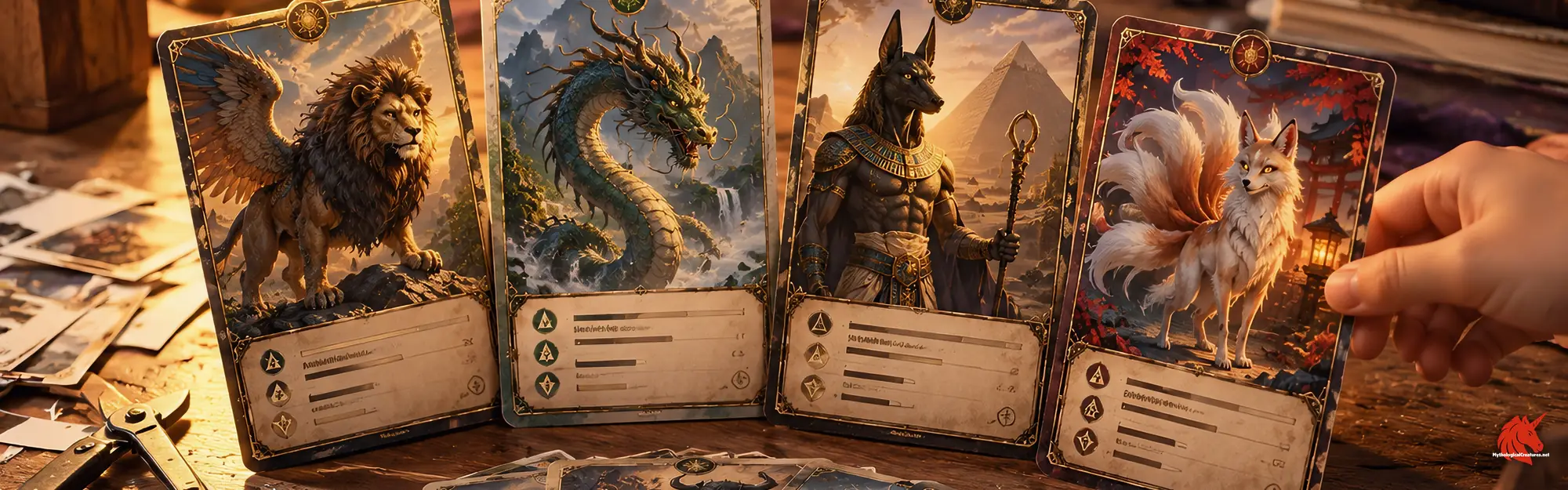
Mythology battle cards
Thirty-six cards. Print, cut, play. Rules on card 36.
A free resource for schools.
Print, display and photocopy freely.
Thirty-five creatures from five mythologies, six ratings each, and a game that gets a class debating which monster would win.
Thirty-six cards in all: thirty-five creatures and the rules. A4, nine cards to a sheet.
Download
What's in the file
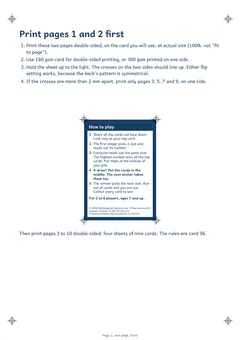
The deck, 36 cards
Nine cards to a sheet. Thirty-five creature cards and the rules card, plus one card back that prints the same way up either way, so any double-sided setting works.
The bulk of the file, nine cards to a sheet.
Card backs
Nine to a sheet. Print these on the reverse, or leave the cards single-sided.
After the fronts, for double-sided printing.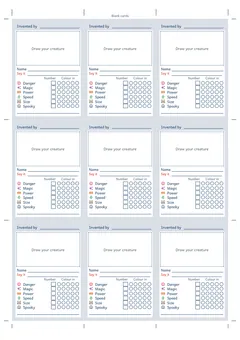
Blank cards
Nine to a sheet, for the creature a child invents on the planning sheet.
In the design-a-creature file, not this one.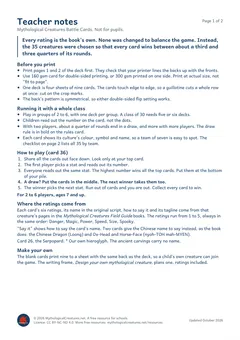
Teacher notes
Curriculum links, how to run it with a whole class, and where the ratings come from.
At the front of the file.
At a glance
- Year or grade
- Where it is named in a curriculum: England, school years 3 to 6. Australia, school years 3 to 7.
- Ages
- 7-13+
- Playing time
- 15 to 30 minutes, 2 to 6 players
- Preparation
- Printing and cutting. About 20 minutes once
- Prior knowledge
- None
What is on every card
- The culture it comes from, and the creature’s name in its original script
- The English name, and its number out of 35
- How to say it
- Six ratings: danger, magic, power, speed, size and spooky
- One line that says what the creature is known for
How to play
- Share all the cards out face down. Look only at your top card.
- The first player picks a stat and reads out its number.
- Everyone reads out the same stat. The highest number wins all the top cards. Put them at the bottom of your pile.
- A draw? Put the cards in the middle. The next winner takes them too.
- The winner picks the next stat. Run out of cards and you are out. Collect every card to win.
For 2 to 6 players, ages 7 and up. The rules are on card 36.
Where the ratings come from
The six numbers are not invented for the game. They are the ratings printed in the field guides, which is why a creature that harms no living thing scores 1 for danger however famous it is, and why the Minotaur beats a Valkyrie on size and loses on magic.
That is worth saying out loud before a class plays. The argument about whether a rating is fair is a better lesson than the game.
Curriculum links
- England
KS2 English work on myths and legends from a range of cultures, with children comparing and ordering the six ratings as they play.
Show the 2 codes
KS2 English: myths and legends · KS2 English: other cultures and traditions
- United States
No Common Core standard is claimed for the card game. RL.4.9 is about the treatment of themes and patterns of events, and the cards compare creatures by six numbers. The comparison task is the resource that meets it.
- Australia
Years 3 to 7 English, Literacy and Literature strands: contributing to a discussion, and forming and justifying an opinion while playing.
Show the 5 codes
English, Years 3 to 7
AC9E3LY02 · AC9E4LY02 · AC9E5LY02 · AC9E6LY02 · AC9E7LE02
These are the year levels where this resource has a named curriculum home. They are not a limit, and much of the material carries across other age groups.
Curriculum links checked October 2026 against National Curriculum (England, 2014), Common Core State Standards and Australian Curriculum v9.0. All curriculum links
Take it further
- Curriculum linksWhat every resource here supports in England, Australia and the United States.
- Compare the mythologiesFive creatures, five cultures, five questions. One lesson, with teacher notes and answers.
- Design your own creaturePlanning sheet, writing frame and a blank card so their creature joins the deck.
Licensed CC BY-NC-ND 4.0. Updated October 2026.