
All teaching resources
Compare myths from different cultures
One lesson. No preparation. Teacher notes and answers included.
A free resource for schools.
Print, display and photocopy freely.
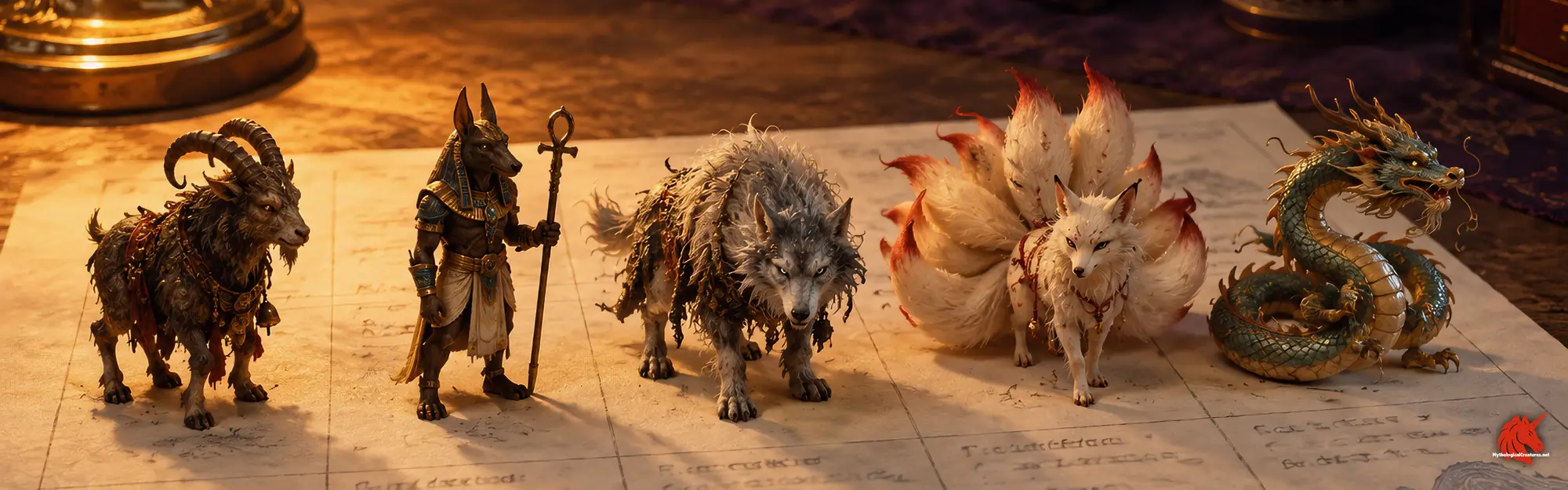
A single A3 sheet comparing five creatures from five mythologies across five questions: what they are made from, where they live, whether they help or harm, what their job is in the story, and how we know about them at all.
The five are the Minotaur, Ammit, Bai Ze, the Nue and Fafnir, one from each culture. Four of them are monsters built from other animals. One is not, and finding that out is the lesson.
Download
Two files, the same lesson. Choose the paper your printer takes.
What's in the file
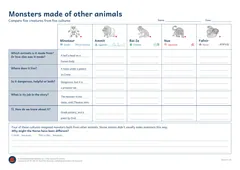
Pupil sheet, worked example
The Minotaur column is filled in, so a class can see what a good answer looks like.
A3: page 5. A4: pages 5 to 6.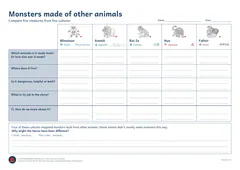
Pupil sheet, blank
Five creatures, five questions, nothing filled in.
A3: page 6. A4: pages 7 to 8.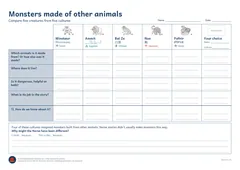
Pupil sheet, with a sixth column
An empty column for a creature of their choosing, or the one they invent on the planning sheet.
A3: page 7. A4: pages 9 to 10.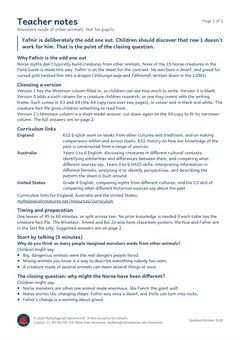
Teacher notes, two pages
Curriculum links, timing and preparation, discussion prompts with likely answers, and a full answers grid.
Pages 3 to 4 in both files.
At a glance
- Year or grade
- Where it is named in a curriculum: England and Australia, school years 3 to 6. United States, grades 3 to 5.
- Ages
- 7-12+
- Lesson time
- 45 to 60 minutes, or split across two
- Preparation
- None. Print and go.
- Prior knowledge
- None: the fact file is in the pack.
What you get
- Pupil sheet in three versions: one column completed as a worked example, fully blank, and an extension version with a sixth column
- Teacher notes, two pages: curriculum links, timing, discussion prompts and a full answer grid
- A3 and A4, colour and greyscale-safe
The last question is the one that does the heavy lifting. Row five asks how we know about each creature at all, and the evidence timeline on each poster answers it.
Curriculum links
- England
KS2 English work on books from other cultures and traditions, and on making comparisons within and across books. KS2 History on how our knowledge of the past is constructed from a range of sources.
Show the 3 codes
KS2 English: other cultures and traditions · KS2 English: comparisons across books · KS2 History: sources
- United States
Grade 4 English, comparing myths from different cultures, and the C3 skill of comparing what different historical sources say about the past.
Show the 2 codes
CCSS.ELA-LITERACY.RL.4.9 · C3 Framework D2.His.10.3-5
- Australia
Years 3 to 6 English: discussing creatures in different cultural contexts, identifying similarities and differences between them, and comparing what different sources say. Years 3 to 6 HASS skills: interpreting information in different formats, analysing it to identify perspectives, and describing the pattern the sheet is built around.
Show the 16 codes
English, Years 3 to 6
AC9E3LE01 · AC9E4LE01 · AC9E5LE01 · AC9E6LE01 · AC9E6LE02 · AC9E3LY02 · AC9E4LY02 · AC9E5LY02 · AC9E6LY02 · AC9E6LY05
HASS, Years 3 to 6
AC9HS3S03 · AC9HS4S03 · AC9HS3S04 · AC9HS4S04 · AC9HS5S03 · AC9HS6S03
These are the year levels where this resource has a named curriculum home. They are not a limit, and much of the material carries across other age groups.
Curriculum links checked October 2026 against National Curriculum (England, 2014), Common Core State Standards and Australian Curriculum v9.0. All curriculum links
Take it further
- Curriculum linksWhat every resource here supports in England, Australia and the United States.
- Design your own creaturePlanning sheet, writing frame and a blank card so their creature joins the deck.
- Battle cardsThirty-six cards, six ratings, one game. Print, cut, play.
Licensed CC BY-NC-ND 4.0. Updated October 2026.