
All teaching resources
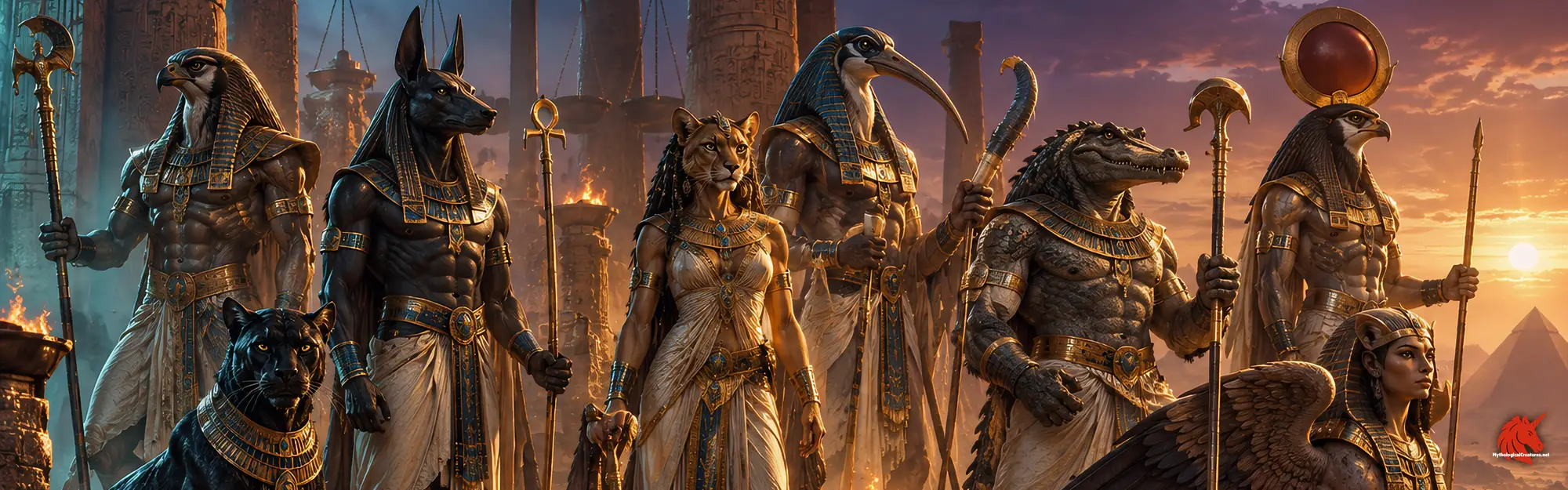
Free Ancient Egypt mythology posters
Five A3 display posters for the Ancient Egypt unit. Print and go.
A free resource for schools.
Print, display and photocopy freely.
Anubis, Bastet, Ammit, Khepri and the Serpopard: one poster each, designed to be read from across a classroom and to stand up to a term on a wall.
On every poster
- The creature's name in hieroglyphs, and how to say it
- Facts drawn from the earliest sources
- A timeline showing where the story comes from: tomb paintings, carvings, statues and museum pieces, with dates
- A discussion question with no single right answer
- Six creature ratings children can compare and debate
Download
All five posters are in one file, in colour and again in black and white.
To print on A4, choose ‘Fit to page’.
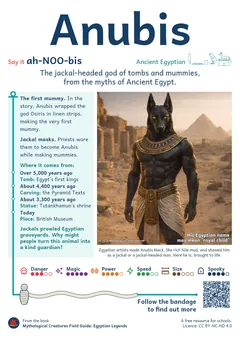
Anubis
𓇋𓈖𓊪𓅱𓃣
ah-NOO-bis
The jackal-headed god of tombs and mummies, from the myths of Ancient Egypt.
Why make a graveyard animal a guardian?
More about Anubis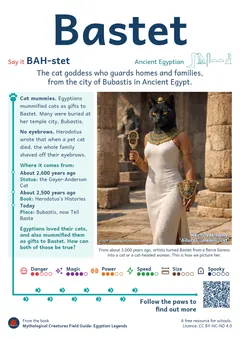
Bastet
𓃀𓄿𓋴𓏏𓏏𓁐
BAH-stet
The cat goddess who guards homes and families, from the city of Bubastis in Ancient Egypt.
How can both be true?
More about Bastet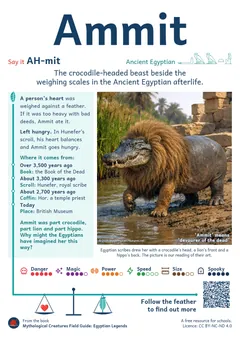
Ammit
𓂝𓅓𓅓𓏏𓁐
AH-mit
The crocodile-headed beast beside the weighing scales in the Ancient Egyptian afterlife.
Why imagine her from three animals?
More about Ammit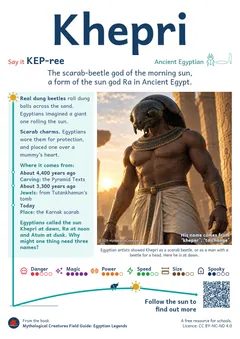
Khepri
𓆣𓂋𓇋
KEP-ree
The scarab-beetle god of the morning sun, a form of the sun god Ra in Ancient Egypt.
Why give the sun three names?
More about Khepri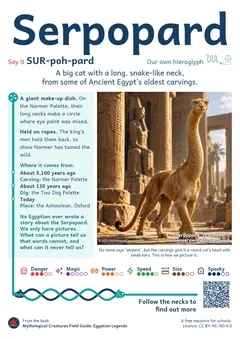
Serpopard
𓆙𓄂
SUR-poh-pard
A big cat with a long, snake-like neck, from some of Ancient Egypt’s oldest carvings.
What can a picture never tell us?
More about the Serpopard
Using these in class
- England
Supports the KS2 Ancient Egypt history unit, and KS2 English work on myths and legends and on books from other cultures and traditions. The source timeline on each poster covers how our knowledge of the past is constructed from a range of sources.
Show the 3 codes
KS2 English: myths and legends · KS2 English: other cultures and traditions · KS2 History: sources
- United States
Grade 4 English, comparing myths and traditional literature from different cultures, when the poster sets are used together.
Show the code
CCSS.ELA-LITERACY.RL.4.9
- Australia
Years 3 to 8 English: discussing creatures in their cultural contexts, and using each poster's discussion question to form and justify an opinion. Year 7 History: the methods and sources historians and archaeologists use, and the beliefs and practices of an ancient society, where this set covers death and funerary customs.
Show the 16 codes
English, Years 3 to 8
AC9E3LE01 · AC9E4LE01 · AC9E5LE01 · AC9E6LE01 · AC9E7LE01 · AC9E8LE01 · AC9E3LY02 · AC9E4LY02 · AC9E5LY02 · AC9E6LY02 · AC9E7LE02
History, Year 7
AC9HH7K08 · AC9HH7K11 · AC9HH7S03 · AC9HH7S04 · AC9HH7S06
These are the year levels where this resource has a named curriculum home. They are not a limit, and much of the material carries across other age groups.
Curriculum links checked October 2026 against National Curriculum (England, 2014), Common Core State Standards and Australian Curriculum v9.0. All curriculum links
Take it further
Display all five, then run the comparison task: a one-lesson activity comparing creatures across five cultures, with teacher notes and answers.
More free resources
- Greek posters 5 sheets
- Norse posters 5 sheets
- Japanese posters 5 sheets
- Chinese posters 5 sheets
- Curriculum linksWhat every resource here supports in England, Australia and the United States.
- Compare the mythologiesFive creatures, five cultures, five questions. One lesson, with teacher notes and answers.
- Design your own creaturePlanning sheet, writing frame and a blank card so their creature joins the deck.
- Battle cardsThirty-six cards, six ratings, one game. Print, cut, play.
Licensed CC BY-NC-ND 4.0. Updated October 2026.