
All teaching resources
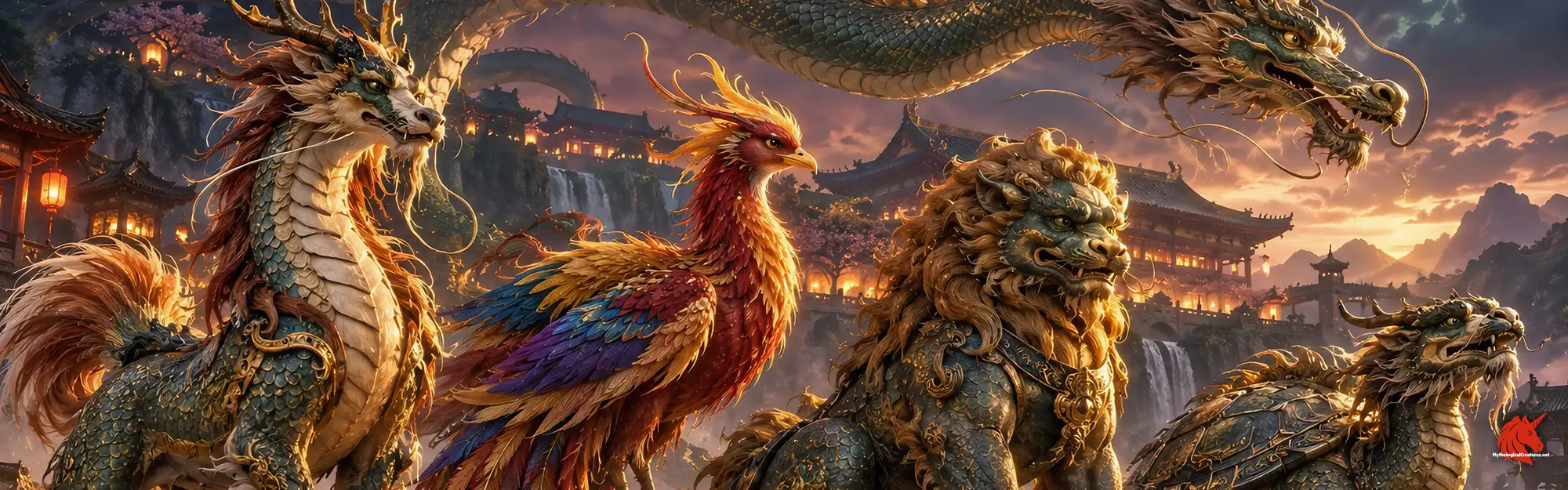
Free Chinese mythology posters
Five A3 display posters for the Shang Dynasty unit. Print and go.
A free resource for schools.
Print, display and photocopy freely.
The Chinese Dragon, Qilin, Fenghuang, Nian and Bai Ze: one poster each, designed to be read from across a classroom and to stand up to a term on a wall.
On every poster
- The creature's name in Chinese, and how to say it
- Facts drawn from the earliest sources
- A timeline showing where the story comes from: oracle bones, books, paintings and monuments, with dates
- A discussion question with no single right answer
- Six creature ratings children can compare and debate
Download
All five posters are in one file, in colour and again in black and white.
To print on A4, choose ‘Fit to page’.
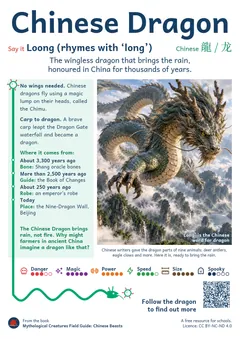
Chinese Dragon
龍 / 龙
Loong (rhymes with ‘long’)
The wingless dragon that brings the rain, honoured in China for thousands of years.
Why a dragon that brings rain?
More about the Chinese Dragon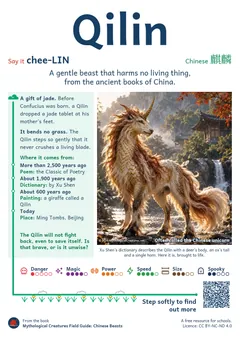
Qilin
麒麟
chee-LIN
A gentle beast that harms no living thing, from the ancient books of China.
Brave, or unwise?
More about the Qilin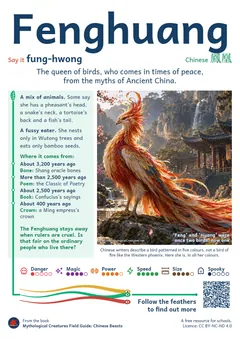
Fenghuang
鳳凰
fung-hwong
The queen of birds, who comes in times of peace, from the myths of Ancient China.
Is that fair on ordinary people?
More about the Fenghuang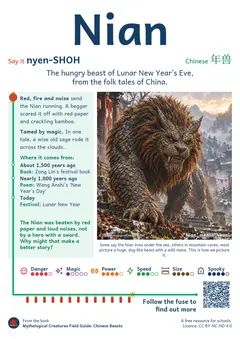
Nian
年兽
nyen-SHOH
The hungry beast of Lunar New Year’s Eve, from the folk tales of China.
Why no hero with a sword?
More about the Nian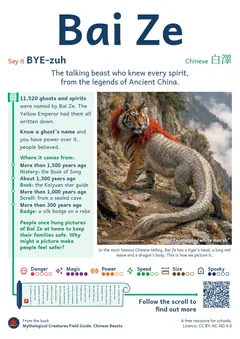
Bai Ze
白澤
BYE-zuh
The talking beast who knew every spirit, from the legends of Ancient China.
Why would a picture feel safer?
More about Bai Ze
Using these in class
- England
Supports the KS2 Shang Dynasty history unit and KS2 English work on myths, legends and books from other cultures and traditions. The source timeline on each poster covers how our knowledge of the past is constructed from a range of sources.
Show the 3 codes
KS2 English: myths and legends · KS2 English: other cultures and traditions · KS2 History: sources
- United States
Grade 4 English, comparing myths and traditional literature from different cultures, when the poster sets are used together.
Show the code
CCSS.ELA-LITERACY.RL.4.9
- Australia
Years 3 to 8 English: discussing creatures in their cultural contexts, and using each poster's discussion question to form and justify an opinion. Year 7 History: the methods and sources historians and archaeologists use, which is what the evidence timeline on each poster shows.
Show the 15 codes
English, Years 3 to 8
AC9E3LE01 · AC9E4LE01 · AC9E5LE01 · AC9E6LE01 · AC9E7LE01 · AC9E8LE01 · AC9E3LY02 · AC9E4LY02 · AC9E5LY02 · AC9E6LY02 · AC9E7LE02
History, Year 7
AC9HH7K08 · AC9HH7S03 · AC9HH7S04 · AC9HH7S06
These are the year levels where this resource has a named curriculum home. They are not a limit, and much of the material carries across other age groups.
Curriculum links checked October 2026 against National Curriculum (England, 2014), Common Core State Standards and Australian Curriculum v9.0. All curriculum links
Take it further
Display all five, then run the comparison task: a one-lesson activity comparing creatures across five cultures, with teacher notes and answers.
More free resources
- Greek posters 5 sheets
- Egyptian posters 5 sheets
- Norse posters 5 sheets
- Japanese posters 5 sheets
- Curriculum linksWhat every resource here supports in England, Australia and the United States.
- Compare the mythologiesFive creatures, five cultures, five questions. One lesson, with teacher notes and answers.
- Design your own creaturePlanning sheet, writing frame and a blank card so their creature joins the deck.
- Battle cardsThirty-six cards, six ratings, one game. Print, cut, play.
Licensed CC BY-NC-ND 4.0. Updated October 2026.