
All teaching resources
Design your own mythological creature
Children invent a creature, then write it up like a field guide entry.
A free resource for schools.
Print, display and photocopy freely.
Children invent a creature, then write it up the way a field guide would: what it is made from, where it lives, what it can do, and how we know about it. An informative text, not a story, which is the version nobody else is handing out.
The planning sheet asks the same questions the comparison task asks of the Minotaur and Ammit, so a child plans their creature exactly as the books describe a real one.
Download
What's in the file
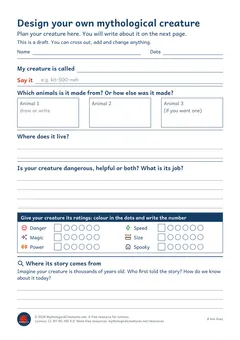
Planning sheet
Name and how to say it, which animals it is made from, where it lives, whether it helps or harms, six ratings to colour in, and where its story comes from.
Page 6.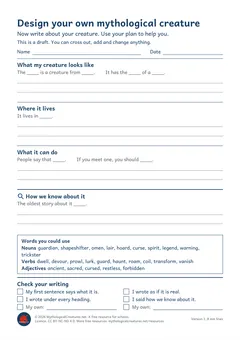
Writing frame
Where they write the creature up from their plan, in three versions so a class can be given different amounts of support.
Pages 7 to 9.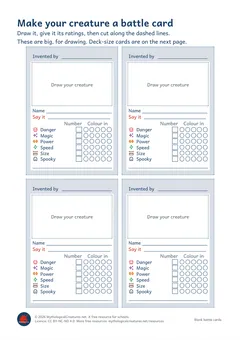
Blank battle cards
Big ones to draw on, then the same card at real size with the deck’s back, so a child’s creature joins the game. Print those double-sided.
Page 10 big, pages 11 to 12 at real size.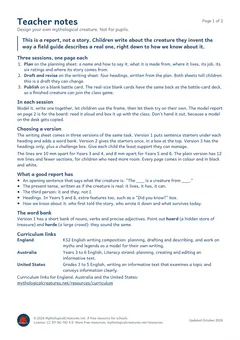
Teacher notes
Curriculum links, timing and preparation, and what to look for in a good plan.
Pages 3 to 4, with a model report.
At a glance
- Year or grade
- Where it is named in a curriculum: England and Australia, school years 3 to 6. United States, grades 3 to 5.
- Ages
- 7-12+
- Lesson time
- Three sessions: plan, write, publish.
- Preparation
- None. Print and go.
- Prior knowledge
- None, though it lands better after the comparison task
What the planning sheet asks
- My creature is called, and how to say it
- Which animals is it made from? Or how else was it made?
- Where does it live?
- Is your creature dangerous, helpful or both? What is its job?
- Give your creature its ratings: danger, magic, power, speed, size, spooky
- Where its story comes from: who first told it, and how do we know about it today?
It says at the top that this is a draft and that anything can be crossed out, added or changed, because a child who thinks the plan has to be neat will not take a risk on it.
Why the ratings are on the planning sheet
The six ratings are drawn exactly as they appear on a battle card, in the same order, down the same two columns. A finished plan is therefore already a card, and the blank cards in this download let a child add theirs to the deck.
The last question does the same job in reverse. Asking who first told the story, thousands of years ago, turns an invented monster into something that has to have come from somewhere. It is the question row five of the comparison sheet asks about the Minotaur.
Curriculum links
- England
KS2 English writing composition: planning, drafting and describing, and work on myths and legends as a model for their own writing.
Show the 2 codes
KS2 English: writing composition · KS2 English: myths and legends
- United States
Grades 3 to 5 English, writing an informative text that examines a topic and conveys information clearly.
Show the 3 codes
CCSS.ELA-LITERACY.W.3.2 · CCSS.ELA-LITERACY.W.4.2 · CCSS.ELA-LITERACY.W.5.2
- Australia
Years 3 to 6 English, Literacy strand: planning, creating and editing an informative text.
Show the 4 codes
English, Years 3 to 6
AC9E3LY06 · AC9E4LY06 · AC9E5LY06 · AC9E6LY06
These are the year levels where this resource has a named curriculum home. They are not a limit, and much of the material carries across other age groups.
Curriculum links checked October 2026 against National Curriculum (England, 2014), Common Core State Standards and Australian Curriculum v9.0. All curriculum links
Take it further
- Curriculum linksWhat every resource here supports in England, Australia and the United States.
- Compare the mythologiesFive creatures, five cultures, five questions. One lesson, with teacher notes and answers.
- Battle cardsThirty-six cards, six ratings, one game. Print, cut, play.
Licensed CC BY-NC-ND 4.0. Updated October 2026.